Can I Get Divorce Without Going to Court in Delhi? ( 2026 Legal Reality)
Can I Get Divorce Without Going to Court in Delhi?
| QUICK ANSWER
Partially yes — but not completely. In India, you cannot get a legally valid divorce entirely without court. A judge must formally grant the divorce decree — that part cannot be skipped. However, you can avoid most court visits by: hiring an advocate who attends court on your behalf, and by using video conferencing for your own mandatory appearances (now permitted by Delhi Family Courts). AdvocateJunction’s doorstep service means you never need to go to a lawyer’s office — we come to you, handle all paperwork, and minimise your court time to the absolute legal minimum. |
Table of Contents
- 1. The Short Answer — Court Is Required, But Your Visits Can Be Minimised
- 2. What Happens in Court vs What Can Be Done Outside
- 3. Online Divorce in India — What Is Actually Available in 2026
- 4. Video Conferencing Appearances — Delhi Family Court Rules
- 5. How Your Advocate Attends Court Instead of You
- 6. Mutual Consent Divorce — Minimum Court Appearances Required
- 7. Contested Divorce — Can You Avoid Court Entirely?
- 8. The AdvocateJunction Doorstep Difference
- 9. FAQs
1. The Short Answer — Court Is Required, But Your Visits Can Be Minimised
Under Indian law, a divorce decree must be issued by a judge sitting in a Family Court after hearing both parties . There is no purely online divorce portal, no administrative divorce process, and no way to get a legally valid divorce certificate without court involvement.
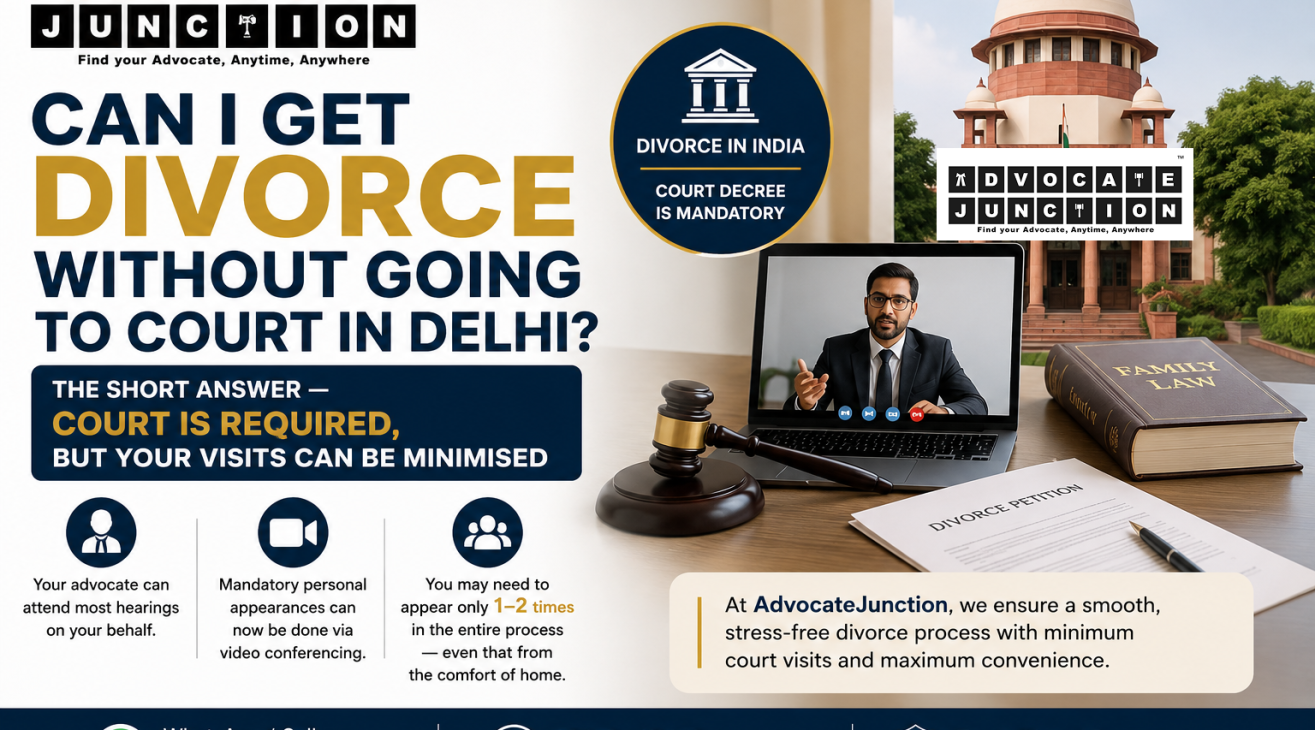
But what most people do not know that their personal presence in court can be minimised . In many cases, your advocate can attend all routine hearings without you, and for mandatory personal appearances, video conferencing is now permitted by Delhi Family Courts.
The result: most of our clients at AdvocateJunction appear in court only 1–2 times during the entire divorce process — and even those appearances can now be done via video call from home.
| BOTTOM LINE TRUTH: You cannot escape court entirely — but you can avoid it almost entirely with the right advocate and the right process. |
2. What Happens in Court vs What Can Be Done Outside
| Task | Can It Be Done Outside Court? | How |
| Initial consultation with advocate | Yes — 100% | AdvocateJunction advocate comes to your home |
| Drafting the divorce petition | Yes — 100% | Advocate drafts, you sign at home |
| Drafting Settlement Agreement (MoU) | Yes — 100% | Both parties sign via advocate coordination |
| Filing the petition at court | Yes — advocate files on your behalf | You do not need to go |
| Routine hearing dates (procedure) | Yes — advocate appears alone | Power of Attorney or vakalatnama covers this |
| First Motion Statement (Mutual Divorce) | No — personal appearance mandatory | But can be done via video conference now |
| Second Motion Statement (Mutual Divorce) | No — personal appearance mandatory | Video conference permitted in Delhi courts |
| Evidence recording (Contested Divorce) | Partially — cross-examination in person | Most hearings can be covered by advocate |
| Final judgement hearing | No — but advocate collects decree | You receive decree copy at home |
3. Online Divorce in India — What Is Actually Available in 2026
You may have seen advertisements for ‘online divorce’ services. Here is what is real and what is misleading:
What Is Real:
- Online filing of some court documents — some Delhi courts now accept e-filing of petitions through the eCourts portal
- Video conferencing appearances — officially permitted for certain hearings by Delhi High Court order
- Online payment of court fees — accepted in most Delhi Family Courts
- Online case tracking — eCourts website lets you check your case status, next hearing date, and orders
What Is Misleading:
- ‘Get divorce in 7 days online’ — not legally possible in India. Any such service is either fraudulent or referring to paperwork only, not the actual decree.
- ‘No court required’ — false. Indian law mandates judicial involvement for divorce.
- ‘Online divorce certificate’ — there is no such thing. Only a court-issued decree is legally valid.
| WARNING: Several websites charge money for ‘online divorce services’ that have no legal validity. A divorce is only legally complete when a Family Court judge passes a decree. Do not pay for anything that claims otherwise. |
4. Video Conferencing Appearances — Delhi Family Court Rules 2026
This is genuinely good news for anyone who wants to minimise court visits. Under the Electronic Evidence and Video Conferencing Rules 2025 and Delhi High Court circulars, video conferencing appearances are now officially permitted in Delhi Family Courts for:
- Statement recording in mutual consent divorce (First and Second Motion)
- Examination-in-chief in contested divorce cases (your main testimony)
- Parties who are NRIs or living outside Delhi
- Parties with medical conditions preventing travel
- Cases where both advocates and the judge agree to VC hearing
How to Request Video Conferencing in Delhi Family Court:
- Your advocate files a formal application requesting VC appearance before the judge
- You appear via video call (WhatsApp Video, Google Meet, or court’s official VC system) on the scheduled date
- The hearing is recorded by the court
- This is fully legally valid — no difference from physical appearance in terms of legal effect
5. How Your Advocate Attends Court Instead of You
When you hire a lawyer, you sign a Vakalatnama — a legal document that authorises the advocate to appear and act on your behalf in court. This means:
- For every routine hearing (adjournments, evidence filing, document submission) your advocate appears alone — you do not need to go.
- Contested divorce cases can have 20–50+ hearings over 2–4 years. With a good advocate, you personally attend only the critical ones — your own examination and cross-examination.
- Mutual consent divorce requires 2 personal appearances (First and Second Motion) — both can now be done via video conference in Delhi courts.
| REAL NUMBERS: A typical mutual consent divorce in Delhi = 2 mandatory personal appearances. A contested divorce = typically 3–6 personal appearances over 1–3 years. With video conferencing, even these can be done from home. |
6. Mutual Consent Divorce — Minimum Court Appearances Required
| Stage | Your Appearance Required? | Can It Be Video Conference? |
| Petition filing | No — advocate files alone | N/A |
| First Motion hearing | Yes — mandatory | Yes — permitted in Delhi courts |
| Cooling-off period (6 months) | No appearances needed | N/A |
| Second Motion hearing | Yes — mandatory | Yes — permitted in Delhi courts |
| Decree collection | No — advocate collects | N/A |
Minimum personal appearances for mutual consent divorce in Delhi: 2 hearings — both can be done via video call from home.
7. Contested Divorce — Can You Avoid Court Entirely?
In contested divorce, you cannot avoid all court appearances — your own testimony (examination-in-chief) and cross-examination by your spouse’s lawyer require your presence or video conference appearance. However:
- Examination-in-chief can often be done via video conference in Delhi Family Courts
- Cross-examination typically requires physical presence — this is the one hearing where you genuinely need to be present or appear via court’s VC system
- All other hearings — filing, evidence submission, arguments — are handled entirely by your advocate
In practice, for a contested divorce in Delhi, expect 3–6 personal appearances (or VC appearances) over 1–3 years. Your advocate handles everything else.
8. The AdvocateJunction Doorstep Difference
AdvocateJunction was built specifically for people who want legal help without the hassle of going to a lawyer’s office or court. Here is how we minimise your court time:
| What We Do | Benefit to You |
| Advocate visits your home for all consultations, document signing, briefings | You never visit a law office |
| We handle all court filings electronically where possible | No trips to court for paperwork |
| We file video conferencing applications proactively for your hearings | Your mandatory appearances are done from home |
| We send hearing updates and next steps via WhatsApp after every date | You always know your case status without calling anyone |
| We collect certified decree copy from court and deliver to your home | You receive final documents without going anywhere |
| 📞 WANT DIVORCE WITHOUT THE HASSLE OF VISITING COURT EVERYDAY?
AdvocateJunction sends a verified family law advocate to YOUR home. We handle everything — you attend minimum hearings via video call.✅ Call / WhatsApp: 9818900704✅ Book Online: advocatejunction.com/contact First 30 Minutes FREE | Delhi NCR | Mon–Sat 10AM–6PM |
9. Frequently Asked Questions
Q: Is online divorce legally valid in India?
No — not completely. There is no law in India that allows a divorce to be granted purely online without judicial involvement. What is possible online: filing documents, video conferencing for appearances, tracking case status, and paying court fees. The final decree must be issued by a judge.
Q: Can I get divorce by just sending a legal notice?
No. A legal notice of divorce has no legal effect on its own. It does not dissolve a marriage. Only a Family Court judge’s decree dissolves a marriage legally in India. A legal notice is sometimes sent as a preliminary step before filing — to document that you communicated your intention — but it is not a substitute for court proceedings.
Q: My spouse and I both agree to divorce. Do we both need to go to court?
For mutual consent divorce in Delhi, both parties must appear for two hearings — First Motion and Second Motion. Both of these can now be done via video conference from home. Your advocate handles everything else. If you are an NRI, special provisions allow even greater flexibility.
Q: I live outside Delhi. Can I still file for divorce in Delhi Family Court?
You can file in Delhi if you last lived together in Delhi with your spouse, or if your spouse currently resides in Delhi. Jurisdiction matters — your advocate will assess which court is correct. Video conferencing means your distance from Delhi is manageable.
Q: Can I use WhatsApp to appear for my divorce hearing?
Delhi Family Courts have accepted WhatsApp Video for some VC hearings — however the court naturally prefers its official VC system (CISCO webex ).. Your advocate will arrange the technical setup and confirm which platform the court accepts for your specific hearing. Granting permission and accepting WhtsApp call in court hearing is totally on Honorable Judge .
Related Articles on AdvocateJunction
| 📞 GET YOUR FREE 30-MINUTE CONSULTATION TODAY
Want to know exactly how to handle your divorce with minimum court time? Talk to our advocate — at your doorstep.✅ WhatsApp / Call: 9818900704✅ Book Online: advocatejunction.com/contact Available Monday to Saturday | 10AM – 6PM | Delhi NCR | First Consultation Always FREE |