
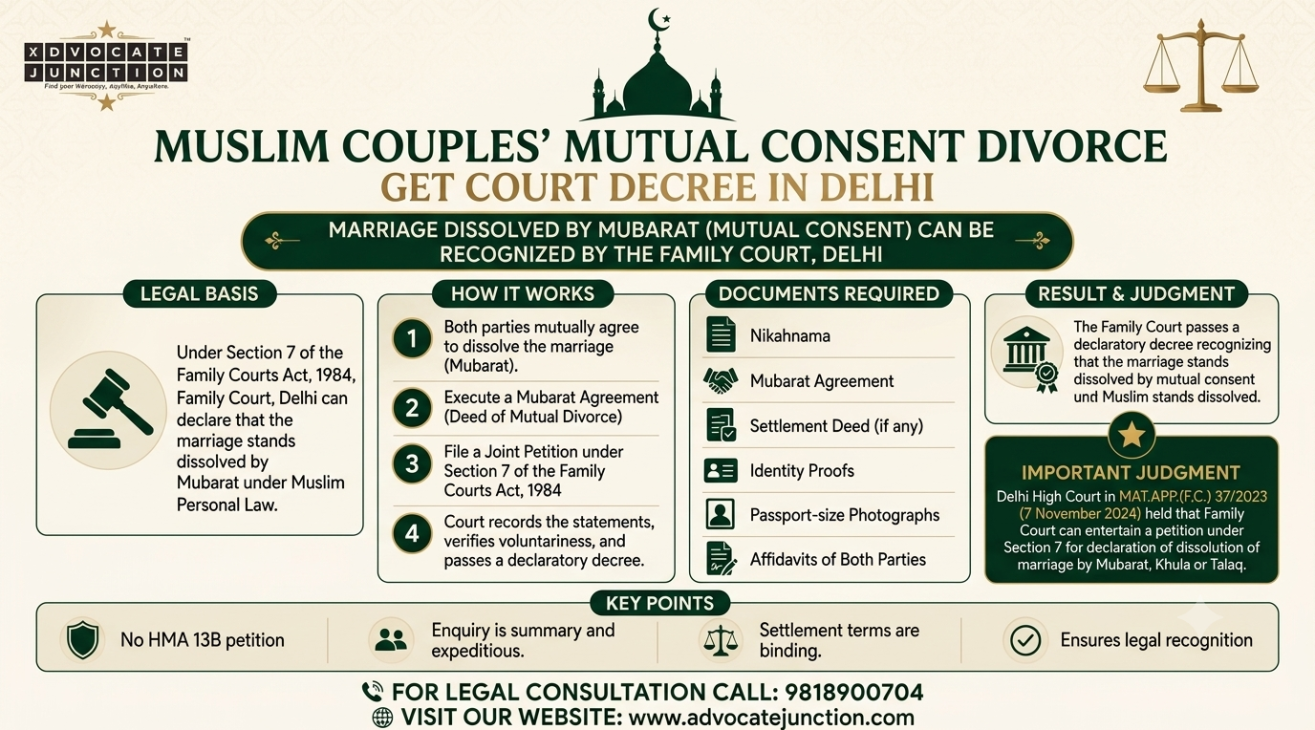
Muslim Mutual Consent Divorce (Mubarat) in India: Step-by-Step Guide to a Family Court Decree
Muslim mutual consent divorce — known as Mubarat — lets a husband and wife dissolve their marriage by mutual agreement, and a Family Court in Delhi can now formally recognise it through a declaratory decree.
What Mubarat Really Means
When a Muslim marriage reaches the point where both husband and wife genuinely want to part ways, Islamic law provides a dignified, mutual route out — Mubarat. The word itself carries the sense of mutual release, and that is exactly what it is: a dissolution of marriage by the mutual consent and desire of both spouses.
This is different from the forms of divorce that are driven by one side alone. In Mubarat, neither spouse is the wronged party seeking to end the marriage against the other’s wishes. Instead, both have arrived at the same conclusion — that the marriage should end — and they agree to release each other from it. It is, in spirit, the Islamic equivalent of what other communities call a mutual consent divorce.
For many Muslim couples in India, Mubarat offers a calmer, more respectful path than a contested battle. There are no accusations to prove, no fault to establish, no drawn-out litigation. Both parties simply agree, record their agreement, and move on with their lives. But a crucial practical question arises — once you have divorced by Mubarat under personal law, how do you get an official, court-recognised document proving it? That is where recent legal developments have made things much clearer, and much better, for Muslim couples in Delhi.
Mubarat, Khula and Talaq — Understanding the Difference
Because there is so much confusion around Muslim divorce, let me clearly distinguish the main forms, so you understand exactly where Mubarat fits.
- Talaq — divorce initiated by the husband. This is the form most people have heard of, and it has been the subject of much legal reform in India.
- Khula — divorce initiated by the wife, where she seeks to be released from the marriage, typically by relinquishing or returning her dower (mehr) or part of it, with the husband’s consent.
- Mubarat — divorce by mutual consent, where both husband and wife desire the separation and agree to release one another. Neither party is the sole initiator; the wish to separate is shared.
The defining feature of Mubarat is mutuality. Both spouses want the marriage to end, and both consent to its dissolution. Because it rests on the free agreement of both, it is one of the most amicable and least contentious ways for a Muslim marriage to end. The settlement terms — such as mehr, maintenance, custody of children, and return of belongings — are worked out and agreed between the parties, rather than imposed after a fight.
| Why Section 13B of the Hindu Marriage Act Does Not Apply
A common point of confusion: the well-known ‘mutual consent divorce’ under Section 13B of the Hindu Marriage Act does not apply to Muslim couples. That provision is part of Hindu law. Muslim couples are governed by Muslim Personal Law (Shariat), under which Mubarat is the recognised mode of mutual consent divorce. So a Muslim couple does not file under Section 13B — they dissolve their marriage by Mubarat under their personal law, and then seek recognition of that dissolution from the Family Court. |
The Legal Basis — Muslim Personal Law and the Family Courts Act
Two legal frameworks come together to make Mubarat both valid and officially recognisable.
First, the recognition of Mubarat itself. Mubarat is a recognised mode of extra-judicial divorce under the Muslim Personal Law (Shariat) Application Act, 1937. This means that when a Muslim husband and wife dissolve their marriage by Mubarat, that dissolution is valid under the personal law that governs them. The Supreme Court of India, in its landmark decision in Shayara Bano v. Union of India, expressly acknowledged that Mubarat is a form of divorce by consent of both parties, well recognised in Muslim Personal Law.
Second, the role of the Family Court. Under Section 7 of the Family Courts Act, 1984, Family Courts are empowered to entertain suits and proceedings for a declaration as to the validity of a marriage or as to the matrimonial status of any person. This is the provision that allows a Family Court to formally declare that a marriage stands dissolved by Mubarat — turning your private personal-law divorce into an officially recognised, court-declared status.
In simple terms: your Mubarat dissolves the marriage under personal law, and the Family Court, under Section 7, gives you a public, official decree confirming it. The court is not being asked to ‘grant’ the divorce — the divorce has already happened under personal law. The court is being asked to declare and record your changed marital status.
The Landmark Delhi High Court Judgment You Should Know
For a long time, Muslim couples faced a frustrating problem. They had validly divorced by Mubarat under their personal law, but when they went to a Family Court seeking an official declaration, some courts refused — wrongly believing they had no power to entertain such a petition, or that mutual consent divorce for Muslims was not contemplated by law. This left couples with a valid divorce but no official document to prove it for passports, remarriage, property, and other purposes.
A recent Delhi High Court judgment has settled this decisively, and it is excellent news for Muslim couples in the capital.
| Delhi High Court — MAT.APP.(F.C.) 37/2023 | Decided 7 November 2024 | High Court of Delhi
A Division Bench of the Delhi High Court (Justices Rekha Palli and Saurabh Banerjee) held that where a Muslim marriage has been dissolved by Mubarat under Muslim Personal Law, the Family Court is empowered under Section 7 of the Family Courts Act to entertain a joint petition and pass a declaratory decree recognising that the marriage stands dissolved by mutual consent. The Court confirmed that Mubarat is a recognised mode of extra-judicial divorce, relied on the Supreme Court’s observations in Shayara Bano, and issued guidance for Family Courts in Delhi when dealing with such petitions. In short — a Delhi Family Court can, and should, formally recognise a Mubarat divorce and issue a decree confirming it. |
This judgment is powerful for you as a Muslim couple because it removes the uncertainty. You no longer have to worry that a Family Court will turn you away. The High Court has made clear that the Family Court has both the power and, once satisfied, the duty to record your dissolution and declare your marital status. Several other High Courts — including Karnataka, Kerala, and Gujarat — have taken the same view, reinforcing that this is now the settled and consistent position across India.
How Mubarat Works — Step by Step
Let me walk you through exactly how a Muslim mutual consent divorce works, from the decision to separate through to holding an official court decree in your hand.
Step 1 — Mutual Agreement to Dissolve the Marriage
It begins with both spouses genuinely agreeing that the marriage should end. This is the heart of Mubarat — the shared, mutual desire to separate. There is no need to prove fault, cruelty, or any wrongdoing by either side. Both simply agree that continuing the marriage is not in either party’s interest.
Step 2 — Execute a Mubarat Agreement (Deed of Mutual Divorce)
The couple then records their divorce in a Mubarat Agreement — sometimes called a Deed of Mutual Divorce or Mubarat Nama. This written document records the factum of dissolution by Mubarat, and importantly, sets out the agreed settlement terms. These typically include the mehr (dower), any maintenance arrangement, custody of children if any, and the return of belongings or articles between the parties. Getting these terms recorded clearly and fairly is one of the most important parts of the process, because a well-drafted agreement prevents future disputes.
Step 3 — File a Joint Petition Under Section 7 of the Family Courts Act
To convert this private agreement into an officially recognised status, both parties file a joint petition before the Family Court in Delhi, seeking a declaration under Section 7 of the Family Courts Act that their marriage stands dissolved by Mubarat. This is the step that gives your divorce official, public recognition. Because the divorce has already taken place under personal law, you are asking the court to declare your status, not to grant the divorce afresh.
Step 4 — The Court Records Statements and Verifies Consent
The Family Court then conducts what is essentially a summary inquiry. Its role here is limited and focused — it verifies that both parties have genuinely and voluntarily agreed to the Mubarat, that the agreement is free of force, fraud, or coercion, and that the dissolution has indeed taken place under Muslim Personal Law. The court records the statements of both parties to satisfy itself of the genuineness and voluntariness of the mutual consent.
Step 5 — The Court Passes a Declaratory Decree
Once satisfied, the Family Court passes a declaratory decree recognising that the marriage stands dissolved by Mubarat under Muslim Personal Law. This decree is your official proof. It can be used for all legal, personal, and official purposes — updating records, remarriage, property matters, passport and visa applications, bank and nominee changes, and anywhere else you need to establish that you are divorced.
| Mubarat Situations We Handle
Muslim mutual consent divorce and Family Court recognition — Delhi NCR, 2026 |
| Both spouses agree to separate amicably → Mubarat agreement + Family Court declaration, start to finish |
| Already divorced by Mubarat but need official proof → Joint petition under Section 7 for a decree |
| Need to settle mehr, maintenance, custody fairly → Properly drafted Mubarat agreement protects both |
| Family Court unsure or refusing to recognise Mubarat → The Delhi HC judgment confirms it must be entertained |
| An amicable divorce, properly recorded, protects both parties and avoids future disputes.
FREE 15-Minute Case Assessment — Advocate Comes to You 📱 WhatsApp: +91-9818900704 advocatejunction.com | Delhi NCR Doorstep Legal Service |
Documents Required for Mubarat and the Family Court Declaration
Being prepared with the right documents makes the process smooth. Here is what you will generally need:
- Nikahnama — the marriage contract, establishing that the marriage existed.
- Mubarat Agreement / Deed of Mutual Divorce — recording the dissolution by mutual consent and the agreed terms.
- Settlement Deed (if separate) — recording mehr, maintenance, custody, and return of articles, where these are dealt with separately.
- Identity proofs of both parties — Aadhaar, PAN, or similar.
- Passport-size photographs of both parties.
- Affidavits of both parties — confirming the voluntary nature of the Mubarat and the truth of the facts stated.
- Address proof and, where relevant, proof of where the parties last resided together, for jurisdiction.
Your advocate will ensure each document is properly prepared and that the Mubarat agreement in particular is drafted to protect your interests, because that document does the real work of settling the terms between you.
Key Points Every Muslim Couple Should Understand
Before you proceed, keep these essential points in mind — they clear up the most common confusions.
- Section 13B HMA does not apply to Muslims. The Hindu Marriage Act’s mutual consent provision is not your route. Mubarat under Muslim Personal Law is.
- The court’s inquiry is summary and expeditious. The Family Court is not re-trying your marriage. It conducts a limited inquiry to confirm genuine mutual consent, and decides the matter without unnecessary delay.
- Settlement terms are binding. The mehr, maintenance, custody arrangements, and return of articles recorded in your Mubarat agreement are binding on both parties, which is exactly why they must be drafted with care.
- The decree ensures legal certainty. A court declaration removes any future doubt about your marital status and avoids disputes down the line — for example, if one party later denies the divorce, or when you remarry or deal with property.
- Mubarat is dignified and amicable. Because it rests on mutual agreement, it avoids the bitterness of a contested divorce and lets both parties move forward with respect.
Why Getting a Family Court Decree Matters So Much
Some couples ask: if we have already divorced validly by Mubarat under our personal law, why bother going to the Family Court at all? It is a fair question, and the answer is about proof and protection.
A Mubarat agreement is, by itself, a private document between the two parties. In everyday life, that private document may not be enough. When you apply for a passport reflecting your changed status, when you wish to remarry, when property or inheritance questions arise, when banks or authorities ask for proof of your marital status, a private agreement can be questioned or may not be accepted. Worse, if one party later has a change of heart and denies that the divorce took place, a private agreement can become the subject of dispute.
A Family Court declaratory decree solves all of this. It is a public, official document issued by a court, confirming your dissolved status beyond dispute. It carries the full weight of a court order and is accepted everywhere. In short, the Mubarat ends your marriage under personal law; the Family Court decree gives you unshakeable, official proof of it. For anyone who values certainty and wants to avoid future complications, obtaining the decree is well worth it.
Protecting Women’s Rights in Mubarat
An amicable divorce should never mean a woman gives up rights she is entitled to. In a Mubarat, the wife’s mehr (dower), her right to maintenance during the iddat period, provision for the children’s maintenance, and the return of her belongings and stridhan-equivalent articles are all matters to be fairly settled in the agreement. Because Mubarat is consensual, there is sometimes pressure — subtle or overt — for a woman to accept less than she is due in exchange for a quick, peaceful separation.
My advice, especially to women, is this: an amicable divorce and a fair settlement are not opposites. You can end your marriage respectfully and still ensure your rightful entitlements are properly recorded and protected. A good advocate ensures the Mubarat agreement is balanced and that you are not signing away rights out of a desire to simply get it over with. The dignity of Mubarat lies precisely in fairness to both sides.
Frequently Asked Questions
Is a Mubarat divorce legally valid in India?
Yes. Mubarat is a recognised mode of divorce by mutual consent under Muslim Personal Law (Shariat), and its validity has been acknowledged by the Supreme Court in Shayara Bano and by several High Courts. When a Muslim husband and wife dissolve their marriage by Mubarat, that dissolution is valid. To obtain official proof, you can then seek a declaratory decree from the Family Court under Section 7 of the Family Courts Act.
Do Muslim couples file for divorce under Section 13B like Hindu couples?
No. Section 13B of the Hindu Marriage Act applies to Hindus, not Muslims. Muslim couples are governed by Muslim Personal Law, under which Mubarat is the recognised form of mutual consent divorce. A Muslim couple dissolves their marriage by Mubarat and then seeks recognition of that dissolution from the Family Court under Section 7 of the Family Courts Act — not under Section 13B.
Can the Delhi Family Court refuse to recognise our Mubarat divorce?
Following the Delhi High Court’s judgment of November 2024, the Family Court is empowered to entertain a joint petition and, once satisfied that the Mubarat is genuine and voluntary, to pass a declaratory decree recognising the dissolution. Earlier, some couples faced refusals based on a mistaken view of the law. That position has now been corrected — the High Court has confirmed the Family Court’s power and provided guidance for such petitions.
How long does it take to get a Family Court decree for Mubarat?
Because the court’s inquiry in such matters is summary in nature — limited to verifying genuine mutual consent — and is meant to be decided expeditiously, it is generally much quicker than a contested divorce. The exact timeline depends on the court and the completeness of your documents, but a well-prepared joint petition with a properly drafted Mubarat agreement moves considerably faster than adversarial proceedings.
What happens to mehr, maintenance and child custody in a Mubarat?
These are settled by agreement between the parties and recorded in the Mubarat agreement or an accompanying settlement deed. The mehr, any maintenance including during the iddat period, provision for children, and return of articles are all agreed and become binding on both parties. This is exactly why the agreement should be drafted carefully and fairly — it governs the financial and custodial terms of your separation.
Can we still get a decree if we divorced by Mubarat some time ago?
Generally yes. If you validly dissolved your marriage by Mubarat earlier and now need official recognition, you can approach the Family Court for a declaration of your marital status. The court’s role is to declare the status based on the Mubarat that has already taken place. Speak to an advocate about your specific facts, and bring whatever documentation of the Mubarat you have.
Do both husband and wife need to appear in court?
Typically both parties join in the petition, since Mubarat is founded on mutual consent, and the court records their statements to confirm the consent is genuine and voluntary. Your advocate will guide you on appearances and can handle much of the procedural work, keeping the process as smooth and dignified as possible for both of you.
Ending a Marriage With Dignity — and Certainty
The end of a marriage is never easy, whatever form it takes. But Mubarat offers Muslim couples something valuable — a way to part with mutual respect, without accusations, without a bitter courtroom fight, and on terms both have agreed. And thanks to the recent clarity from the Delhi High Court, you can now secure something equally important: an official Family Court decree that puts your changed status beyond any doubt.
If you are a Muslim couple considering divorce by mutual consent, you do not have to navigate the personal law, the agreement drafting, and the Family Court process alone. The two things that matter most are a fair, well-drafted Mubarat agreement that protects both parties, and a properly filed Section 7 petition that gets you a clean, official decree.
At AdvocateJunction, we help Muslim couples across Delhi NCR through the entire Mubarat process — drafting a balanced Mubarat agreement that fairly settles mehr, maintenance, custody, and articles, and filing the joint petition to obtain a Family Court declaratory decree recognising your divorce. We work with sensitivity and confidentiality, and because we are a doorstep service, we come to you. The first 15 minutes are free.
WhatsApp us at +91-9818900704.
Related Articles on this topic
- Mutual Consent Divorce in Delhi — Complete Guide
- How to Claim Maintenance from Husband in Delhi
- Child Custody Rights in India — Complete Legal Guide
- NRI Marriage Crisis in India
- Muslim marriage can be dissolved through Mubaraat -Gujarat Highcourt
- Family courts are empowered to consider applications for divorce by mutual consent filed by Muslim couples.