
NRI Marriage Crisis India
The Left-Behind Brides: Unmasking India’s Quiet NRI Marriage Epidemic
A few weeks ago, a distressed young woman walked into our AdvocateJunction office in Rohini. Her story began like a fairy tale: a lavish wedding to a Dubai-based Non-Resident Indian (NRI), followed by a celebratory departure. For the first month, her husband called every single day. Soon, those daily check-ins dwindled to once a month. Then, absolute silence.Today, she remains stuck in limbo—clinging to the fading hope that he will return to fulfill his promises and take her with him.
This is far from an isolated incident. Across India, a silent crisis is unfolding in plain sight. Thousands of women are being systematically abandoned by foreign-based spouses, left completely stranded without financial stability, legal recourse, or even a basic means to locate the men who vowed to protect them.
The Official Data: When the Government Speaks
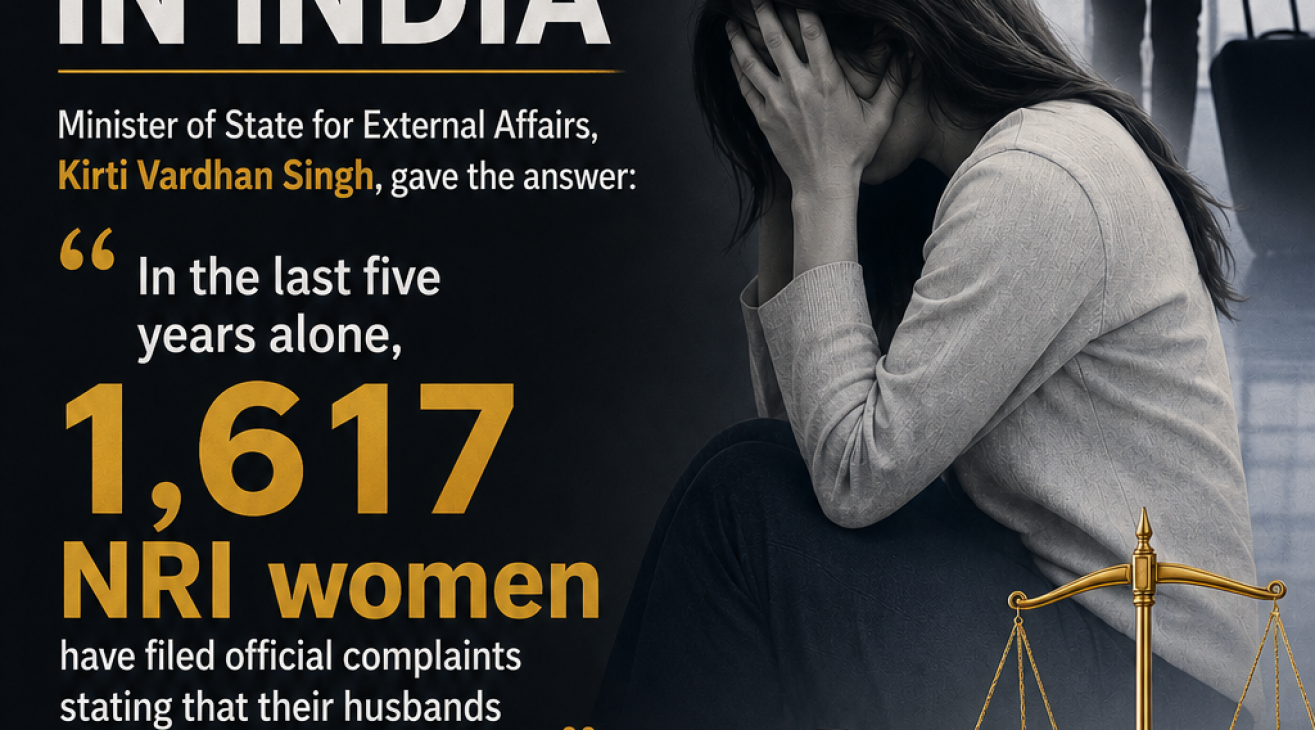
The scale of this crisis is no longer up for debate; it is officially documented. In a direct inquiry in the Rajya Sabha regarding the abandonment of Indian women by overseas spouses, the government laid bare the numbers.
The response delivered by the Minister of State for External Affairs revealed a grim reality: within a recent five-year window, 1,617 women officially registered complaints stating they had been deserted abroad by their NRI husbands.
Remember, this metric only represents the fraction of victims who possessed the resources, bravery, and legal literacy to file an official grievance. The true number of women suffering in isolation remains un-tracked.
Geographically, this epidemic is deeply concentrated. According to parliamentary committee insights, three states bear the brunt of the crisis:
Punjab: Accounts for nearly 40% of all reported cases.
Gujarat: Represents roughly 20% of the total volume.
Andhra Pradesh: Comprises approximately 15% of the national metrics.
The Legal Maze: Why the System Fails Abandoned Wives
For an abandoned bride, seeking justice under existing frameworks feels like navigating a labyrinth with no exit. The legal machinery fails these women across three primary fronts:
1. The Jurisdiction Trap
A major hurdle is the manipulation of foreign legal setups. An NRI husband can quietly secure an ex-parte divorce decree in countries like the UK, the US, or Canada without his wife ever receiving a formal summons. Because Indian courts do not automatically dismiss or penalize these foreign decrees, the wife is forced to fight an incredibly expensive, multi-jurisdictional legal battle across two different continents.
2. The Extradition Roadblock
In India, marital cruelty and dowry extortion are treated as severe criminal offenses. However, Western legal systems frequently categorize dowry demands as civil or matrimonial disputes rather than criminal acts. Consequently, foreign authorities routinely reject extradition requests, allowing abusive husbands to remain insulated and untouchable overseas.
3. Execution and Enforcement Failures
Even when an Indian court rules in favor of the victim and issues a warrant, executing that order through diplomatic channels, embassies, and consulates is a slow, deeply bureaucratic process. If the husband simply chooses never to return to Indian soil, the court’s orders often remain completely unenforced.
A Glimmer of Hope: The NRI Marriage Bill
To fix these structural gaps, lawmakers have introduced a vital legislative framework: The Registration of Marriage of Non-Resident Indian Bill. If successfully codified into active law, this legislation will fundamentally rewrite the rules of engagement:
Mandatory Registration: Marriages involving an NRI must be legally registered within 30 days of the ceremony, regardless of whether the wedding took place in India or on foreign soil.
Passport Revocation: Failure to register the marriage or comply with court orders gives authorities the immediate power to impound or revoke the NRI husband’s passport.
Seizure of Indian Assets: Courts will gain the power to declare non-compliant husbands as “proclaimed offenders,” allowing law enforcement to seize and attach their ancestral properties or assets within India.
Digital Summons: Warrants and legal notices can be officially uploaded to a designated Ministry of External Affairs (MEA) portal. This eliminates the husband’s ability to claim he never received the legal paperwork.
Critical Action Steps: What to Do If You Are Affected
If you or someone in your immediate circle is facing this nightmare, proactive preparation is vital. Do not wait for things to improve on their own. Take these strategic legal steps immediately:
Secure All Evidence: Compile every shred of documentation available. This includes marriage certificates, passport and visa copies, flight tickets, WhatsApp conversations, banking statements, and call history logs. Backup and screenshot everything before digital accounts are deleted.
Initiate Criminal Proceedings: Lodge a First Information Report (FIR) at your local police station or specialized Women’s Cell. File under Section 85 of the Bharatiya Nyaya Sanhita (BNS)—the modernized criminal law replacing Section 498A IPC—for marital cruelty. Even if the abuse occurred outside India, Indian courts maintain explicit jurisdiction under Section 208 of the Bharatiya Nagarik Suraksha Sanhita (BNSS) (formerly Section 188 CrPC), provided the husband holds Indian citizenship.
Engage the National Commission for Women (NCW): Connect directly with the NRI Cell of the NCW. They offer free legal consultations, trauma counseling, and maintain direct channels with the Ministry of External Affairs to expedite Look-Out Circulars (LOCs).
Log a Case on the MADAD Portal: Utilize the MEA’s official MADAD portal . This specialised online grievance tracking system is specifically designed to handle and escalate consular issues faced by Indians abroad.
Seek Embassy Intervention: If you are currently stranded on foreign soil, contact the nearest Indian Embassy or Consulate immediately. Ask to access the Indian Community Welfare Fund (ICWF), which provides direct financial aid, temporary accommodation, and local legal representation for Indian citizens in distress.
Frequently Asked Questions (FAQs)
Q1. My NRI spouse left me stranded within India. What legal resources do I have?
You have the right to initiate criminal proceedings by lodging an FIR under Section 85 of the Bharatiya Nyaya Sanhita (BNS) for marital cruelty and desertion. Additionally, you can pursue financial relief by filing a maintenance petition under Section 144 of the BNSS (formerly Section 125 CrPC) and seek a formal divorce through an Indian family court. Domestic courts retain absolute jurisdiction even if your marriage was originally solemnized or registered overseas.
Q2. What is the procedure to file a maintenance lawsuit against an overseas husband?
You must submit a formal maintenance application under the relevant provisions of the BNSS in the Family Court operating within the district where you currently reside. It is a common misconception that your husband must be physically present in India for this process to move forward; domestic courts can legally evaluate your case and issue binding financial support orders in his absence.
Q3. Is it possible for my NRI husband to obtain a divorce decree without my knowledge?
Regrettably, an NRI spouse can approach overseas courts in jurisdictions like the US, UK, or Canada to secure an ex-parte (one-sided) divorce decree without your participation. However, the Supreme Court of India has firmly established that foreign matrimonial judgements are legally invalid within India if they violate Indian personal laws, ignore natural justice, or were acquired without giving the wife a fair opportunity to contest.
Q4. What happens if my husband overseas refuses to pay court-mandated maintenance?
If your spouse fails to comply with a financial support order, you can submit an enforcement petition to the court. The judiciary holds the power to penalize non-compliance by freezing his domestic bank accounts, attaching his immovable properties in India, revoking his passport, or issuing non-bailable warrants. If he continuously evades summons from abroad, the court can formally label him a “proclaimed offender”.
Q5. How can I trace my foreign-based husband if he has cut off all communication channels?
You should immediately file a formal grievance on the Ministry of External Affairs’ official MADAD portal. Diplomatic authorities possess the administrative mechanisms to trace individuals via passport databases, consular records, and visa details. Once located, the local Indian Embassy or Consulate can assist the court in serving formal legal notifications directly to his overseas residence.
Q6. Can an FIR be registered in India if my NRI husband resides entirely abroad?
Yes. Under Section 208 of the BNSS (formerly Section 188 CrPC), Indian authorities possess extraterritorial jurisdiction over offenses committed outside India, provided the accused holds Indian citizenship. You can lodge your complaint at your local police station, and the judicial system will route the subsequent legal summons through the Ministry of External Affairs.
Q7. What is the current status of the NRI Marriage Bill?
The Registration of Marriage of Non-Resident Indian Bill was originally presented in Parliament in 2019. The proposed draft outlines a framework making marital registration compulsory within a strict 30-day window and establishes strict penalties like passport cancellation for non-compliance. It remains under legislative review and has not yet been fully enacted into law.
Q8. Where can a victim access pro-bono legal counsel for overseas matrimonial disputes?
Affected women can directly reach out to the dedicated NRI Cell of the National Commission for Women (NCW) using their helpline at 7827170170. Furthermore, you can approach the District Legal Services Authority (DLSA) in your home region or connect with state-level NRI grievance cells to receive cost-free legal advocacy and professional guidance.
Q9. What specific evidentiary documentation is required to establish a case of abandonment?
You should carefully organise your marriage registration certificate, explicit wedding photographs, copies of your spouse’s passport and visa status, travel itineraries, detailed WhatsApp or email exchanges, call history records, and domestic bank account statements. Additionally, preserve any documentation pointing toward financial extortion, dowry demands, or historical threats.
Q10. What is the typical time frame required to secure maintenance orders against an NRI spouse?
An application for temporary or interim maintenance is frequently assessed and decided by the courts within 2 to 4 months. However, the final settlement and conclusive maintenance decrees can take anywhere from 1 to 2 years, depending largely on the administrative backlog of the family court and whether the overseas spouse attempts to deliberately delay the legal process.
The Conclusion
Behind every cold statistic is a living, breathing woman. She placed her entire future in the hands of another, operating on promises of mutual respect and partnership. To be discarded and cut off in an unfamiliar legal limbo is a profound violation of human dignity.
While policy frameworks like the pending NRI Marriage Bill and evolving judicial metrics show that the legal system is gradually shifting, the road to justice requires proactive action. The definitive turning point begins the moment an individual refuses to suffer in silence, steps forward, and asserts her statutory legal rights.
Reference List for this blog
-
Ministry of External Affairs, Government of India (2025, March 27). Rajya Sabha Unstarred Question No. 3100 – Abandoned Indian Women.
-
Law Commission of India (2024, February 15). Report No. 287 – Law on Matrimonial Issues Relating to Non-Resident Indians and Overseas Citizens of India.
-
Ministry of External Affairs (2019). Introduction of a Bill on NRI Marriages (EOI Addis Ababa).
-
ThePrint (2025, March 27). 1,617 complaints received from NRI women abandoned by spouses abroad in 5 years: Govt.
-
NDTV (2019). Bill Introduced For NRI Men To Register Marriage Within 30 Days.
Disclaimer: This article is intended for informational purposes only and does not constitute formal legal advice. If you require specialized assistance with an NRI matrimonial dispute, consult an authorised legal expert or reach out directly to the AdvocateJunction legal team.