
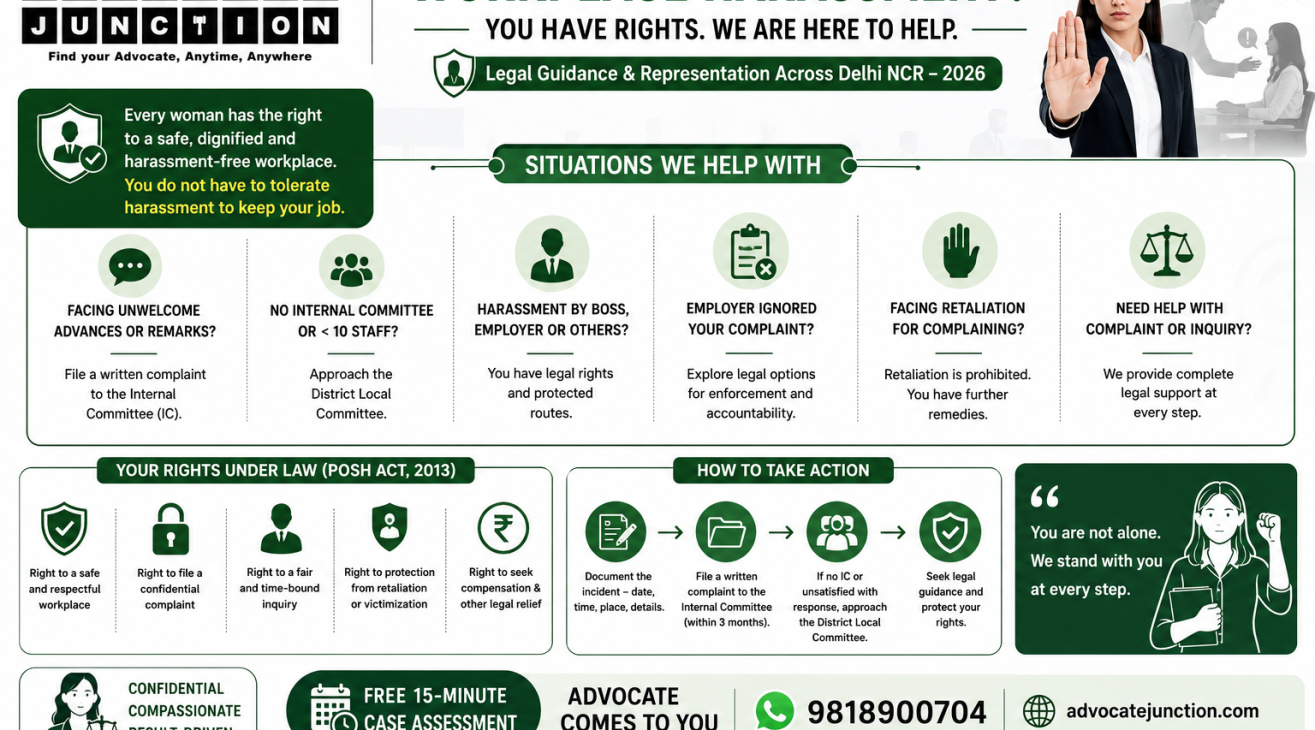
Sexual Harassment at Workplace: Your Rights and How to Complain Under the POSH Act
Sexual harassment at workplace, Indian law gives you a clear, protected right to complain — and your employer is legally bound to act on it. I hope most of people would have see the movie PINK. Amitabh Bachhan was playing a role of an advocate in this movie and he explained that if an women says NO then it means NO. Its the very core of sexual harassment in daily life .
You Have a Right to a Safe Workplace
Let me begin with something that too many women are made to doubt: you have an absolute right to be free from sexual harassment at workplace . It is not a favour your employer grants. It is not something you should tolerate to keep your job or avoid awkwardness. It is your legal right, protected by a specific law designed entirely for your safety.
That law is the Sexual Harassment of Women at Workplace (Prevention, Prohibition and Redressal) Act, 2013 — usually called the POSH Act. It exists precisely because the law recognises that harassment at work is real, damaging, and must be dealt with formally. Let me explain what your rights are and exactly how you can act on them.
What Counts as Sexual Harassment at Work?
Many women are unsure whether what they are experiencing ‘counts’. The law defines sexual harassment broadly, and it is not limited to physical contact. It includes any one or more of these unwelcome acts or behaviours:
- Physical contact and advances — any unwelcome physical touch or approach.
- A demand or request for sexual favours — including where it is linked to your job, promotion, or treatment at work.
- Sexually coloured remarks — comments, jokes, or observations of a sexual nature.
- Showing pornography or sexually explicit material.
- Any other unwelcome physical, verbal, or non-verbal conduct of a sexual nature — including messages, staring, gestures, or unwanted advances online or on chat.
The key word throughout is unwelcome. If the behaviour is unwelcome to you and is of a sexual nature, it can amount to sexual harassment — regardless of whether the other person claims it was a joke or harmless. You do not have to have been physically touched to have a valid complaint.
| Harassment Linked to Your Job is Especially Serious
The POSH Act specifically recognises situations where harassment is tied to your employment — for example, an implied or explicit promise of better treatment, promotion, or a threat about your job or performance, connected to sexual favours. This ‘quid pro quo’ harassment, and a hostile work environment created by such conduct, are both squarely covered. If someone with power over your job is behaving this way, the law takes it very seriously. |
Your Employer’s Legal Duty — the Internal Committee
Here is something every working woman should know: the law places clear duties on your employer, not just on you. Every workplace with 10 or more employees is legally required to constitute an Internal Committee (often called the Internal Complaints Committee or ICC) to receive and inquire into complaints of sexual harassment.
This committee must be properly constituted — headed by a senior woman, including an external member familiar with these issues, to ensure fairness and independence. Your employer is also legally required to make employees aware of the policy, conduct awareness programmes, and display information about the committee and the law. If your workplace has fewer than 10 employees, or the complaint is against the employer, you can approach the Local Committee constituted by the district authorities.
How to File a Complaint — Step by Step
- Put it in writing. A complaint of sexual harassment should be made in writing to the Internal Committee. If you find it hard to write it yourself, the committee is required to help you record it. Keep a copy.
- File within the time limit. The law provides that a complaint should generally be made within three months of the incident (or the last incident in a series), extendable in appropriate circumstances. So act reasonably promptly, but know that extensions are possible.
- Preserve your evidence. Save any messages, emails, chats, call records, or other material. Note dates, times, places, and any witnesses. Even where there is no direct witness, your consistent account and supporting material matter.
- The inquiry. The Internal Committee conducts an inquiry, giving both sides a chance to be heard, and maintains confidentiality. During the inquiry you can request interim relief — such as a transfer, leave, or that the respondent be restrained from reporting on your work.
- The findings and action. If the complaint is proven, the committee recommends action against the respondent per the service rules — which can include warnings, withholding of promotion or increments, and termination — and can recommend that compensation be paid to you.
Workplace Harassment Situations We Help With
Confidential legal guidance and representation across Delhi NCR
- Facing unwelcome comments, messages, touching, or sexual advances at work → Get legal advice and file a complaint before the Internal Committee (IC).
- Your employer has not formed an Internal Committee or your workplace has fewer than 10 employees → You may approach the District Local Committee for redressal.
- Harassed by your manager, senior, employer, colleague, client, or visitor → Understand your legal rights and available remedies.
- Your employer ignored your complaint or failed to act → Explore legal options for enforcement and accountability.
- Facing retaliation, threats, transfer, demotion, poor appraisals, or termination after complaining → Retaliation is prohibited, and additional legal remedies may be available.
- Need help preparing your complaint, collecting evidence, or attending proceedings → Get professional legal assistance at every stage.
- Seeking compensation or other legal relief after workplace harassment → Evaluate the remedies available under applicable law.
Every employee has the right to a safe, dignified, and harassment-free workplace. You should not have to choose between your career and your safety.
✅ FREE 15-Minute Confidential Case Assessment
🏠 Doorstep Legal Consultation Available Across Delhi NCR
📱 WhatsApp: +91-9818900704
You Are Protected Against Retaliation
One of the biggest fears women have is that complaining will cost them their job or invite revenge. The law anticipates this. Retaliation against a woman for making a complaint — victimisation, unfair treatment, or punishment for having complained — is prohibited. Confidentiality is also required; the identity of the complainant and the details of the proceedings are to be kept confidential.
If you face retaliation, that itself is a further wrong you can act on. So while the fear is understandable, the law is structured to protect you for coming forward, not to leave you exposed. Adv. Priya Tomar’s note: “The women I have advised who came forward were, almost always, glad they did — not because it was easy, but because staying silent had been quietly eroding them. The law genuinely stands with you here.”
Frequently Asked Questions
What if my company does not have an Internal Committee?
If your workplace has 10 or more employees and has not constituted an Internal Committee, the employer is in breach of the law, and that non-compliance carries penalties. In such a case, or where you work in a smaller establishment, you can approach the Local Committee constituted at the district level to receive your complaint. Not having a committee does not leave you without a remedy.
Is there a time limit to complain?
Generally a complaint should be made within three months of the incident, or within three months of the last incident where there is a series of them. However, the committee can extend this period if it is satisfied that circumstances prevented you from filing earlier. So while it is best to act promptly, a delay does not automatically defeat your complaint.
Can I file a police complaint as well?
Yes, depending on the nature of the acts. Some conduct amounting to sexual harassment is also a criminal offence, and you may pursue a criminal complaint in addition to the POSH complaint. The POSH process and a criminal complaint can proceed in parallel. An advocate can advise on the best combination for your specific situation.
Will my complaint be kept confidential?
Yes. The POSH Act requires confidentiality regarding the complainant’s identity and the details of the inquiry. Publication or disclosure of such details is prohibited. This protection is built into the law precisely to encourage women to come forward without fear of exposure.
What if the harassment is happening online or over chat?
Unwelcome conduct of a sexual nature over email, messaging apps, or other digital means, connected with your work or workplace, can amount to sexual harassment under the Act. Preserve the messages as evidence. Digital harassment is not outside the law’s reach.
Can I complain if the harassment happened outside the office?
Yes. Sexual harassment is not limited to the office premises. If the incident occurred during an official meeting, business trip, work-related event, training programme, office transport, or any other activity connected with your employment, it may still fall within the scope of the POSH Act. The law focuses on the work-related context rather than just the physical workplace.
Can I file a complaint after resigning from my job?
Yes, in many cases. Resigning does not automatically take away your right to complain. If the complaint is filed within the prescribed limitation period, or if the Internal Committee allows an extension for sufficient reasons, your complaint may still be considered. It is advisable to seek legal advice without unnecessary delay.
What evidence should I keep for a workplace harassment complaint?
Any evidence that supports your complaint can be helpful. This may include emails, WhatsApp messages, text messages, screenshots, CCTV footage, photographs, call records, diary entries, medical records (where relevant), and the names of colleagues who witnessed the incident. Even if you do not have documentary evidence, your complaint can still be examined based on the facts and circumstances.
Can my employer fire me for filing a sexual harassment complaint?
An employer should not retaliate against an employee for making a genuine complaint of sexual harassment. Actions such as dismissal, demotion, salary reduction, unfair transfers, poor performance ratings, intimidation, or creating a hostile work environment after a complaint may themselves give rise to additional legal remedies. If you experience retaliation, consult an advocate immediately.
Can I have an advocate help me during a POSH complaint?
The POSH Act primarily provides for an internal inquiry by the Internal Committee or the Local Committee. Although advocates do not ordinarily represent parties during the inquiry itself unless permitted under the applicable rules or policies, you can consult an advocate before, during, and after the proceedings. An advocate can help you prepare your complaint, preserve evidence, understand your rights, and advise on any related civil or criminal proceedings.
Can I file a complaint if the harassment happened only once?
Yes. A single incident of unwelcome conduct of a sexual nature may be sufficient to constitute sexual harassment under the POSH Act. The law does not require repeated incidents before a complaint can be made. The nature and seriousness of the conduct are important factors.
Can a male colleague or customer be held responsible under the POSH Act?
Yes. A complaint can be made against any person who commits sexual harassment in connection with the workplace, including a colleague, manager, employer, client, customer, vendor, consultant, or visitor, depending on the circumstances of the case.
Does the POSH Act apply to work-from-home or remote employees?
Yes. The protection under the POSH Act is not limited to a physical office. If sexual harassment occurs during virtual meetings, work-related calls, emails, messaging apps, or any interaction connected with employment, it may be covered by the Act.
Can an intern, trainee, or contract employee file a POSH complaint?
Yes. The POSH Act protects not only permanent employees but also interns, trainees, apprentices, temporary workers, consultants, volunteers, contract employees, and other women associated with the workplace, regardless of whether they receive a salary.
What happens after I submit a POSH complaint?
After receiving your complaint, the Internal Committee or Local Committee will review it, notify the respondent, conduct an inquiry by hearing both parties and examining evidence, and submit its findings with recommendations to the employer or competent authority. Both parties are generally given an opportunity to present their case.
Can I withdraw my workplace harassment complaint?
Yes. In some situations, a complainant may choose to withdraw or settle the matter, subject to the provisions of the POSH Act and the applicable procedures. However, settlements cannot be based on monetary compensation alone, and the committee must follow the law while considering such requests.
Will I have to face the person accused during the inquiry?
Not necessarily. The Internal Committee may adopt procedures that minimise unnecessary confrontation while ensuring a fair inquiry. Depending on the circumstances, the committee may hear the parties separately and take appropriate steps to maintain dignity and fairness.
What interim relief can I request during the inquiry?
During the inquiry, you may request interim measures such as transfer of either party, leave for a specified period as permitted by law, or other appropriate relief to ensure your safety and prevent further harassment. The committee may recommend such measures to the employer.
What if my employer ignores the Internal Committee’s recommendations?
Employers are expected to act on the recommendations of the Internal Committee in accordance with the POSH Act. Failure to comply may expose the employer to legal consequences, including penalties under the Act and other available legal remedies.
Do I need a lawyer before filing a POSH complaint?
While the POSH complaint process is designed to be accessible, legal advice can help you understand your rights, prepare a clear complaint, preserve important evidence, and decide whether additional civil or criminal remedies may be appropriate. Consulting an advocate early can help you avoid procedural mistakes.
Speaking Up Is Your Right — AdvocateJunction Can Help You Do It Safely
Sexual harassment at work thrives on silence — on the hope that you will feel too embarrassed, too afraid for your job, or too unsure of your rights to act. The law was written to break that silence and to put the responsibility where it belongs: on the harasser and on the employer to provide a safe workplace.
You do not have to figure this out alone, and you do not have to choose between your dignity and your career. With the right guidance, you can complain safely, confidentially, and effectively.
At AdvocateJunction, we help women across Delhi NCR act against workplace sexual harassment — advising on your rights, helping you draft and file your complaint, guiding you through the Internal or Local Committee process, and protecting you against retaliation. Everything is handled with confidentiality and care, at your doorstep. The first 15 minutes are free.
WhatsApp us at +91-9818900704 — completely confidential.
Related Articles on this topic
- Legal Rights of Women in India
- Domestic Violence Legal Rights in India
-
Indecent behaviour and assault land Punjab police chief K.P.S. Gill in trouble
- TanuShree Dutta and Nana Patekar case
- The HCL Technology Case
- Tarun Tejpal Sexual harrashment Case
Disclaimer: This content is purely educational and should not be taken as legal advice. While we strive to provide accurate and up-to-date information, laws change rapidly and vary by location. Reading or interacting with this blog does not create an attorney-client relationship. If you need legal assistance, please contact a qualified lawyer in your jurisdiction.