
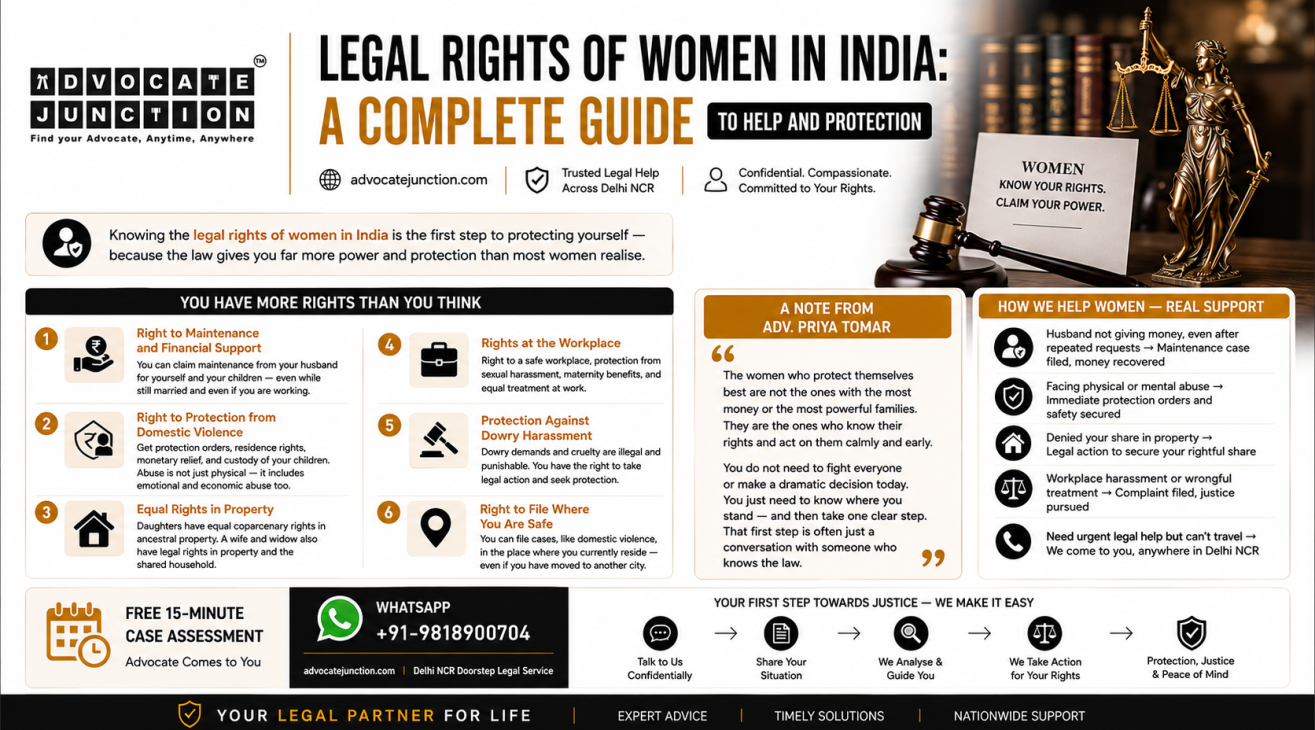
Legal Rights of Women in India: A Comprehensive Guide
Knowing the legal rights of women in India is the first step toward protecting yourself—because awareness empowers you to assert your rights and seek justice with confidence.
You Have More Rights Than You Think
In my years of practice, the single most common thing I hear from women is a version of this: “I didn’t know I could do that.” They didn’t know they could claim maintenance while still married. They didn’t know financial control counts as domestic violence. They didn’t know a daughter has equal rights in ancestral property. They didn’t know they could file a complaint in the city they fled to.
So let me use this guide to do one simple, powerful thing — tell you clearly what rights you have. You do not have to act on all of them today. But knowing they exist changes everything. Let us go through the main ones.
1. The Right to Maintenance and Financial Support
If your husband is not supporting you, or has left you without money, you have the right to claim maintenance — monthly financial support — for yourself and your children. Importantly, you can claim this even while still married and even if you are working, if your husband earns significantly more. Maintenance is not charity; it is your legal right, and courts enforce it.
2. The Right to Protection from Domestic Violence
Domestic violence under Indian law is not only physical. It includes emotional abuse, verbal abuse, and economic control — like being denied money or stopped from working. Under the Protection of Women from Domestic Violence Act, you can get a protection order (stopping the abuse and contact), a residence order (your right to stay in the shared home), monetary relief, and custody of your children. Protection orders can come quickly, sometimes within days.
3. Equal Rights in Property
Daughters in India now have equal coparcenary rights in ancestral property — the same as sons — including married daughters, confirmed by the Supreme Court. A wife has rights in her husband’s property and to the shared household. A widow has a right to her deceased husband’s property. If your family is denying you property because you are a woman, that is contrary to law.
4. Rights at the Workplace
Every woman has the right to a safe workplace. The law against sexual harassment at the workplace requires organizations to have an Internal Complaints Committee, and gives you a clear route to file a complaint and seek action. You also have rights to maternity benefits and to equal treatment. Harassment is never something you must simply tolerate.
5. Protection Against Dowry Harassment
Demanding dowry is illegal, and harassment or cruelty related to dowry is a punishable offence. If you are facing cruelty or dowry demands from your husband or in-laws, the law provides both criminal remedies and protection. You do not have to endure it in silence.
| Advocate’s Note
“The women who protect themselves best are not the ones with the most money or the most powerful families. They are the ones who know their rights and act on them calmly and early. You do not need to fight everyone or make a dramatic decision today. You just need to know where you stand — and then take one clear step. That first step is often just a conversation with someone who knows the law.” |
6. The Right to File Where You Are Safe
Many women believe they must return to the city where they were married, or where the abuse happened, to file a case. That is often not true. In domestic violence matters, for example, courts have held that a woman can file in the place where she currently resides — even if she has fled to her parents’ home in another city. You can seek protection from a place of safety.
| How We Help Women — Real Support
Confidential, doorstep legal help across Delhi NCR |
| Husband not giving money, even while married → Claim maintenance for you and your children |
| Facing abuse — physical, mental, or financial → Protection order, often within days |
| Being denied your share of family property → Equal rights — claim your share |
| Harassment at workplace → Formal complaint and action, safely |
| You do not have to face any of this alone. And you do not have to leave home to get help.
FREE 15-Minute Case Assessment — Advocate Comes to You 📱 WhatsApp: +91-9818900704 advocatejunction.com | Delhi NCR Doorstep Legal Service |
Frequently Asked Questions
Can I get legal help without my husband or family knowing?
Yes. A consultation with an advocate is confidential. You can understand your rights and options privately, and decide what to do at your own pace. AdvocateJunction’s doorstep service and WhatsApp consultation are designed to be discreet and comfortable — you do not have to visit a public office or court to get advice.
I don’t have money of my own. Can I still get legal help?
Yes. Free legal aid is available for women through the State Legal Services Authority. Additionally, in maintenance and domestic violence cases, you can claim litigation costs from your husband. Lack of your own money should never stop you from claiming your rights — the law has provisions precisely for this.
Do I have to file for divorce to get protection or maintenance?
No. You can seek maintenance and protection from domestic violence without filing for divorce. Many women get a protection order or maintenance while remaining married. These rights exist independently of divorce — you choose what steps to take based on your situation.
Is it too late to claim my rights if years have passed?
Not necessarily. Many rights remain available even after time has passed, though acting sooner is always better and some claims have time limits. If you have endured a situation for years thinking nothing could be done, speak to an advocate — you may have more options than you expect.
The Law Gives You Rights. We’re Here to Help You Exercise Them.
The Law Protects You. We’re Here to Help You Use It. If you’ve read this far, you’ve already taken an important step by learning about your legal rights. The law in India provides women with strong protections—whether it’s the right to maintenance, protection from domestic violence, equal property and inheritance rights, a safe workplace, or legal remedies against dowry harassment. These are not privileges or favours; they are rights guaranteed by law.
Knowing your rights gives you confidence, but taking the right legal action at the right time is just as important. Every situation is different, and having the right legal guidance can help you make informed decisions and protect what matters most.
If you have questions, need legal advice, or are facing a legal issue, the experienced lawyers at Advocate Junction are here to support you with clear guidance, complete confidentiality, and practical legal solutions—every step of the way.
At AdvocateJunction, we help women across Delhi NCR understand and claim these rights — confidentially, respectfully, and at your doorstep. You do not have to travel to a strange office or sit in a court corridor. We come to you. The first 15 minutes are free and completely private.
WhatsApp us at +91-9818900704 — whenever you are ready.
| Emergency Contacts — Save These
Police Emergency: 112 Delhi Commission for Women Helpline: 181 (24 hours) National Women Helpline: 7827170170 AdvocateJunction — Confidential Legal Help: +91-9818900704 |
Related Articles on AdvocateJunction
- Domestic Violence Legal Rights in India — What Every Woman Should Know
- How to Claim Maintenance from Husband in Delhi