
OCI Cardholder Rights in India: What You Can and Cannot Do
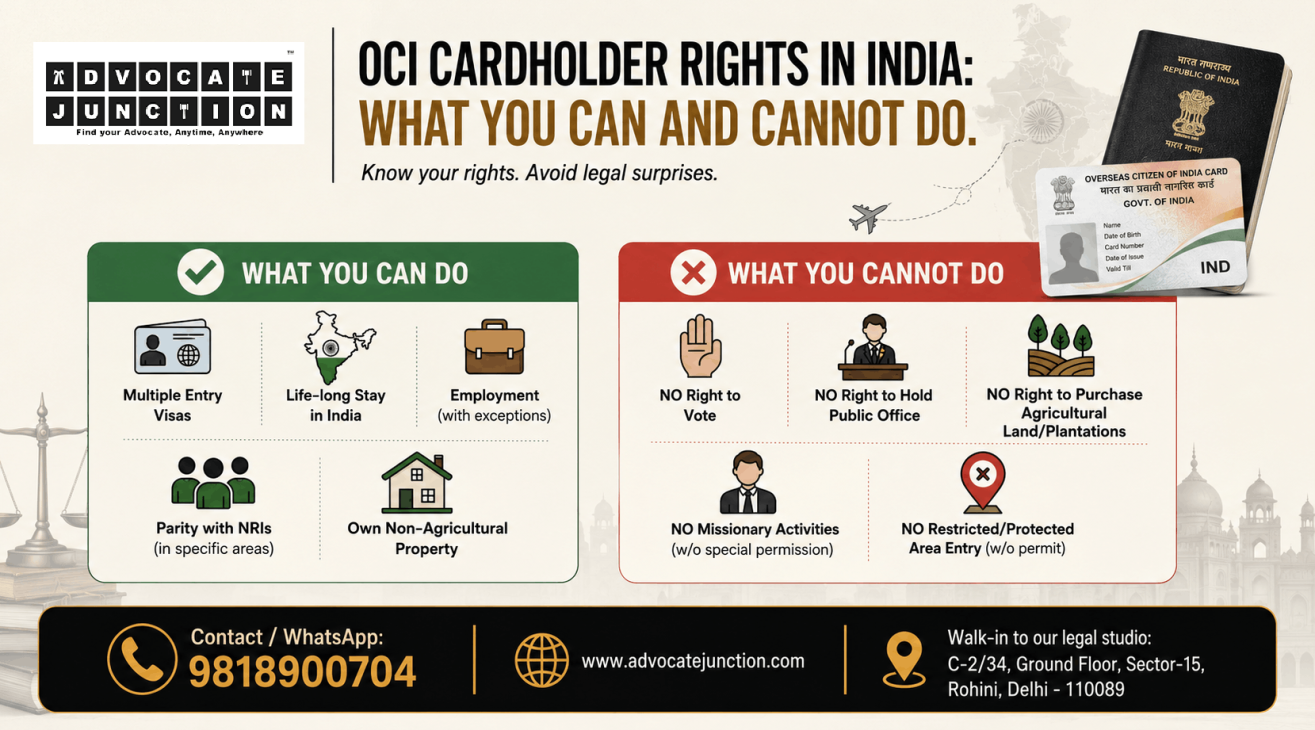
OCI cardholder rights in India are extensive, making it easier for Overseas Citizens of India (OCIs) to live, work, study, and manage personal affairs without the need for a separate visa. However, these rights are not identical to those of Indian citizens, and understanding the legal boundaries is essential before making important financial or personal decisions.Whether you are planning to invest, relocate, start a business, or inherit family property in India, understanding these rights and limitations before taking action can help you avoid legal disputes, financial losses, and unnecessary complications.
Rohan Lands in Delhi With a Plan
| Rohan grew up in London, the son of parents who had emigrated from Delhi in the 1980s. He holds a British passport and an OCI card. Now in his thirties, doing well, he has decided he wants a base back in India — a flat in Gurgaon, perhaps a small business, time spent between two countries.
He arrives full of plans, and quickly runs into questions no one had answered for him. Can he buy the flat he wants? Can he buy a farmhouse on the outskirts he has fallen for? Does he need a visa each time? Can he run the business himself? Can he vote, or hold a government post? He assumed his OCI card made him ‘almost Indian’. The truth is more precise than that. |
Rohan’s confusion is universal among OCI and PIO cardholders, so let us walk through his questions the way we would if he were sitting in the office — because the answers map neatly onto what every cardholder should know.
First — What an OCI Card Actually Is
The Overseas Citizen of India (OCI) scheme gives people of Indian origin who hold foreign citizenship a special, long-term status in India. It is often loosely called ‘dual citizenship‘, but that description is misleading. An OCI cardholder is a foreign citizen with valuable privileges in India — not an Indian citizen. That single distinction explains almost every ‘can I or can’t I’ question Rohan has.
The older PIO (Person of Indian Origin) card scheme has effectively been merged into the OCI framework, so today OCI is the status that matters for most people in Rohan’s position.
What Rohan CAN Do
A great deal, as it turns out. The privileges are genuinely generous:
- Enter and stay freely. An OCI card allows lifelong, multiple-entry travel to India and freedom from registering with authorities for extended stays — no need to chase a fresh visa each visit.
- Buy most property. He can buy residential and commercial property in India, much like a resident, giving him the Gurgaon flat he wants.
- Do business and work. He can engage in most economic, financial, and business activities, and pursue many professions, subject to the rules that apply generally.
- Parity in many areas. In several respects — such as domestic travel and certain economic matters — he is treated on par with resident Indians.
What Rohan CANNOT Do
This is where the precise lines matter, and where cardholders get caught out:
- Buy agricultural land, plantation property, or farmhouses. This is the big one for Rohan — his dream farmhouse is off-limits to purchase. OCI cardholders generally cannot buy agricultural land, plantations, or farmhouses, though they may inherit such property.
- Vote or hold constitutional and government posts. He cannot vote, contest elections, or hold certain public and constitutional offices — these are reserved for citizens.
- Assume equal footing in every field. Certain activities and professions have specific restrictions or require particular permissions for foreign nationals, and OCI status does not automatically remove those.
| The Farmhouse Trap
The most common and costly OCI mistake is buying — or agreeing to buy — agricultural land or a farmhouse, which OCI cardholders generally cannot purchase. Sellers and brokers do not always flag this, and a deal can go a long way before the problem surfaces. If your India plans include anything resembling agricultural or plantation land, get the position checked before you pay a rupee. Inheritance is treated differently from purchase. OCI / PIO Situations We HandleProperty, Business & Legal Status Guidance Across Delhi NCR
FREE 15-Minute Case AssessmentAdvocate Comes to Your Home, Office, or Hotel (Delhi NCR) 📱 WhatsApp: +91-9818900704 Frequently Asked QuestionsCan an OCI cardholder buy property in India?Yes, for most property. OCI cardholders can generally buy residential and commercial property in India. The key exception is agricultural land, plantation property, and farmhouses, which OCI cardholders generally cannot purchase — although they may acquire such property through inheritance. Always confirm the category of the property before buying. What is the difference between OCI and PIO?OCI (Overseas Citizen of India) and the older PIO (Person of Indian Origin) were separate schemes for people of Indian origin holding foreign citizenship. The PIO scheme has effectively been merged into the OCI framework, so OCI is now the operative status for most people. OCI generally offers broader, lifelong privileges compared with the earlier PIO card. Is an OCI cardholder an Indian citizen?No. An OCI cardholder is a foreign citizen with special long-term privileges in India — not an Indian citizen. This is why an OCI holder cannot vote, contest elections, or hold certain government and constitutional posts, and faces some property and activity restrictions that do not apply to citizens. The ‘dual citizenship’ label often used for OCI is misleading. Can an OCI cardholder work or do business in India?Generally yes. OCI cardholders can engage in most economic, financial, and business activities and pursue many professions in India, subject to the rules that apply generally to such activities. Some specific fields carry restrictions or require particular permissions for foreign nationals, so it is worth checking the position for your particular activity. Can an OCI cardholder stay in India indefinitely?Technically yes .OCI status allows multiple-entry, lifelong travel to India without obtaining a visa for each visit. OCI holders may stay in India for extended periods subject to applicable laws and any future Government notifications. Does the Bharatiya Nyaya Sanhita (BNS), 2023 apply to OCI cardholders?Yes. Once an OCI cardholder is present in India, they are subject to Indian criminal law, including the Bharatiya Nyaya Sanhita, 2023 (BNS), the Bharatiya Nagarik Suraksha Sanhita, 2023 (BNSS), and the Bharatiya Sakshya Adhiniyam, 2023 (BSA), wherever applicable.OCI status does not provide immunity from criminal investigation, arrest, prosecution, or trial under Indian law. Can an OCI cardholder be arrested in India under the BNS?A big yes. If an OCI cardholder is alleged to have committed an offence under the Bharatiya Nyaya Sanhita, 2023, they can be investigated, arrested, prosecuted, and tried in accordance with the BNSS, 2023, just like any other person subject to Indian criminal jurisdiction. Can an OCI card be cancelled?Yes it can be.The Government of India may cancel OCI registration under circumstances specified under the Citizenship Act, 1955, including cases involving fraud, concealment of material facts, or where cancellation is otherwise permitted under law. Know the Lines Before You Cross ThemRohan left the office with a clear map — the Gurgaon flat was well within reach, the farmhouse was not, the business was workable with the right structure, and the voting booth was not for him. That clarity saved him from an expensive misstep and let him build his India plans on solid ground. At AdvocateJunction, we advise OCI and PIO cardholders across Delhi NCR — on property, business, inheritance, and the precise limits of your status — so your plans rest on certainty, not assumptions. We come to you, or advise you from abroad. The first 15 minutes are free. WhatsApp us at +91-9818900704 Related Articles on AdvocateJunction
© 2026 AdvocateJunction. All rights reserved. | advocatejunction.com | For informational purposes only. Not legal advice |