
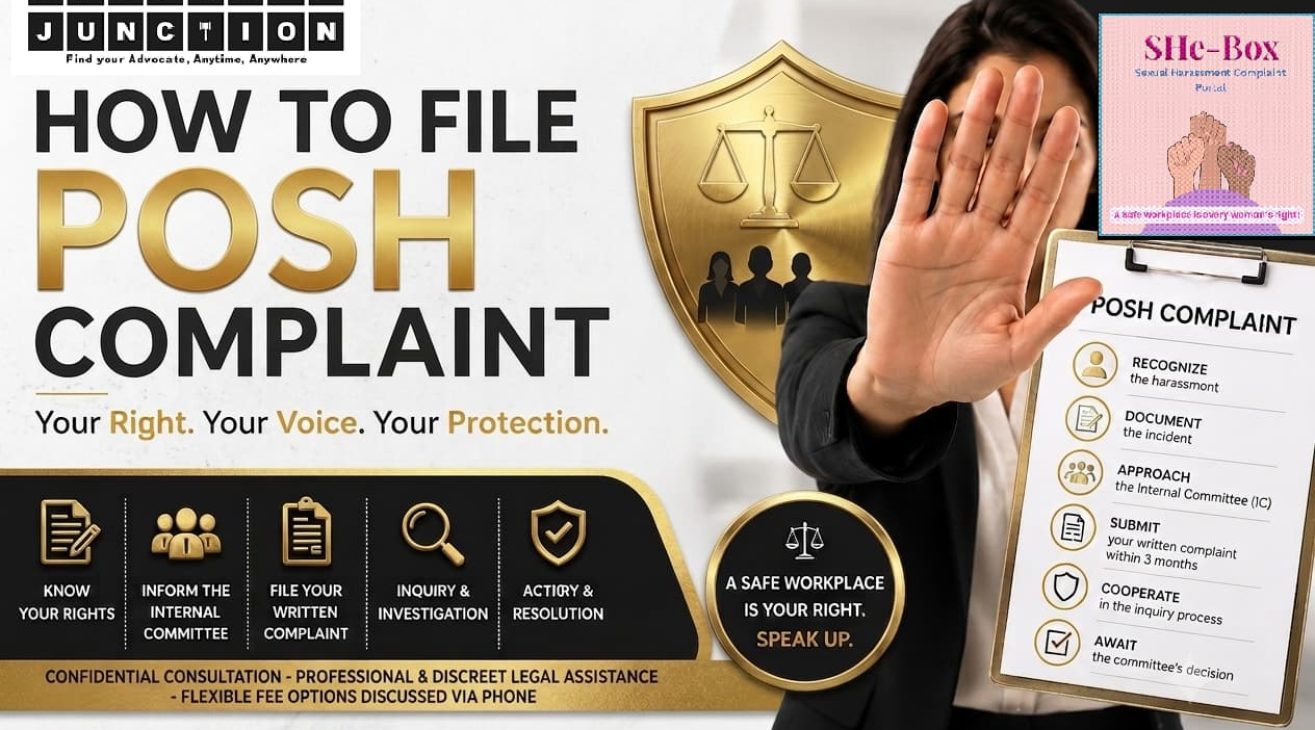
How to File a POSH Complaint: step-by-step guide to take action
Knowing how to file a POSH complaint — the exact steps, the timeline, the evidence — turns a situation that feels powerless into one where the law is clearly on your side.
Recently we got a call from a lady who is now a days in Kolkata and she wanted to file a POSH complaint against his boss in Delhi. After deep digging we came to know that 1 year back she was in Delhi and she faced so much tension in office that she left the job and returned back to her home town kolkata. After a years she decided to file a complaint and take action . Its a real life example that women take time and courage to speak in such type of harrasments . You have been putting it off. Not because you are weak, but because the calculations running through your head are exhausting. What if no one believes me. What if I lose my job. What if it becomes my word against his and everyone takes his side. What if I am overreacting. What if speaking up makes everything worse than just enduring it. Despite legal protections, many women are left in the dark about the exact steps on how to file a POSH complaint when they need to most.
Every woman who has sat across from me in this situation has run those same calculations. The harassment is bad enough; the fear of what happens if you report it is often worse. And so days become weeks, weeks become months, and the thing that was done to you quietly becomes something you carry alone.
So let me change the ground you are standing on. There is a law written specifically for this — the Sexual Harassment of Women at Workplace (Prevention, Prohibition and Redressal) Act, 2013, the POSH Act. It does not leave you to fight alone in a corridor. It gives you a defined process, a committee that must hear you, deadlines the other side has to meet, confidentiality, and protection from retaliation. Once you can see the actual steps, the fog of what if starts to lift. Let me walk you through exactly how it works.
Before the steps — you are on stronger ground than you think
Two things to settle first, because they are what the fear feeds on.
You are almost certainly not overreacting. Sexual harassment under the POSH Act is not only physical. It includes unwelcome physical contact or advances, a demand or request for sexual favours, sexually coloured remarks, showing pornography, and any other unwelcome physical, verbal or non-verbal conduct of a sexual nature — including over messages and chat. The test is whether it was unwelcome to you and of a sexual nature. If it was, it counts, regardless of what the other person claims they ‘meant’.
The law protects you for coming forward. Retaliation against a woman for making a complaint is prohibited. Confidentiality is required — your identity and the details of the proceedings are to be kept confidential. The law was built anticipating exactly your fear, and structured to protect you against it.
Step 1 — Know who receives your complaint
Your complaint goes to the Internal Committee — often called the Internal Complaints Committee, or ICC. Every workplace with 10 or more employees is legally required to have one, properly constituted, headed by a senior woman and including an external member so it is fair and independent.
If your workplace has fewer than 10 employees, or your complaint is against the employer himself, you go instead to the Local Committee constituted by the district authorities. So there is always a body to receive your complaint — the absence of an ICC does not leave you without a route.
Step 2 — Put your complaint in writing
A POSH complaint should be made in writing to the Internal Committee. Write what happened — the incidents, dates, places, who was involved, and who else was present or aware. Be factual and specific rather than emotional; a clear, dated account carries weight.
If you find it hard to write it yourself — and many women do, because reliving it on paper is painful — the Committee is required to help you record your complaint. You are not expected to be a lawyer. You are expected to tell the truth, and they must help you put it down. Keep a copy of whatever you submit.
Step 3 — File within the time limit (but don’t panic about it)
The law says a complaint should generally be made within three months of the incident or within three months of the last incident where there has been a series of them. That is the standard window.
But here is the important part, because time limits frighten people into thinking they have missed their chance: the Committee can extend this period if it is satisfied that circumstances prevented you from filing earlier. Fear, pressure, and the sheer difficulty of coming forward are real circumstances. So while it is best to act reasonably promptly, a delay does not automatically end your complaint. If time has passed, get advice rather than assuming the door has closed.
Step 4 — Gather and preserve your evidence
This is the single most practical thing you can do, and the earlier you start, the stronger you are. Preserve everything:
- Messages, emails, chats, voice notes — anything showing the conduct. Back them up somewhere the other person cannot reach, like a personal cloud account or your own device at home.
- A dated record — write down each incident as soon as you can after it happens. A contemporaneous note is worth far more later than a memory reconstructed months on.
- Witnesses — anyone who saw an incident, or whom you told at the time. Colleagues you confided in become important, even if they did not see the act itself.
- Any medical or counselling record if the harassment affected your health, and you sought help.
| Why early evidence decides cases
In my experience, the complaints that hold up are rarely the ones with the most dramatic single incident. They are the ones where the woman started keeping records early — saved the messages before her phone could be taken, noted dates as things happened, told someone outside her own head. You cannot always control what was done to you. You can control whether there is a clear, dated trail of it. Start that trail today, even if you are not ready to file yet. |
Step 5 — The inquiry, and your right to interim relief
Once your complaint is filed, the Internal Committee conducts an inquiry. Both sides are heard, and the process is meant to be confidential. This is not a public trial; it is a structured, private examination of what happened.
Crucially, during the inquiry you can ask the Committee for interim relief — steps to protect you while the matter is pending. This can include a transfer for you or the respondent, granting you leave, or restraining the respondent from reporting on your work or your performance. You do not have to keep sitting next to the person you have complained about while the inquiry runs. Ask for the protection you need.
Step 6 — Findings and action
If the complaint is proven, the Committee recommends action against the respondent in line with the service rules — which can include a written apology, warnings, withholding of promotion or increments, and termination in serious cases. The Committee can also recommend that compensation be paid to you, taking into account the mental trauma, the impact on your career, and other factors.
The findings and recommendations go to the employer, who is required to act on them. So this is not a process that simply airs your grievance and stops; it leads to consequences and, where warranted, compensation.
What if they retaliate? What if the ICC is unfair?
Two real fears, answered honestly.
Retaliation. If, after you complain, you face victimisation — sudden poor appraisals, a punitive transfer, exclusion, threats, or pressure to withdraw — that retaliation is itself prohibited under the law, and it becomes a further wrong you can act on. Document it exactly as you documented the original harassment. Retaliation often strengthens your position rather than weakening it, because it shows consciousness of guilt.
An unfair or missing committee. If your workplace has no ICC despite being required to have one, those non-compliance carries penalties for the employer, and you can approach the Local Committee. If you are dissatisfied with the Committee’s handling or outcome, there are avenues to challenge it, including appeal. And some conduct amounting to harassment is also a criminal offence, so a criminal complaint can be pursued alongside the POSH process where appropriate. You are not trapped inside a single flawed forum.
| A note from Adv. Priya Tomar
“The women I have guided through this were almost never glad in the moment — it is hard, and I will not pretend otherwise. But months later, nearly all of them told me the same thing: that the silence had been quietly costing them more than the complaint ever did. You do not have to be fearless to do this. You just have to take the first documented step, and let the process — and people who know it — carry some of the weight from there.” |
You’re probably wondering how to file a POSH complaint—here is a clear, step-by-step breakdown.
What if it’s my word against his, with no proof?
Cases are often decided on more than a single smoking-gun document. A consistent, dated account, colleagues you told at the time, patterns of messages or behavior, and the respondent’s own conduct during the inquiry all matter. This is exactly why keeping a contemporaneous record and preserving messages is so valuable — it turns ‘my word against his’ into ‘my documented account against his denial’. Start that record now, even before you decide to file.
Will my employer find out it was me, and will everyone know?
The POSH Act requires confidentiality — your identity and the details of the inquiry are to be kept confidential, and publishing or disclosing them is prohibited. This protection exists precisely so that women can come forward without being exposed. While no process is perfect, the law is firmly on the side of keeping your complaint confidential.
It happened months ago. Is it too late?
Not necessarily. The standard window is three months from the incident or the last incident, but the Committee can extend this where circumstances prevented you from filing earlier — and fear and pressure are real circumstances. Do not decide on your own that you have missed your chance. Get it assessed; you may well still be able to file.
Can I complain if the harassment happened over chat or email, not in person?
Yes. Unwelcome conduct of a sexual nature over email, messaging apps, or other digital means, connected with your work or workplace, is covered by the Act. In fact, digital harassment often leaves the clearest evidence trail — so preserve those messages carefully.
Do I need a lawyer to file a POSH complaint?
No. You can file a POSH complaint directly with your organization’s Internal Committee without a lawyer. However, legal guidance can help you draft a stronger complaint, preserve evidence, seek appropriate relief, and protect your rights—especially in complex cases or when the employer is uncooperative.
Frequently Asked Questions – How to file a POSH Complaint
1. How do I file a POSH complaint against my manager in India?
If your manager has subjected you to sexual harassment at the workplace, you can file a written complaint with your company’s Internal Committee (IC) under the Sexual Harassment of Women at Workplace (Prevention, Prohibition and Redressal) Act, 2013. The complaint should clearly mention the incidents, dates, locations, and any supporting evidence such as emails, messages, CCTV footage, or witness details. Once received, the Internal Committee will initiate an inquiry and provide both parties an opportunity to present their case.
2. What is the process to file a sexual harassment complaint at my workplace?
The process begins with preparing a written complaint describing the incident(s). Submit it to the Internal Committee within three months of the incident or the last incident in case of repeated harassment. The Committee may attempt conciliation if requested by the complainant, excluding monetary settlement. If conciliation is not sought or fails, a formal inquiry is conducted, witnesses are examined, evidence is reviewed, and recommendations are submitted to the employer.
3. Can I file a POSH complaint after leaving my job?
Yes, you may still be able to file a complaint if it is within the statutory limitation period. The complaint generally must be filed within three months from the date of the incident or the last incident of a continuing series. If there are valid reasons for the delay, the Internal Committee may extend the time by another three months after recording its reasons.
4. How many days do I have to file a POSH complaint in India?
Under the POSH Act, a complaint should ordinarily be filed within three months from the date of the incident. If the harassment consists of multiple incidents, the limitation is calculated from the last incident. In appropriate cases, the Internal Committee may extend this period by another three months if sufficient cause for the delay is shown.
5. Who should I contact to file a POSH complaint in my office?
You should approach your organization’s Internal Committee (IC). Every workplace employing ten or more employees is required to constitute an Internal Committee. The contact details of the Presiding Officer or committee members are generally displayed in the workplace or available through the HR department.
6. Can I file a POSH complaint if my company does not have an Internal Committee?
Yes. If your employer has failed to constitute an Internal Committee despite being legally required to do so, you can approach the Local Committee constituted by the District Officer. The absence of an Internal Committee does not take away your legal right to seek redressal.
7. What evidence do I need before filing a POSH complaint?
You do not need perfect or direct evidence to file a complaint. Useful evidence may include emails, WhatsApp chats, text messages, call records, photographs, CCTV footage, voice recordings where legally admissible, diary entries, witness statements, or any document supporting your version. Even if documentary evidence is unavailable, your complaint can still be investigated based on the facts and circumstances.
8. Can I file a POSH complaint online in India?
Some organizations allow online submission through their internal grievance portal or HR system. Certain State Governments and Local Committees may also provide online grievance mechanisms. If no online option exists, you can submit a signed written complaint directly to the Internal Committee or Local Committee.
9. What happens after I submit a POSH complaint to the Internal Committee?
The Internal Committee acknowledges the complaint, informs the respondent, and commences the inquiry. Both parties are given an opportunity to present evidence and witnesses. After completing the inquiry, the Committee submits its recommendations to the employer, who is required to act on them within the prescribed time under the Act.
10. Can a woman file a POSH complaint against a coworker or only against her boss?
Yes. A POSH complaint can be filed against any person at the workplace whose conduct amounts to sexual harassment. This includes a supervisor, manager, colleague, client, customer, vendor, consultant, contractor, intern, or any other person connected with the workplace.
11. How can I prove sexual harassment at work?
Proof can come from many sources, including emails, messages, CCTV footage, witness testimony, call records, photographs, or other relevant documents. However, every case is different, and the Internal Committee evaluates all available evidence together with the statements of the parties before reaching a conclusion.
12. What should I write in a POSH complaint letter?
Your complaint should include your name and designation, the name of the respondent, dates and places of the incidents, a chronological description of what happened, names of any witnesses, details of available evidence, and the relief or action you seek. Keep the complaint factual, clear, and as specific as possible.
13. Can I withdraw a POSH complaint after filing it?
The POSH Act does not specifically provide an unrestricted right to withdraw a complaint after the inquiry has begun. In some situations, the complainant may request conciliation before the inquiry commences, provided the settlement does not involve monetary compensation. Whether proceedings stop depends on the facts and the applicable legal provisions.
14. Is it mandatory to have witnesses in a POSH complaint?
No. A complaint cannot be rejected merely because there are no witnesses. Many incidents of sexual harassment occur in private. The Internal Committee considers all available evidence, surrounding circumstances, and the credibility of the parties while conducting the inquiry.
15. What if my employer ignores my POSH complaint?
If your employer fails to act on your complaint or has not constituted an Internal Committee where required, you may approach the Local Committee, appropriate authorities, or seek legal remedies before the competent court or tribunal, depending on the facts of your case. Employers who violate the POSH Act may also face statutory penalties.
16. Can I file a police complaint along with a POSH complaint?
Yes. Filing a POSH complaint does not prevent you from filing a criminal complaint if the conduct also amounts to an offence under the Bharatiya Nyaya Sanhita (BNS) or any other applicable law. Both proceedings may continue independently, depending on the nature of the allegations.
17. Is there any time limit to report workplace sexual harassment?
Yes. A complaint should generally be filed within three months from the date of the incident or the last incident. The Internal Committee may extend this period by another three months if sufficient reasons for the delay are established.
18. What are my rights after filing a POSH complaint?
You have the right to a fair and confidential inquiry, protection against retaliation, an opportunity to present evidence, assistance during the proceedings where applicable, and a reasoned decision by the Internal Committee. The employer is also required to implement the Committee’s recommendations in accordance with the law.
19. Can contract employees or interns file a POSH complaint?
Yes. The POSH Act protects not only permanent employees but also contract workers, trainees, interns, apprentices, probationers, temporary employees, consultants, and any woman visiting or working at the workplace, irrespective of the nature of her employment.
20. What is the punishment for sexual harassment at the workplace in India?
The consequences depend on the findings of the Internal Committee and the seriousness of the misconduct. Disciplinary action may include a written apology, warning, withholding promotion or increments, suspension, termination of employment, counseling, or other actions under the employer’s service rules. If the conduct also constitutes a criminal offence, the offender may additionally face prosecution and punishment under applicable criminal law.
The first step is smaller than the fear
Go back to where you started reading this — the exhausting loop of what if. Notice that almost every fear in it has an answer now. What if no one believes me: a dated record and witnesses? What if I lose my job: retaliation is unlawful. What if everyone knows: confidentiality is required. What if it’s too late: the deadline can be extended. What if I’m overreacting: if it was unwelcome and sexual, it counts.
You do not have to file today. You do not have to confront anyone. The first step is quieter and more manageable than the whole battle you have been dreading: start writing down what happened, save the messages somewhere safe, and tell one person you trust. Those three things, done this week, put real ground under your feet — and when you are ready to file, the process is there, and so are people who can carry it with you.
At AdvocateJunction, we provide professional, fee-based legal support to working women across Delhi NCR navigating POSH complaints. As a private legal consultancy, our team offers dedicated assistance at every stage—from drafting your complaint and organizing evidence to guiding you through Internal Committee (IC) or Local Committee (LC) proceedings, securing interim protection, and taking legal action against workplace retaliation.
To ensure complete privacy and convenience, we operate discreetly without requiring in-person office visits. All legal advisory services are customized to your situation, and our fee structure is discussed transparently during your initial phone call. WhatsApp us at +91-9818900704 — confidential, whenever you are ready.
Need Help? Save These Important NumbersIf you or someone you know is facing workplace sexual harassment, these helplines may be useful: · Police Emergency: 112 · Delhi Commission for Women (24×7 Helpline): 181 · National Women Helpline: 7827170170 · Advocate Junction (Delhi NCR Doorstep legal Support): +91-9818900704 If you are in immediate danger, call 112 without delay. For legal guidance on filing a POSH complaint or understanding your rights, you can seek confidential assistance from Advocate Junction. The SHe-Box (Sexual Harassment electronic Box) is a centralized portal launched by India’s Ministry of Women and Child Development to foster safer workplaces for women. It serves as a secure, single-window system where female employees—across public, private, organized, and unorganized sectors—can easily file workplace harassment complaints and track their resolution status in real-time. |
Related Articles on this topic
- Sexual Harassment at the Workplace
- Legal Rights of Women in India
- Domestic Violence Legal Rights in India
- 254 Complaints under SHe-Box portal – Govt of India
© 2026 AdvocateJunction. All rights reserved. | advocatejunction.com | For informational purposes only. Not legal advice.