
Lump-Sum Alimony vs Monthly Maintenance: Which Is Better in India?
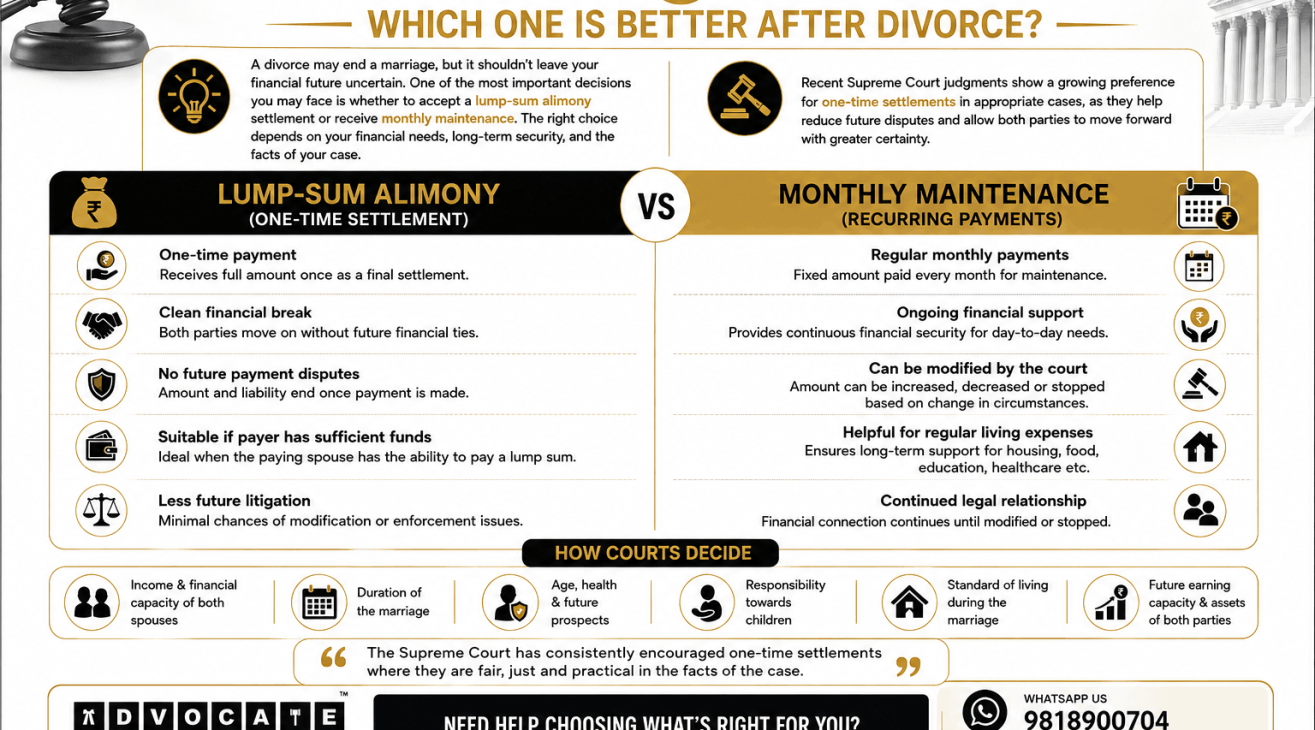
A divorce may end a marriage, but it should not leave your financial future uncertain. One of the most important decisions you may face is whether to accept a lump-sum alimony settlement or receive monthly maintenance. The right choice depends on your financial needs, long-term security, and the facts of your case. Recent Supreme Court judgments also show a growing preference for one-time settlements in appropriate cases, as they help reduce future disputes and allow both parties to move forward with greater certainty. This guide explains the legal differences, key advantages and risks, and how courts decide which option is most appropriate.
If your marriage is ending and money is on the table, you will face this choice: take a single large payment now, or a fixed amount every month. They are very different paths, with different risks and different advantages. Here is a clear comparison to help you understand which suits your situation.
What is lump-sum alimony?
Lump-sum alimony is a single, one-time payment made by one spouse to the other as a full and final settlement of all maintenance and alimony claims. Once it is paid, the paying spouse generally owes nothing further, and the receiving spouse cannot usually come back for more. It is often called a ‘clean break’ — the financial tie between the spouses is cut in one stroke.
What is monthly maintenance?
Monthly maintenance is a recurring payment — a fixed amount paid every month by one spouse to the other, and often to the children. It continues over time and can, in changed circumstances, be increased, decreased, or modified by a court. It keeps a financial link between the spouses alive rather than cutting it.
What is the main difference between the two?
The core difference is finality. Lump-sum alimony ends the financial relationship in one payment — no future claims, no returning to court, no ongoing dependence. Monthly maintenance keeps an ongoing obligation that must be paid, enforced if missed, and can be revisited later. Lump-sum is closure; monthly is continuity.
What are the advantages of lump-sum alimony?
- Finality: no future litigation, no returning to court to enforce payments.
- Immediate capital: the receiving spouse gets a lump amount to rebuild life, buy a home, or invest.
- No dependence on the ex-spouse: no monthly chasing, no worry about a defaulting payer.
- Clean separation: both parties move on without any lingering financial link.
What are the disadvantages of lump-sum alimony?
- It is final: once accepted, you generally cannot claim more, even if circumstances change badly.
- Requires a large payment: the paying spouse must have or arrange substantial funds at once.
- Risk of undervaluing: if not calculated carefully, the receiving spouse may accept less than fair future maintenance would have given.
What are the advantages of monthly maintenance?
- Flexibility: the amount can be modified if incomes or needs change.
- No large upfront burden: suits a payer who earns steadily but lacks a big lump sum.
- Ongoing security: a steady, predictable income stream for the receiving spouse and children.
What are the disadvantages of monthly maintenance?
- Enforcement hassle: if the payer defaults, you must chase payment, sometimes for years.
- Ongoing link: both parties remain financially tied and may return to court repeatedly.
- Uncertainty: a payer’s job loss or non-payment can disrupt your income.
Which does the Supreme Court prefer now?
Recent Supreme Court judgments show a clear preference for one-time, full-and-final clean-break lump-sum settlements over open-ended monthly maintenance, especially where a marriage has irretrievably broken down. Using its powers under Article 142, the Court has repeatedly dissolved marriages while ordering a single lump-sum settlement that closes all civil and criminal proceedings between the parties. The judicial thinking is that finality serves both sides better than years of enforcement and return visits to court. That said, the amount must still be fair, based on the standard of living, the husband’s real capacity, and the wife’s future security — the principles from Rajnesh v. Neha case decision continue to apply to how the figure is fixed.
Which is better for you — lump-sum or monthly?
There is no single right answer; it depends on your situation. Lump-sum is usually better when the paying spouse has substantial assets, when you want a clean break with no future contact, and when you would rather have capital now than chase payments later. Monthly maintenance can suit you better when the payer earns steadily but has no large lump sum, or when your needs may grow (for example, children’s rising costs) and you want the option to seek modification. The safest approach is to have the numbers worked out properly and the settlement drafted carefully — a badly drafted lump-sum settlement can become a trap, and a monthly order without enforcement teeth can become a headache.
Key takeaway
Lump-sum alimony gives finality and immediate capital but cannot be revisited; monthly maintenance gives flexibility and ongoing security but keeps you tied and dependent on payment. The Supreme Court increasingly favours the clean-break lump sum where a marriage is truly over — but the right choice for you depends on the assets involved, your need for certainty, and how the settlement is drafted.
How to Decide: Lump-Sum vs. Monthly Maintenance?
Opt for Lump-Sum Alimony if:
- You want total independence: Eliminates all post-divorce financial ties, contact, and legal disputes with your ex-spouse.
- You can manage capital: You have the financial literacy or professional guidance to invest and grow a single payout.
- Liquid assets exist upfront: The paying spouse has sufficient savings, property, or liquid assets to transfer immediately.
Opt for Monthly Maintenance if:
- The paying spouse is salaried: The paying spouse relies on a periodic salary and lacks the liquid capital or assets needed for a single upfront payout.
- You need stable cash flow: Provides predictable recurring income to cover day-to-day living expenses and utilities.
- You want inflation protection: Leaves the legal door open to petition the court for upward revisions due to rising living costs, emergency medical needs, or income changes.
Key Reality Check
Spouse’s Financial Structure Matters: A lump-sum settlement is only viable if the paying spouse actually holds liquid capital or transferable assets. If their wealth is strictly tied to a monthly salary, courts will typically order monthly maintenance, as forcing an unpayable lump sum can lead to default and legal deadlock.
AdvocateJunction has a group of legal professionals specializing in alimony and maintenance solutions across Delhi NCR — evaluating lump-sum offers, drafting enforceable settlements, and executing court orders. All services and consultations are paid. To consult with our team, reserve your slot via WhatsApp at +91-9818900704 or on our website.
Related Articles on AdvocateJunction
- Maintenance Law in India — The Rajnesh v. Neha Guidelines
- How to Claim Maintenance from Husband in Delhi
- Mutual Consent Divorce in Delhi — Complete Guide
© 2026 AdvocateJunction. All rights reserved. | advocatejunction.com | For informational purposes only. Not legal advice.