
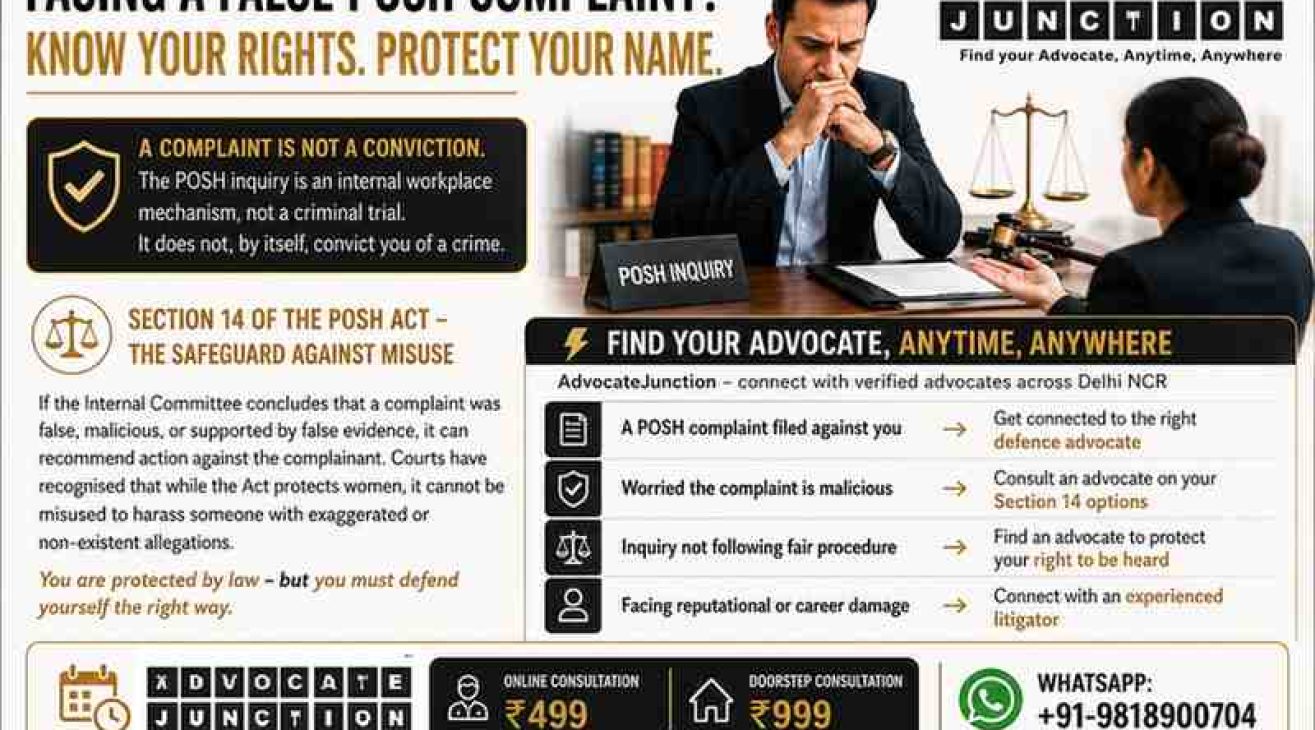
False POSH Complaint? How to Defend Yourself the Right Way
Facing a false POSH complaint is frightening, but a complaint is not a conviction — and the law gives an innocent person real, structured ways to defend their name.
The message reaches you and the floor seems to tilt. A sexual harassment complaint has been filed against you at work. Your mind goes straight to the worst places — your reputation, your career, your family finding out, colleagues who will look at you differently before anyone has established a single fact. The fear is immediate and total, and it pushes people toward exactly the wrong reactions: confronting the complainant, firing off angry messages, or freezing and doing nothing.
Let me be clear and steadying about one thing before anything else. A complaint is not a verdict. It triggers an inquiry; it does not establish guilt. The POSH Act’s internal process is a redressal mechanism, not an automatic conviction machine, and it gives the person complained against defined rights. If the allegation against you is genuinely false, the law provides a structured path to defend yourself — and, where a complaint is proven to be knowingly false or malicious, consequences for the person who filed it. Panic is your enemy here. A calm, correct strategy is your ally. Let me lay it out.
First — understand what you are actually facing
The POSH Act — the Sexual Harassment of Women at Workplace (Prevention, Prohibition and Redressal) Act, 2013 — sets up an Internal Committee to inquire into complaints. When a complaint is filed against you, the Committee conducts an inquiry in which both sides are heard. You are not presumed guilty; you are entitled to present your version, your evidence, and to have the process follow the rules.
It is also important to understand what the process is not. The POSH inquiry is an internal workplace mechanism, not a criminal trial. It does not, by itself, convict you of a crime. Some conduct can separately amount to a criminal offence, but the POSH proceeding itself is about workplace redressal. Keeping this distinction clear helps you respond proportionately instead of panicking as though you have already been sentenced.
The crucial difference: ‘unproven’ is not the same as ‘false’
This is the single most important legal point for anyone in your position to understand, and most people get it wrong.
A complaint that cannot be proved is not automatically a false complaint. In law, a complaint becomes ‘false’ only when it is shown to have been fabricated or made with malicious intent — not merely when the evidence falls short. Courts and committees are deliberately careful here, because women must be able to bring genuine complaints without fear that an unproven case will instantly be branded a lie and turned against them.
Why does this matter to you, the accused? Two reasons. First, it sets realistic expectations: your goal in the inquiry is to show the allegation is untrue, but clearing yourself does not automatically mean the complainant will be punished. Second, it means that if you want to pursue action against a genuinely malicious complaint, you must be prepared to establish that malice or fabrication — not just point to the fact that the case was not proved. Understanding this keeps you from making a legally weak counter-move that backfires.
| Section 14 of the POSH Act — the safeguard against misuse
The law does contain a safeguard against false and malicious complaints. Under Section 14 of the POSH Act, if the Internal Committee concludes that a complaint was false or malicious, or that false evidence was produced, it can recommend action against the complainant. Courts have recognised that while the Act exists to protect women, it cannot be allowed to be misused to harass someone through exaggerated or non-existent allegations. So the protection for the genuinely wronged accused exists — but it is applied carefully, and it turns on proving falsity or malice, not mere failure of proof. |
What to do — and what not to do when you are under false POSH complaint
How you behave in the first days shapes everything. Here is the disciplined approach.
Do not contact or confront the complainant
Every instinct screams at you to demand an explanation, to make them see reason, to ‘sort it out’. Do not. Any contact can be read as intimidation or an attempt to influence the process, and it can convert a defensible position into a damaging one. Whatever you feel, keep your distance and let the process work. This single mistake ruins more defences than any other.
Preserve your own evidence, immediately
Just as a complainant is advised to keep records, so must you. Gather everything that supports your account — messages, emails, chats, call logs, work records, CCTV or entry logs if relevant, and anything showing the actual nature of your interactions with the complainant. Preserve it safely and do not delete anything, even things you think are unhelpful; selective deletion looks worse than the material itself. A clear, documented timeline of your interactions is your strongest shield.
Cooperate fully and correctly with the inquiry
Respond to the Committee’s notices, attend as required, and present your case calmly and factually. Refusing to participate or being hostile damages you. You are entitled to a fair inquiry — proper notice, a chance to be heard, to give your evidence, and to respond to what is alleged. Insist on that fairness politely, in writing where needed, but engage with the process rather than fighting it.
Get legal advice early, not after it goes wrong
The biggest mistakes are made in the first week, by people acting on panic without advice. An experienced advocate helps you frame your response, organise your evidence, insist on procedural fairness, identify weaknesses in the allegation, and — if it comes to it — advise on challenging an unfair outcome or pursuing action for a malicious complaint. Early advice is far cheaper than repairing an early blunder.
Can you take action if the complaint is genuinely false?
Yes, but with realistic expectations. If the Internal Committee finds, after inquiry, that the complaint was false or malicious or based on false evidence, it can recommend action against the complainant under Section 14. Separately, where there is clear malice and fabrication, legal remedies such as an action for defamation or malicious prosecution may be available, depending on the facts.
But — and this is the honest caution — do not assume that being cleared automatically entitles you to counter-sue and win. Because ‘unproven’ is not the same as ‘false’, a counter-action requires you to establish that the complaint was knowingly false or maliciously intended, which is a higher bar than simply not being found guilty. Rushing into an ill-founded counter-case can itself backfire. So treat any counter-action as a considered second step, taken on advice, not as an automatic reflex.
False POSH Complaint FAQs
Does a complaint mean I am already considered guilty?
No. A complaint triggers an inquiry; it does not establish guilt. Under the POSH Act you are entitled to a fair process in which both sides are heard and you can present your evidence. The Committee reaches a conclusion after the inquiry, not before it. Treating the complaint as an automatic conviction is both legally wrong and practically harmful, because it pushes people into panic-driven mistakes.
If the complaint isn’t proved, will the complainant automatically be punished?
Not automatically. A complaint that is merely unproven is not the same as one that is false or malicious. Action against a complainant under Section 14 requires the Committee to conclude that the complaint was actually false, malicious, or based on false evidence — a higher standard than simply failing to prove the allegation. This distinction is deliberate, to protect genuine complainants, and it means clearing your name does not by itself guarantee action against the other side.
Should I confront the person who accused me?
No — this is one of the most damaging things you can do. Contacting or confronting the complainant can be seen as intimidation or interference with the process and can seriously harm your defence. However unfair it feels, keep your distance, preserve your evidence, and let the inquiry take its course with proper legal support. Restraint here protects you.
Can I be criminally convicted through the POSH inquiry?
The POSH inquiry itself is an internal workplace redressal mechanism, not a criminal trial, and it does not by itself result in a criminal conviction. Some conduct can separately be pursued as a criminal offence through the criminal justice system, which has its own higher standard of proof. Understanding that the POSH process and criminal prosecution are different helps you respond proportionately to what you are actually facing.
Do I really need a lawyer for an internal inquiry?
Strongly advisable. Even though it is an internal process, the stakes — your reputation, career, and record — are high, and the first days are when costly mistakes happen. An experienced advocate helps you respond correctly, organise your evidence, insist on procedural fairness, and advise on next steps if the outcome is unfair or if a malicious complaint warrants counter-action. AdvocateJunction can connect you with the right advocate for this; early, calm legal guidance is your best protection.
Steady, not silent; firm, not aggressive
If you take one thing from this, let it be the posture that actually works: steady, not panicked; cooperative, not hostile; firm about your rights, not aggressive toward the person who accused you. A false allegation is a genuine injustice, and the fear it brings is real. But the way through it is not confrontation or silence — it is a calm, documented, well-advised defence that lets the truth emerge through the process the law provides.
And hold on to the balance in all this. The POSH Act exists for a serious reason — to protect women from real harassment — and most complaints are genuine. But the law also recognises that it must not be misused, and it gives a wrongly accused person both a fair hearing and, where malice is proven, a remedy. Your job is to use that framework properly, not to fight it.
AdvocateJunction is a platform that helps you find and connect with the right advocate for your matter — including experienced advocates who defend individuals facing POSH complaints across Delhi NCR. Tell us your situation and we connect you with a verified advocate suited to your case, so you get the right guidance from day one, confidentially.
How to book your consultation:
- Online consultation — ₹499 for a one-hour session with an advocate, from anywhere.
- Doorstep consultation — ₹999 for a one-hour session with an advocate at your home, across Delhi NCR.
To book your slot, WhatsApp us at +91-9818900704. We will understand your matter and connect you with the right advocate.
Important Judicial References you should read if you are facing similar kind of problem
Every POSH case depends on its own facts, but Indian courts have consistently emphasised two important principles: first, a complaint that cannot be proved is not automatically a false or malicious complaint; and second, every respondent is entitled to a fair inquiry that follows the principles of natural justice. The judgments below explain these principles and are useful for understanding how courts interpret the POSH Act, including Section 14.
1. Bijaya Mishra v. Union of India & Ors. (Jharkhand High Court, 30 January 2024) – Section 14 explained Bijaya Mishra v. Union of India (30 January 2024)
Why this case is important
- The Court held that “false complaint” is not the same as an “incorrect” or “unsubstantiated” complaint.
- Merely because the allegations could not be proved does not justify invoking Section 14.
- Before recommending action under Section 14, the Internal Committee must establish malicious intent through the prescribed procedure.
-
2. Shrinivas (Srinivass) Shinde v. Directorate of Skill Development & Entrepreneurship (Bombay High Court, Goa Bench, 20 April 2026) Shrinivas Shinde v. Directorate of Skill Development (20 April 2026)
Why this case is important
- The Court discussed the scope of Section 14.
- It clarified that the ICC’s power is limited to recommending action against the complainant where the statutory conditions are satisfied.
- The judgment also explains that Section 14 does not extend to punishing an alleged instigator who was not the complainant under the Act.
Related Articles on AdvocateJunction
- Sexual Harassment at the Workplace — Your Rights Under POSH
- How to File a POSH Complaint — Step by Step
This article explains the general legal position and is not a substitute for advice on your specific facts. All content verified under current Indian law 2026.
© 2026 AdvocateJunction. All rights reserved. | advocatejunction.com | For informational purposes only. Not legal advice