
How Much Maintenance Can a Wife Claim? The Family Court Formula — Explained for 2026
|
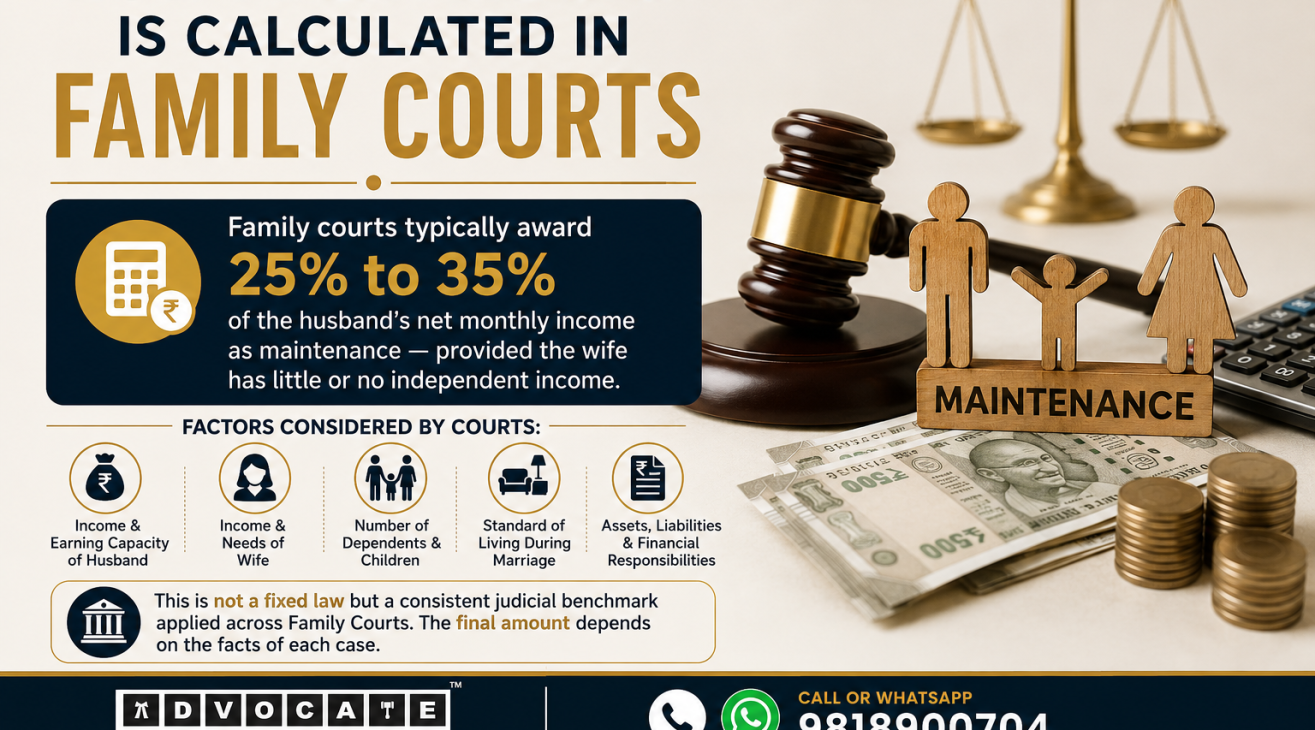
Quick Answer Delhi Family courts do not follow any fixed mathematical formula for maintenance. However, in many cases involving a non-earning or substantially lower-earning wife, maintenance awards often fall within the range of approximately 25% to 35% of the husband’s net monthly income, depending on factors such as the parties’ income, standard of living, financial responsibilities, and the needs of any children. This is a judicial guideline rather than a statutory rule, and the final amount varies according to the facts of each case. Keep reading to understand how courts calculate maintenance in practice. |
Why There Is No Fixed Formula — But One That Works Like One
There is no single statutory formula written into Indian law for calculating maintenance. However, after the Supreme Court’s landmark judgement in Rajnesh v. Neha (2020), Delhi Family Courts follow a structured, consistent approach that works like a formula in practice.
The calculation happens in six steps. Understanding these steps helps you walk into a consultation knowing your realistic range.
The Six Steps Delhi Family Courts Follow
- Determine the husband’s net income. Courts look at salary slips, income tax returns, and bank statements. If the husband has hidden his income, the court imputes income based on his lifestyle — his car, house, children’s school fees, credit card spends, and social media activity.
- Offset the wife’s income. If the wife earns independently, her income is considered — but not deducted rupee for rupee. What matters is the gap between their incomes and whether she can maintain her established standard of living on her own earnings.
- Apply the 25–35% benchmark. Courts apply 25% to 35% of the husband’s net income as a base maintenance figure. The percentage is higher when the husband earns less; at very high income levels the percentage may be lower but the absolute amount is higher.
- Add children’s maintenance separately. School fees, tuition, medical expenses, and extracurricular activities are calculated on top of the wife’s maintenance — not included in the 25–35%.
- Adjust for standard of living. If the family lived in a premium flat, took foreign holidays, or the children study in expensive private schools, courts adjust the amount upward to maintain continuity of that lifestyle.
- Calculate arrears. Final maintenance is payable from the date of filing the application — not from the date the court passes the order. Every month you delay filing is a month of maintenance you permanently lose.
Realistic Maintenance Amounts in Delhi NCR — 2026
The figures below are based on actual court orders from Delhi NCR Family Courts in 2024–2026. Use them as a planning guide, not a guarantee. Every case depends on specific facts and how well the evidence is presented.
When the Wife Is Not Working
- Husband earns ₹20,000–₹35,000/month → Wife typically gets ₹7,000–₹12,000/month. Each child adds ₹3,000–₹5,000/month.
- Husband earns ₹35,000–₹60,000/month → Wife typically gets ₹12,000–₹20,000/month. Each child adds ₹5,000–₹8,000/month.
- Husband earns ₹60,000–₹1,00,000/month → Wife typically gets ₹20,000–₹32,000/month. Each child adds ₹8,000–₹14,000/month.
- Husband earns ₹1,00,000–₹2,00,000/month → Wife typically gets ₹30,000–₹60,000/month. Each child adds ₹12,000–₹25,000/month.
- Husband earns above ₹2,00,000/month → Wife typically gets ₹50,000–₹1,50,000+/month. Children’s maintenance assessed separately based on lifestyle.
When the Wife Is Working
A working wife can absolutely claim maintenance. What matters is the income gap. If your husband earns ₹1,20,000/month and you earn ₹25,000/month, you cannot maintain the established standard of living on your income alone. Courts in Delhi have consistently awarded maintenance in exactly this situation.
The typical award for a working wife is 15–25% of the husband’s income rather than 25–35%, depending on the income gap. The larger the gap, the closer it gets to the non-working wife’s range.
What Pushes Your Amount Higher
Many women settle for less than they deserve because they do not know which factors increase their claim. Here is what consistently results in higher awards in Delhi courts.
Factors That Work in Your Favour
- Long marriage, especially over 10 years. Courts recognise the years you invested in the family.
- You gave up your career to raise children or support your husband’s ambitions. Courts treat this as a major factor justifying higher maintenance.
- Children are in your custody. More children means more needs — school fees, tuition, medical, activities — all added on top of your personal maintenance.
- Husband’s high lifestyle expenditure. If he drives an expensive car, lives in a premium flat, takes foreign vacations — this evidence directly pushes your award up.
- Health conditions. Serious illness, disability, or ongoing medical treatment requiring significant expense.
- No current marketable skills. If you have been a homemaker for years and cannot re-enter the job market quickly, courts factor this in.
Factors That Can Reduce Your Amount
- Good independent income where the gap with your husband’s earnings is small.
- Significant personal assets — owned property, fixed deposits, or inherited wealth.
- Very short marriage with no children, typically under 3 years.
- Remarriage — this ends your maintenance right from your first husband under most Indian laws.
What If Your Husband Hides His Income?
Income concealment is extremely common in maintenance cases. Husbands show a low declared income on paper while living a completely different lifestyle. Delhi courts are fully aware of this pattern and have strong tools to counter it.
Lifestyle Income Reconstruction is the most effective strategy when documentary income proof is unavailable. Your advocate builds a picture of his actual income using his monthly EMIs, rent, car loan repayments, children’s school fees, club memberships, credit card transactions, and social media posts.
| Real Example from Delhi Courts
A husband declared ₹18,000/month as income. His lifestyle included a ₹40,000/month rented flat, a car loan of ₹22,000/month EMI, and children studying in a school with ₹18,000/month fees. The court imputed his income at ₹95,000/month and awarded ₹28,000/month maintenance to the wife. The Supreme Court in Rajnesh v. Neha (2020) made it clear that a husband cannot evade maintenance liability by understating his income or remaining intentionally unemployed. Courts are entitled to assess his true earning capacity and determine maintenance on the basis of realistic financial capability rather than self-serving disclosures. |
|
How Does Your Situation Compare? Real outcomes from Delhi Family Courts — 2026 |
| Wife not working, husband earns ₹50,000/month, 1 child → Typical order: ₹14,000–₹18,000/month wife + ₹7,000–₹10,000/month child |
| Wife earns ₹22,000, husband earns ₹1,00,000, 2 children → Typical order: ₹22,000–₹30,000/month wife + ₹16,000–₹22,000/month children |
| NRI husband in UAE, wife in Delhi, no salary slips → Typical order: ₹35,000–₹60,000/month (court imputes income) |
| Short marriage 2 years, no children, wife not working → Typical order: ₹8,000–₹14,000/month interim |
| Your case is unique. Get a free personalised assessment.
FREE 15-Minute Case Assessment — Advocate Comes to You, Book Doorstep Legal Support WhatsApp: +91-9818900704 advocatejunction.com | Delhi NCR’s Doorstep Legal Service |
Frequently Asked Questions
Is the 25–35% rule a fixed law or just a guideline?
It is a judicial guideline, not a statutory formula. Courts are not bound to apply exactly 25–35%, but this range has emerged consistently from Supreme Court and Delhi High Court decisions. The Rajnesh v. Neha (2020) Supreme Court judgement is the closest India has to a standardised framework.
Can the maintenance amount be increased after the order is passed?
Yes. A maintenance order can be modified at any time if circumstances change — your husband gets a promotion, your medical needs increase, or inflation has eroded the real value of the original order. Delhi courts regularly entertain enhancement applications.
Does maintenance include rent or is it a separate amount?
Maintenance in India is a single monthly amount covering all your needs — food, rent, clothing, medical, transport. However, if you are living in the matrimonial home, you may separately apply for a residence order under the Domestic Violence Act, keeping that home without it being deducted from your maintenance.
What is the difference between maintenance and alimony?
In Indian law, maintenance refers to ongoing monthly support during or after marriage breakdown. Alimony technically refers to a one-time lump sum payment at divorce settlement, though the terms are used interchangeably in common usage. Courts can award either monthly maintenance or a one-time lump sum — most cases result in monthly maintenance as it is more practical and adjustable.
How long will I receive maintenance?
Monthly maintenance continues until you remarry, the court modifies the order on your husband’s application, or you pass away. There is no automatic time limit in Indian maintenance law. Courts review orders only when circumstances change significantly.
Conclusion — Know Your Number Before You Walk In
The biggest mistake women make in maintenance cases is not knowing their realistic expectation before filing. Either they ask for too little out of guilt, or they ask for an unrealistic amount that damages their credibility with the court.
The Delhi court formula gives you a clear framework. Your specific facts — your husband’s actual income, your needs, your children’s requirements, and your established standard of living — determine where within that range your case lands. A well-prepared, evidence-backed case gets significantly more than a poorly presented one with the same underlying facts.
Start with a free 15-minute WhatsApp assessment at AdvocateJunction. Our advocate comes to you.
© 2026 AdvocateJunction. All rights reserved. | advocatejunction.com | Content is for informational purposes only and does not constitute legal advice.
Also Read