
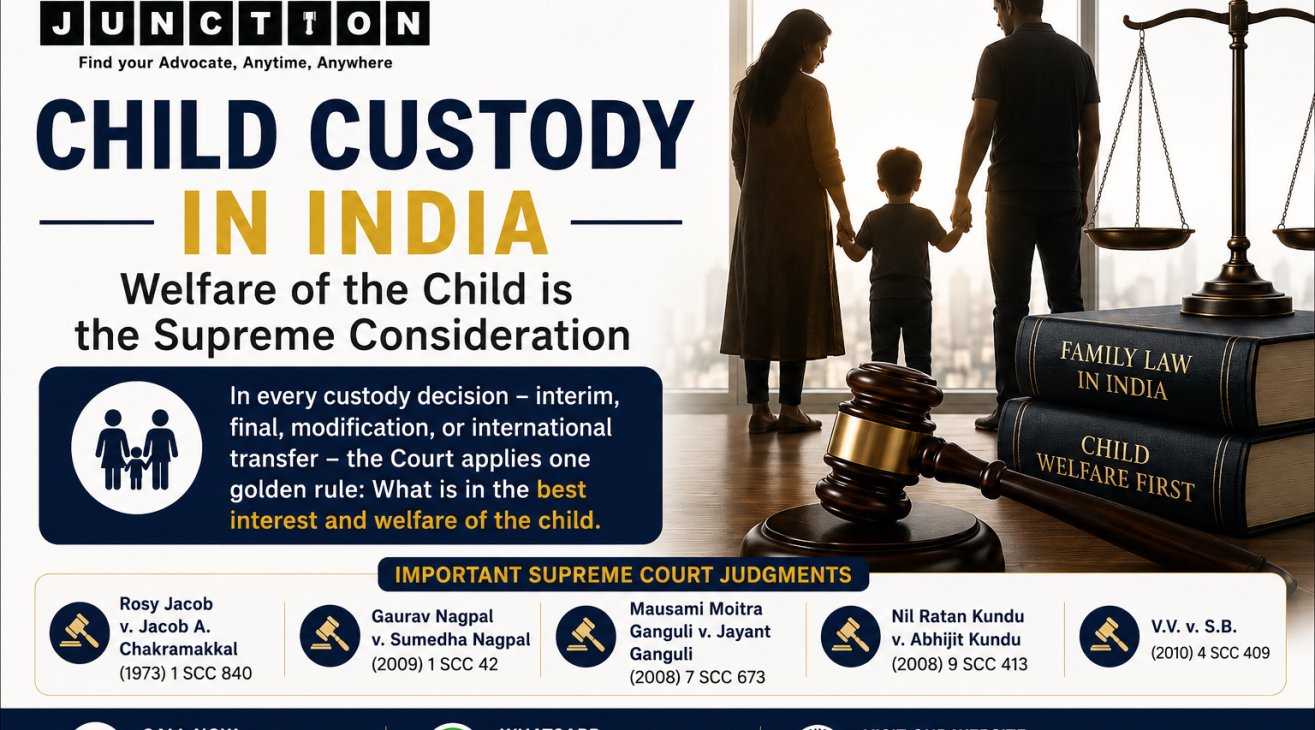
Child Custody Rights in India: A Complete Legal Guide for Parents — 2026
| Child Custody – Who gets it after divorce in India? |
| If you are going through a separation or divorce and are worried about your child’s future — custody, visitation, schooling, and who gets to make decisions — this guide is written specifically for you. |
| We are explaining about Indian child custody law in plain language, covering types of custody, court procedures, how judges decide, rights of mothers and fathers, and what you can do right now to protect your relationship with your child. |
| Every section is based on actual Indian law: the Hindu Minority & Guardianship Act 1956, Guardians & Wards Act 1890, and recent Supreme Court judgements in 2024–2026. |
| 78%
of custody cases in India are filed in District Family Courts |
3–18 months
average time to get a custody order in Delhi NCR |
60%+
of interim custody is granted to mothers for children under 5 |
100%
of decisions are based on ‘welfare of the child’ — not gender |
| SECTION 1 — LEGAL FOUNDATION |
Understanding Child Custody Law in India
Child custody disputes in India are emotionally charged and legally complex. Whether you are a mother, father, grandparent, or relative seeking guardianship — the law provides a clear framework to protect the child’s best interests. However, navigating that framework without proper legal guidance often leads to costly mistakes that can affect outcomes for years.
Unlike common perception, Indian custody law is not inherently biased towards mothers or fathers. The courts are guided by one overarching principle: the welfare of the child is paramount.
1.1 The Legal Framework — Which Laws Apply?
India does not have a single, unified custody law. The applicable law depends on the religion of the parties involved:
| Religion / Community | Primary Law Governing Custody | Key Authority |
| Hindus, Sikhs, Jains, Buddhists | Hindu Minority & Guardianship Act, 1956 | Family Court / District Court |
| Muslims | Guardians and Wards Act, 1890 + Personal Law | Family Court |
| Christians & Parsis | Guardians and Wards Act, 1890 | District Court |
| All religions (general) | Guardians and Wards Act, 1890 | High Court / Supreme Court on appeal |
| NRI / International cases | Private International Law + Hague Convention principles | High Court |
Regardless of religion, the Guardians and Wards Act 1890 serves as the overarching legislation, and courts consistently reference Supreme Court guidelines from landmark judgements.
1.2 The ‘Welfare of the Child’ — The Supreme Consideration in Custody Cases
In India, courts do not decide child custody cases based only on what the mother or father wants. The most important factor is what is best for the child ? Whether the court is deciding temporary custody, permanent custody, visitation rights, or any change in an existing custody arrangement, the child’s safety, happiness, education, health, and overall well-being always come first.
Courts assess welfare across multiple dimensions. These are not just abstract principles — judges ask for actual evidence on each point:
- Physical welfare: housing, nutrition, healthcare access, safety of the environment
- Emotional welfare: attachment to each parent, risk of psychological harm, history of domestic violence
- Educational welfare: continuity of schooling, proximity to school, academic support
- Social welfare: extended family relationships, community, peer group stability
- Moral welfare: values, character, and overall development environment
- Financial welfare: which parent can better provide material stability
- The child’s own wishes: courts give increasing weight to children above 9 years of age
| Common Misconception |
| Many parents believe that ‘mothers always get custody’ in India. This is outdated. |
| While courts do give preference to mothers for children below 5 years (especially for breastfeeding infants), there is no blanket rule. Fathers who can demonstrate superior welfare provisions, a stable environment, and a strong parental bond have successfully won custody — including sole custody — in numerous High Court and Supreme Court decisions. |
| Source: Gaurav Nagpal v. Sumedha Nagpal (2009 SC) — The child’s welfare, not the rights of parents, is the paramount consideration. |
| SECTION 2 — TYPES OF CUSTODY |
Types of Child Custody in India — Explained Simply
Before you approach a lawyer or file a petition, it is critical that you understand what type of custody you are seeking — and what each type actually means for your day-to-day relationship with your child.
2.1 Physical Custody vs. Legal Custody
| Physical Custody | Legal Custody |
| Where the child actually lives and who provides day-to-day care.
✔ School drop-off & pick-up ✔ Daily meals, bedtime routines ✔ Medical appointments ✔ Extracurricular activities |
The right to make major life decisions about the child’s upbringing.
✔ Choice of school and curriculum ✔ Medical treatment decisions ✔ Religious upbringing ✔ Travel abroad, passport |
A court can award different parents different types of custody. For example: a mother may get sole physical custody (child lives with her), while both parents share joint legal custody (both must consent to major decisions). Understanding this distinction is critical when negotiating or fighting a custody case.
2.2 The Four Main Types of Custody Orders in India
Type 1: Sole / Exclusive Custody
One parent gets both physical and legal custody. The other parent typically gets scheduled visitation rights but has limited or no role in decision-making. Courts grant sole custody when the other parent is found to be abusive, addicted, absent, or incapable.
Type 2: Joint Custody
Both parents share custody — either physical, legal, or both. The child may live with each parent on a split schedule (e.g., weekdays with mother, weekends with father), or one parent has primary physical custody while both share decision-making authority. Joint custody is increasingly favoured by Indian courts as it maintains the child’s bond with both parents.
Type 3: Third-Party / Guardian Custody
When neither biological parent is deemed fit to care for the child, courts may award custody to a grandparent, aunt/uncle, or another relative. This is governed by the Guardians and Wards Act, 1890, and is relatively rare but applicable in cases of parental death, severe mental illness, or prolonged absence.
Type 4: Interim / Temporary Custody
A short-term custody arrangement ordered by the court while the main case is pending. In urgent situations — such as one parent attempting to take the child out of India, or domestic violence — courts can issue interim custody orders within days. This is often the most critical phase and where having a lawyer makes the biggest difference.
| Real Scenario — A Delhi NCR Case we handled |
| A mother in Gurgaon contacted AdvocateJunction after her husband took the child to his parents’ home in another city without informing her. Within 48 hours, our advocate filed an urgent interim custody petition. The Family Court issued a production order requiring the child to be brought back within 5 days. |
| This was possible because of quick legal intervention. Delays in such cases can result in the other party establishing ‘habitual residence’ in a different city, complicating your case significantly. |
| SECTION 3 — RIGHTS OF EACH PARENT |
Mother’s Rights vs. Father’s Rights in India
This is the most searched topic among parents going through a custody dispute. Let us be precise and factual about what the law actually says — not what popular belief suggests.
3.1 Mother’s Rights Under Indian Law
Under the Hindu Minority & Guardianship Act, 1956, the mother is the natural guardian of a child below 5 years of age.
Beyond age 5, this automatic preference reduces, and courts weigh welfare factors on a case-by-case basis. However, mothers continue to have strong rights in the following circumstances:
- Breastfeeding infants and toddlers below 5 — courts almost always grant physical custody to the mother unless she is found unfit
- Proven domestic violence by the father — mother gets custody with protective orders
- Father’s extended absence from the child’s life — courts favour the parent with established daily bond
- Mother can demonstrate stable housing, employment, and parental involvement
3.2 Father’s Rights Under Indian Law
Contrary to popular belief, fathers have equal standing before Indian courts when the child is above 5 years of age, and in some cases even for younger children.
Fathers can successfully obtain custody when they can demonstrate:
- Mother’s lifestyle, substance use, or mental health condition poses risk to the child
- Father has been the primary caregiver (stay-at-home fathers, mothers who work extended hours abroad)
- Mother is relocating to another city or country and disrupting the child’s schooling
- Strong parental bond evidenced through school records, medical records, and testimonies
- Stable household with extended family support (grandparents, siblings)
3.3 Rights of the Child — Often Overlooked
Indian law, consistent with the UN Convention on the Rights of the Child (India is a signatory), recognises the child as an independent stakeholder — not just a subject of dispute. Key child rights in custody proceedings include:
- Right to be heard: Courts appoint a child’s counsel or conduct in-camera proceedings for children above 9 years
- Right to maintain relationship with both parents: Courts cannot completely eliminate access of one parent unless there is proven harm
- Right to stability: Courts prioritise the child’s existing routine — school, friends, neighbourhood — and resist disruptive relocation unless warranted
- Right to cultural and religious identity: Particularly relevant in inter-faith marriages and NRI custody cases
| SECTION 4 — THE COURT PROCESS |
How Custody Cases Work in Indian Courts — Step by Step
Understanding the process removes fear. Here is exactly what happens when you file a custody petition in a Delhi NCR Family Court — from day one to the final order.
| 1 | Consultation & Case Assessment (Week 1)
Your advocate evaluates your situation, documents, and urgency. If the child is at immediate risk, an emergency interim application is prepared. For regular cases, a full petition is drafted. At AdvocateJunction, this begins with a 15-minute free WhatsApp assessment. |
| 2 | Filing the Custody Petition (Week 1–2)
The petition is filed at the appropriate Family Court in Delhi NCR. It includes grounds for custody, a welfare report, and supporting documents (school records, medical records, financial documents, affidavits from witnesses). |
| 3 | Notice to the Other Party (Week 2–4)
The court issues notice to the other parent, who has 30 days to file a written reply. During this period, the court may pass an interim custody order if you’ve applied for one. |
| 4 | Mediation (Month 2–4)
Family courts are required to attempt mediation before proceeding to trial. A trained mediator works with both parents. If mediation succeeds, a consent order is passed — faster, cheaper, and more durable. If mediation fails, the case proceeds to trial. |
| 5 | Evidence & Trial (Month 3–12)
Each side presents evidence — documents, witness statements, expert opinions. Courts may order a social welfare report or interview the child privately. Hearings are not continuous; expect gaps between dates. |
| 6 | Final Custody Order (Month 6–18)
The court passes a detailed order specifying physical custody, visitation schedule, decision-making rights, holiday arrangements, and support obligations. Violation of this order is contempt of court. |
4.1 Documents You Must Prepare
Courts evaluate documentary evidence heavily. From day one, start collecting and organising these documents:
| Must-Have Documents | Supportive Evidence |
| ✔ Marriage certificate | ✔ School report cards and attendance records |
| ✔ Child’s birth certificate | ✔ Medical records showing you took child to appointments |
| ✔ Aadhaar cards (yours and child’s) | ✔ Photographs of you with the child (dated) |
| ✔ Proof of residence / house | ✔ WhatsApp chats showing parental communication |
| ✔ Income proof / bank statements | ✔ Character witnesses — teachers, neighbours, relatives |
| ✔ FIR copies (if domestic violence) | ✔ Evidence of the other parent’s misconduct / absence |
| Need Help With Child Custody?
Get a FREE 15-Minute Legal Assessment — Our Advocate Comes to You WhatsApp Now: +91-9818900704 | advocatejunction.com Delhi NCR’s Doorstep Legal Service — Trusted by 500+ Families |
| SECTION 5 — SPECIAL SITUATIONS |
Special Custody Situations in India
5.1 NRI Child Custody Cases
When one parent lives abroad (USA, UK, UAE, Canada, Australia) and the other is in India, custody disputes become significantly more complex. Key issues include:
- Jurisdiction: Indian courts have jurisdiction if the child is in India. If the child is abroad, you may need to file in the foreign country first.
- Hague Convention: India is NOT a signatory to the Hague Convention on International Child Abduction — meaning foreign custody orders are not automatically enforceable in India.
- Mirror Orders: High Courts can issue mirror orders that are enforceable both in India and the foreign country.
- Passport impoundment: Courts routinely seize the child’s passport to prevent international removal during proceedings.
| NRI Parent Alert |
| If your spouse has taken your child to India from abroad (or vice versa) without your consent, this constitutes child abduction under international law. |
| You must act within 12 months to file a Hague Convention application in the foreign country and simultaneously approach the Indian High Court. |
| AdvocateJunction has experience handling NRI custody cases for families in the USA, UAE, Canada, and UK. Book a WhatsApp assessment immediately. |
5.2 Custody After Mutual Divorce
When both parents agree to divorce mutually, custody terms are written into the divorce agreement itself. Courts generally honour mutual agreements, provided they are in the child’s welfare. Key points:
- Custody terms agreed in a mutual consent divorce are treated as a court order — violation is contempt of court
- Either parent can approach the court to modify the agreement if circumstances change significantly (relocation, remarriage, deteriorating conditions)
- Courts are more likely to approve joint custody arrangements in mutual divorces
5.3 Custody When a Parent Remarries
Remarriage of either parent does not automatically affect custody. However, it becomes a relevant factor if:
- The step-parent has a problematic background or the child is being raised in an unhealthy environment
- The biological parent’s new domestic situation is unstable
- The child objects strongly to living with the step-parent
Courts have upheld and also modified custody orders following remarriage — it is purely a welfare assessment, not a moral judgement.
5.4 Custody in Domestic Violence Situations
The Protection of Women from Domestic Violence Act, 2005 (PWDVA) is directly relevant in custody cases where abuse is alleged:
- Protection Orders under PWDVA can prohibit an abusive spouse from approaching the child
- Courts treat domestic violence as a significant negative factor against the abusive parent in custody assessment
- Children who have witnessed domestic violence are considered at psychological risk — courts may order counselling
- A criminal case under Section 498A IPC or PWDVA runs parallel to custody proceedings — both courts consider each other’s findings
| If You Are in a Domestic Violence Situation |
| Your safety and your child’s safety come first. Please contact the National Women Helpline: 181 or the Delhi Commission for Women: 011-23379181. |
| Once you are safe, contact a family law advocate immediately. Evidence of domestic violence significantly strengthens your custody case. |
| AdvocateJunction’s advocate team can assist you confidentially at your location — no need to travel. |
| SECTION 6 — VISITATION & ENFORCEMENT |
Visitation Rights and Enforcing Custody Orders
6.1 Understanding Visitation Rights
The parent who does not have primary physical custody is typically granted visitation rights — structured time to maintain their relationship with the child. Indian courts take visitation seriously and do not use it as a bargaining chip.
A typical Delhi NCR custody order includes:
- Regular visitation: 1–2 weekends per month (Saturday morning to Sunday evening)
- Holiday visitation: Alternate major holidays — Diwali, Christmas, Eid, school summer break split equally
- Birthday visitation: Each parent gets time on the child’s birthday annually
- Video call access: Courts frequently order daily or weekly video calls for the non-custodial parent
- Extended vacation: 3–4 weeks during summer holidays with the non-custodial parent
6.2 What If the Custodial Parent Denies Visitation?
Denial of court-ordered visitation is contempt of court — a serious legal offence. If your ex-partner is refusing your visitation rights:
- Document every denial: Date, time, what happened, messages or calls
- Send a legal notice through your advocate — this often resolves the issue quickly
- File a contempt petition in the Family Court — courts can impose fines or even imprisonment
- File for modification of custody — repeated denial of visitation is grounds to transfer primary custody to the other parent
| Case Reference — Delhi High Court |
| In Nil Ratan Kundu v. Abhijit Kundu (2008 SC), the Supreme Court held that if one parent persistently interferes with the other’s relationship with the child, the court can change custody — even if the interfering parent had been the primary caregiver. |
| This principle is regularly applied in Delhi NCR Family Courts. Interference with parental access is treated as evidence of parenting unsuitability. |
| SECTION 7 — FREQUENTLY ASKED QUESTIONS |
Top 25 Most-Asked Questions on Child Custody in India
These are the exact questions parents call us about every day. Adv. Priya Tomar has answered each one based on current 2026 law and Delhi NCR court practice.
| Q: Can a father get custody of a child below 5 years? |
| A: Yes, though it is more difficult. Courts have a natural inclination towards mothers for very young children (below 5), particularly for breastfeeding infants. However, fathers can and do win custody of children below 5 when they can demonstrate: (a) the mother is unfit due to addiction, mental illness, or neglect, (b) the father has been the primary caregiver, or (c) the mother has abandoned the child. Courts always evaluate on welfare grounds, not gender alone. |
| Q: How long does a custody case take in Delhi? |
| A: In Delhi NCR Family Courts, an interim custody order can be obtained within 2–8 weeks of filing, depending on urgency. Final orders typically take 12–24 months if contested. Mutual consent custody arrangements — where both parents agree — can be formalised within 2–4 months. Expedited processing is possible when there is evidence of harm to the child or international relocation risk. |
| Q: What is the age at which the child’s preference is considered? |
| A: Indian courts begin giving weight to the child’s preferences at around age 9. By age 12, the child’s expressed preference carries significant weight — though the court is not bound by it. For teenagers (15+), the court generally follows the child’s preference unless it is clearly against their welfare. Courts conduct in-camera hearings with the child, separate from both parents, to assess genuine preference without undue influence. |
| Q: Can a mother take the child to another city without the father’s permission? |
| A: Not if there is a custody order in place that does not permit relocation. If you relocate without court permission, you risk contempt of court proceedings and custody transfer. If you need to relocate for legitimate reasons (job, family care), file a relocation application with the court explaining the reasons and how the child’s welfare and the other parent’s access will be maintained. Courts evaluate relocation requests carefully. |
| Q: What happens to custody if I remarry? |
| A: Remarriage alone does not affect your custody rights. Your parental rights and responsibilities continue regardless of remarriage. However, if the new domestic situation negatively impacts the child’s welfare (new partner has criminal background, unstable home, child objects strongly), the other parent can file a modification petition. The court will assess the new situation and decide whether custody modification is warranted. |
| Q: Can grandparents file for custody? |
| A: Yes. Under the Guardians and Wards Act, 1890, any person who has a legitimate interest in the child’s welfare can file for guardianship. Grandparents have successfully obtained guardianship when both biological parents are deceased, have abandoned the child, or are deemed unfit. Courts will still apply the welfare test and consider whether grandparent custody is truly in the child’s best interest. |
| Q: Can I get an emergency custody order? |
| A: Yes. In urgent situations — where there is immediate risk of harm to the child, attempted international abduction, or sudden disappearance of the child — courts can pass emergency interim orders within 24–72 hours of application. This requires showing urgency and risk. AdvocateJunction handles emergency filings on priority. Contact us immediately via WhatsApp if your child is at risk. |
| Q: Does the mother working affect her custody chances? |
| A: No. Indian courts have repeatedly held that a mother’s employment does not disadvantage her in custody proceedings. Working mothers routinely retain custody. Courts focus on who provides primary care, who the child is more bonded with, and the overall welfare environment — not whether the parent works. Stay-at-home fathers are similarly not automatically preferred over working mothers. |
| Q: What if the other parent violates the custody order? |
| A: File a contempt petition in the Family Court immediately. Courts take violations of custody orders very seriously. Remedies include: (a) fines on the violating parent, (b) imprisonment in severe cases, (c) modification of custody in your favour, (d) police assistance in enforcing the order. Do not take matters into your own hands — document the violation and seek legal remedy. |
| Q: How much does a custody case cost in Delhi NCR? |
| A: Costs vary based on complexity and duration. A basic contested custody case in Delhi NCR Family Court can cost between ₹50,000 to ₹2,50,000 in total legal fees over the full case duration. Emergency filings cost more upfront. Mutual consent custody arrangements are significantly cheaper — ₹15,000 to ₹40,000 typically. AdvocateJunction offers transparent fee structures and a free initial 15-minute assessment. Contact us to understand your specific case costs. |
| SECTION 8 — ACTION PLAN FOR PARENTS |
What to Do Right Now — A Parent’s Action Checklist
Whether your custody situation is urgent or you are planning ahead, here is a concrete action checklist you can start today:
| ✅ Immediate Actions (This Week) |
| 1. Document your daily care involvement — note dates and activities in a diary |
| 2. Collect and photocopy all important documents: child’s birth certificate, school records, medical records |
| 3. If domestic violence is involved, file an FIR and approach a shelter or the National Women Helpline (181) immediately |
| 4. Do NOT remove the child from their home or school without legal advice — this can hurt your case |
| 5. Get a legal assessment — AdvocateJunction offers a free 15-minute WhatsApp consultation |
| 📋 Short-Term Actions (Next 30 Days) |
| 6. Consult a family law advocate and assess your custody strategy |
| 7. If mediation is an option, explore it — it is faster, cheaper, and less traumatic for the child |
| 8. Begin building your documentary evidence file with advocate guidance |
| 9. If the other parent has violated your rights, send a legal notice immediately |
| 10. If you are an NRI parent with a child in India (or vice versa), file applications in both jurisdictions without delay |
Conclusion — Protect Your Child’s Future
Child custody is one of the most emotionally and legally complex areas of family law. The decisions made in the first few weeks of a custody dispute — the evidence you gather, the filings you make, the strategy you adopt — can determine the outcome for years to come.
The law in India is clear: the welfare of the child is paramount. Your job as a parent is to demonstrate — through evidence, conduct, and legal strategy — that you are the parent best placed to provide that welfare. The courts will listen. It is important to note that the case is titled Vikram Vir Vohra v. Shalini Bhalla clarifies that that custody and visitation arrangements are never “final” or “rigid” because they must evolve alongside the child’s changing needs and the parents’ life circumstances . AdvocateJunction was built for exactly these situations. We are Delhi NCR’s only doorstep legal service for families — our advocates come to you. No court halls to navigate alone. No intimidating office visits. Just a calm, professional conversation about your child’s future — at your home, at your time.
| Need Help With Child Custody?
Get a FREE 15-Minute Legal Assessment — Our Advocate Comes to You WhatsApp Now: +91-9818900704 | advocatejunction.com Delhi NCR’s Doorstep Legal Service — Representing 500+ Families in Delhi Courts |
Disclaimer: This content is for informational purposes only and does not constitute legal advice.
© 2026 AdvocateJunction. All rights reserved. | advocatejunction.com | For specific legal advice, please consult a qualified advocate. AdvocateJunction facilitates legal consultations in Delhi NCR.
Also Read from AdvocateJunction’s Family Law Series
- Mutual Consent Divorce Guide
- Contested Divorce step by step Guide
- How much doorstep legal service cost in Delhi NCR