
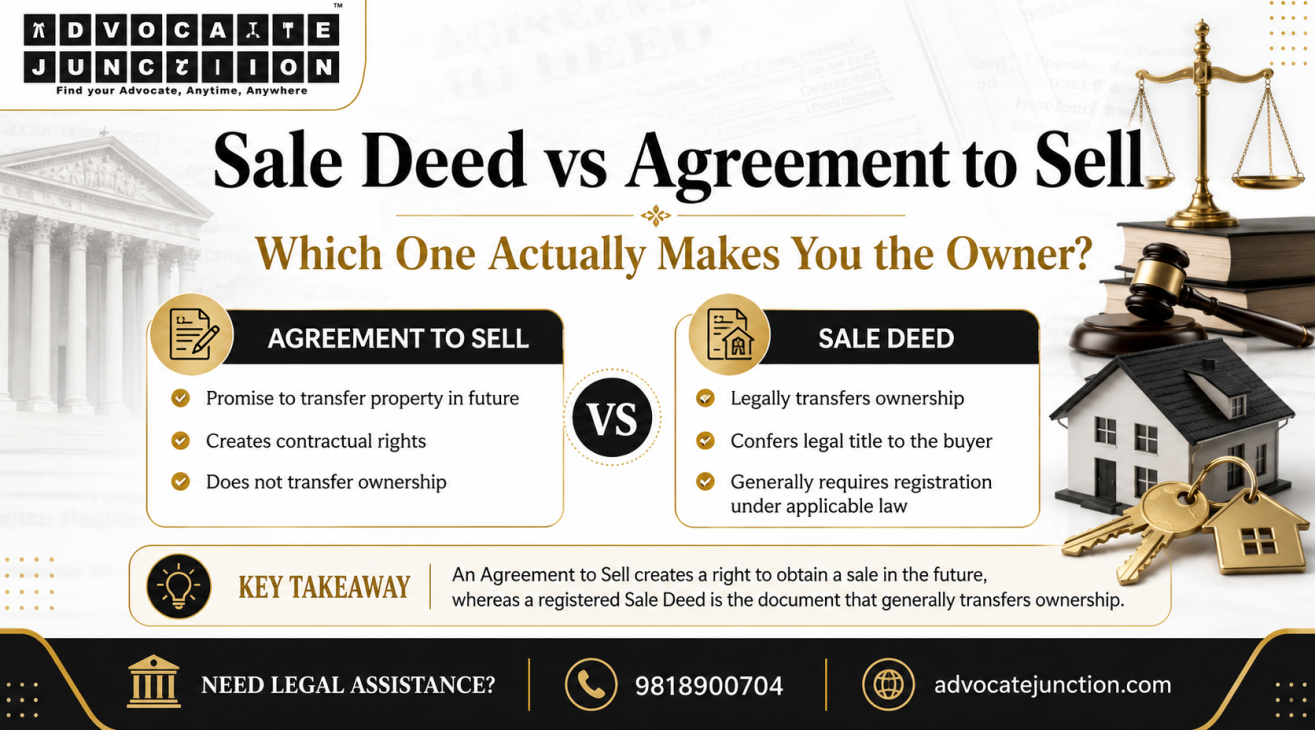
Sale Deed vs Agreement to Sell, Which One Actually Makes You the Owner?
Sale Deed vs Agreement to Sell is one of the most commonly misunderstood topics in property law. Learn the key differences and understand your legal rights before making a property purchase.
A Common Question Among Property Buyers
Let me tell you about a mistake I have seen too many times. A buyer pays most of the price for a flat, signs an agreement to sell, gets the keys, moves in — and genuinely believes they own the property. Years later, when they try to sell it or take a loan against it, they discover the truth: without a registered sale deed, they were never the legal owner at all.The confusion between these two documents is one of the most dangerous gaps in the property market. So let me explain the difference clearly, because it decides whether you actually own what you paid for.
What is an Agreement to Sell?
An agreement to sell is exactly what the name says — an agreement that a sale will happen in the future. It records the terms: the price, the payment schedule, the date by which the sale will be completed, and the conditions both sides must fulfil.
But here is the crucial point — an agreement to sell does not transfer ownership. It is a promise to transfer ownership later. You do not become the owner by signing it. You become a person who has a right to demand that the sale be completed.
What is a Sale Deed?
A sale deed is the document that actually transfers ownership from the seller to you. When a sale deed is executed, stamped with the correct stamp duty, and registered at the Sub-Registrar’s office, ownership of the property legally passes to you.
This is the document that makes you the owner. Not the agreement to sell, not the allotment letter, not the payment receipts — the registered sale deed.
| The one line to remember
An agreement to sell gives you a right to become the owner. A registered sale deed makes you the owner. Never confuse the two, and never treat an agreement to sell as proof of ownership. |
The Key Differences, Side by Side
- Ownership transfer: Agreement to sell — no transfer, only a promise. Sale deed — actual transfer of ownership.
- When ownership passes: Agreement to sell — at a future date on completion. Sale deed — immediately on registration.
- Registration: Agreement to sell — often not compulsory (though advisable). Sale deed — compulsory registration to be valid.
- Risk to buyer: Agreement to sell — seller could refuse to complete, or sell to someone else. Sale deed — you are the owner, protected.
- What it proves: Agreement to sell — proves a deal was agreed. Sale deed — proves you own the property.
Why This Matters — The Suraj Lamp Judgement
The Supreme Court settled this question firmly, and every property buyer should know it.
| Suraj Lamp & Industries v. State of Haryana | 2011 / 2012 | Supreme Court of India
The Supreme Court held clearly that immovable property can be legally transferred only through a registered sale deed. An agreement to sell, a General Power of Attorney, or a will does not transfer ownership or title. The court specifically noted that ‘GPA sales’ and agreement-to-sell arrangements were being misused to avoid stamp duty and deal in unaccounted money — and confirmed they give the buyer no ownership. This is the judgement your advocate relies on to protect you, and the reason you must always insist on a registered sale deed.The Supreme Court explained that a Power of Attorney (GPA) is just a permission slip.Even if the paperwork says the GPA “cannot be cancelled” (irrevocable), it still does not count as a real property sale deed. It does not make the buyer the official owner of the property. in year 2005 Supreme Court has clearly stated about it in State of Rajasthan & Ors. v. Basant Nahata case. |
| Property Document Situations We Handle
Protect your purchase before you pay — Delhi, Noida, Greater Noida, Gurgaon |
| Seller offering to sell on agreement to sell only → Insist on registered sale deed before full payment |
| Paid money but seller delaying the sale deed → Suit for specific performance to force completion |
| Buying resale property, unsure what to sign → Get the documents reviewed before you pay token |
| Someone selling on GPA / power of attorney → Do not proceed — that is not ownership |
| One document review now can save you years of dispute later.
FREE 15-Minute Case Assessment — Advocate Comes to You, Book Doorstep Legal Consultancy 📱 WhatsApp: +91-9818900704 advocatejunction.com | Delhi NCR Doorstep Legal Service |
Frequently Asked Questions
I have only an agreement to sell. Am I the owner?
No. An agreement to sell does not make you the owner. It gives you a legal right to have the sale completed through a registered sale deed. Until that sale deed is executed and registered, ownership remains with the seller. If you have paid substantial money and the seller is delaying, you may need to file a suit for specific performance to compel completion.
Is an agreement to sell useless then?
Not at all — it is an important document. It locks in the terms, protects your right to complete the purchase, and is the basis for forcing the sale if the seller backs out. It is simply not proof of ownership. Think of it as step one, with the registered sale deed as the essential step two.
The seller wants to skip the sale deed to save stamp duty. Is that safe?
No — walk away from that arrangement, or get advice first. Skipping the registered sale deed to save stamp duty leaves you without legal ownership, which is a far bigger loss than the stamp duty saved. The Suraj Lamp judgement makes clear such arrangements give you no title. Always pay the stamp duty and get a proper registered sale deed.
Should a lawyer review my sale deed before I sign?
Strongly yes. A sale deed is the document that makes you the owner, so its contents matter enormously — the property description, the seller’s title, the payment terms, and the clauses protecting you. For a purchase worth lakhs or crores, an independent legal review is a small, wise investment.
Before You Pay, Get the Document Right
A property purchase turns on one document above all others — the registered sale deed. Get that right, and your ownership is secure. Get confused between an agreement to sell and a sale deed, and you could find yourself having paid full price for a property you do not legally own.
At AdvocateJunction, we review property documents and handle sale deeds across Delhi NCR — Delhi, Noida, Greater Noida, Gurgaon, Ghaziabad. We come to you, check the papers before you pay, and make sure the document that matters is done correctly. The first 15 minutes are free.
WhatsApp us at +91-9818900704 before you sign anything.
Related Articles on this topic
How to Register Property in Delhi NCR — Step by Step
NRI property dispute in Delhi NCR , how to protect your Property from abroad
General power of attorney has no legal sanctity: SC
Sale deeds and SC: What apex court has said about property ownership and what it means