WhatsApp Chats as Evidence in Court: Are They Valid in India?
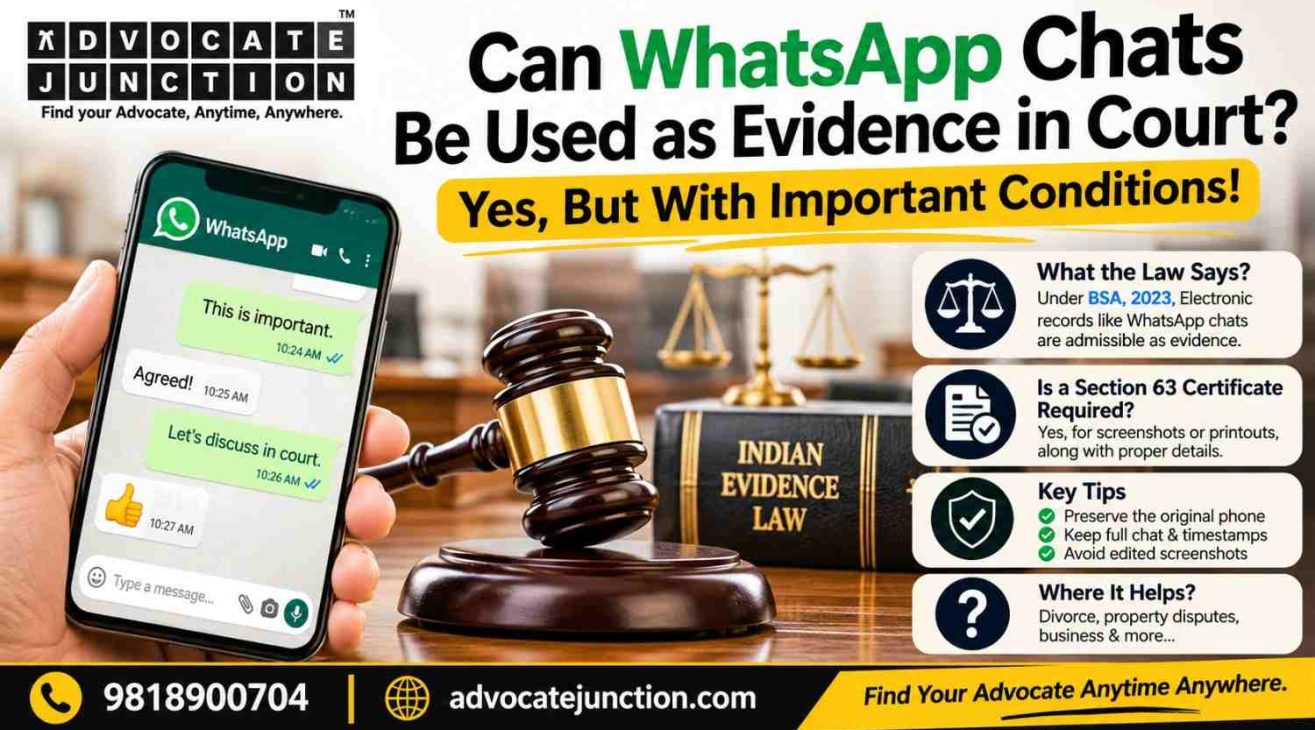
WhatsApp chats as evidence in court are valid in India, but only if they are properly certified and proved. The same rules cover audio recordings and emails.
| Short Answer
Yes. WhatsApp chats, audio recordings and emails are admissible in India as electronic records under Section 63 of the Bharatiya Sakshya Adhiniyam, 2023 (BSA). A screenshot alone is not enough. You need a Section 63(4) certificate that includes the record’s hash value. Admissible does not mean automatically believed, because the court still decides how much weight to give it. |
Key Takeaways
- The BSA came into force on 1 July 2024 and replaced the Indian Evidence Act, 1872. The old “Section 65B” is now Section 63.
- Original phone produced in court = primary evidence. Printouts, screenshots and exports = secondary evidence, which needs to be further probed and cetified.
- Do not delete chats. Preserve the original device and account.
- The Supreme Court upheld the stricter certificate rules in May 2026.
Are WhatsApp chats as evidence in court valid in Indian law?
Yes. Under Section 61 of the BSA, a court cannot reject a record just because it is electronic. Under Section 62, the contents of an electronic record must be proved in the manner Section 63 lays down.
Kya WhatsApp chat court me valid hoti hai? Haan, lekin sahi tareeke se pesh karne par hi.
Is a WhatsApp chat primary or secondary evidence?
Under Section 57 of the BSA, a digital record produced from proper custody can itself be primary evidence.
| What you produce | Type of evidence | Certificate needed? |
| Original phone with the chat | Primary | Generally no, if the owner proves it in court |
| Printout of the chat | Secondary | Yes |
| Screenshot | Secondary | Yes |
| Chat export or pen-drive copy | Secondary | Yes |
Most people file printouts or screenshots, so most people need the certificate.
What is the Section 63(4) certificate?
If you are submitting a printout, screenshot, PDF export or other electronic copy of WhatsApp conversations, you generally need to comply with Section 63(4) of the BSA, including the prescribed certificate.
The certificate deals with:
- Identification of the electronic record.
- How the record was generated or extracted.
- Details of the device involved.
- Compliance with the statutory conditions concerning the electronic record.
- Signatures of the appropriate person in charge and an expert, as prescribed.
The certificate should accompany the electronic record when it is submitted for admission.
The original device and the electronic record stored on it can have a different evidentiary route from a printout or copied record. Therefore, the certificate requirement should not be treated as identical in every situation.
It is a prescribed certificate that must accompany electronic records filed as secondary evidence. The Supreme Court has long treated this as mandatory. In Arjun Panditrao Khotkar v. Kailash Gorantyal, the Court held the certificate to be a mandatory condition for admitting electronic records as secondary evidence.
The BSA format has two parts:
- Part A: filled by the party or person in charge of the device.
- Part B: filled by an expert. The certificate must also disclose the hash value of the record.
What is Hash Value ?
A hash value is a digital fingerprint of a file. If even one message is changed, the fingerprint changes. Hash Value – Is property ko computer science aur cryptography ki bhasha mein “Avalanche Effect” aur “Uniqueness” kaha jata hai. Har digital file ya chat ka ek unique ‘angoothe ka nishaan’ (digital fingerprint) hota hai, jise technical bhasha mein Hash Value kehte hain.
Jaise har insaan ka fingerprint alag hota hai, waise hi har file ka ye code bhi bilkul unique hota hai. Agar kisi file ya chat mein ek comma, space, ya ek akshar bhi badla gaya, toh uska poora fingerprint (hash) turant badal jata hai. Isi se court ya police ko 100% pakka saboot milta hai ki digital evidence ke saath koi chhed-chhad (tampering) nahi hui hai.
What did the Supreme Court decide in 2026?
In Pune Bar Association v. Union of India (22 May 2026), the petitioners argued the requirements were too heavy. The Supreme Court upheld Section 63(4) and its Schedule as neither arbitrary nor unreasonable, pointing to risks from A.I. and deepfake technology.
It also eased one practical problem. The Court disagreed with the Madras High Court’s view that only government-notified examiners can sign Part B, and said persons with real expertise in computer science and cyber forensics can also qualify. But the Court did not give a conclusive opinion and kept the question open. Please confirm the current position with your advocate.
Are audio recordings admissible as evidence?
Yes. An audio recording is an electronic record, so the Section 63 certificate applies. Courts also look at:
- Whether the voice is properly identified
- Whether the recording is complete and untampered
- Whether the conversation is relevant to the dispute
- Whether the original device or memory card is preserved
What about secret recordings between spouses?
Kya bina bataye spouse ki call record karna evidence ban sakta hai? In matrimonial cases, yes. In Vibhor Garg v. Neha (14 July 2025), the Supreme Court held that a secretly recorded phone conversation of a spouse is admissible in matrimonial proceedings. The marital privilege does not bar this in a dispute between the spouses themselves. The BSA equivalent is Section 128.
This ruling is about matrimonial disputes. It does not mean you can record anyone anywhere and use it freely. The certificate and authenticity tests still apply.
Are emails admissible as evidence?
Yes, through the same Section 63 route. Emails are often stronger than screenshots because they carry headers and metadata. To make an email count:
- Keep the original email in its digital form, not only a printout.
- Preserve the full header showing sender, recipient, date and server path.
- Show it came from the sender’s genuine account, for example through a reply acknowledging it.
- File the Section 63(4) certificate with the printout.
Does a valid certificate guarantee the court will believe the evidence?
No. Meeting the certificate requirement does not by itself establish authenticity, integrity or evidentiary weight. The other side can still argue the chat was edited or the number was not theirs.
Timing matters a lot. If an electronic record is admitted without objection, the opposing party may lose the right to challenge it later. Raise objections on time.
How to preserve digital evidence: step-by-step checklist
- Do not delete anything. Keep the original chat, phone and account.
- Back up early. Early collection of evidence and use of forensic experts are recognised best practices.
- Use the export chat feature to capture full conversations with dates and time stamps. Avoid cropped screenshots.
- Note phone numbers and dates of the conversations.
- Never edit, trim or reorder
- Get the Section 63(4) certificate (Parts A and B, with hash value) prepared with your advocate.
- File it with the records at the right stage. Do not assume gaps can be fixed later.
- Keep the original device safe in case the court asks for it.
Frequently Asked Question
1. Is a WhatsApp screenshot enough to win a case?
No. A screenshot is secondary evidence and needs the certificate. Even then, the court decides how much weight to give it based on supporting corroboration.
2. Kya sirf WhatsApp chat ka printout ya photo dikha kar case jeeta ja sakta hai?
Nahi. Court ki nazar mein screenshot ya printout sirf ek secondary evidence hai, jiske saath Section 63(4) BSA ka certificate lagana zaroori hota hai. Certificate lagane ke baad bhi judge ye dekhte hain ki chat ke saath koi chhed-chhad toh nahi hui, isliye original phone aur baaki saboot saath rakhna zaroori hai.
3. Are deleted WhatsApp chats admissible?
They can be admissible only if recovered and certified properly. Deleting chats can badly weaken your case, so preserve the original data and device as early as possible.
4. Agar phone se WhatsApp messages delete ho gaye hon, toh kya unhe court mein saboot banaya ja sakta hai?
Delete ki gayi chats tabhi maanya (admissible) hongi jab unhe kisi certified cyber-forensics expert dwara properly recover aur certify kiya gaya ho. Chats delete karne se aapka case bahut kamzor ho sakta hai, isliye vivad shuru hote hi original device aur data ko safe rakhein.
5. Can I record a call without telling the other person?
In matrimonial disputes, the Supreme Court has allowed such recordings as evidence under specific conditions. In other situations, the position is strictly fact-specific, so take formal legal advice before relying on a covert recording.
6. Kya bina bataye kisi ki phone call record karna court mein valid hai?
Matrimonial disputes (pati-patni ke jhagdon) mein Supreme Court ne aisi secret call recordings ko saboot ke taur par maana hai. Lekin baaki civil ya criminal cases mein har mamle ke facts alag hote hain—isliye kisi secret recording ko court mein pesh karne se pehle apne advocate se zaroor salah lein.
7. Is the certificate needed for emails and audio too?
Yes. All electronic records produced as secondary evidence follow the statutory route under Section 63(4) of the Bharatiya Sakshya Adhiniyam.
8. Kya CCTV footage, email aur call recording ke liye bhi certificate lagana padta hai?
Haan, sabke liye chahiye. Chahe WhatsApp chat ho, email ho, CCTV footage ho ya call recording—agar aap original device ki jagah uski copy, pen drive ya printout court mein de rahe hain, toh Section 63(4) BSA ka certificate lagana compulsory hai.
9. Who can sign Part B of the certificate?
An expert. Following recent judicial interpretations, a qualified computer or cyber-forensics expert can sign it, but since procedural nuances apply, always confirm with your advocate.
10. Kya certificate baad me bhi court mein jama kar sakte hain?
Kuch mamlon mein courts ne iski chhoot di hai, par is par kabhi bharosa na karein. Hamesha shuruat mein hi primary ya secondary records ke sath proper certificate file karein.
11. In which cases can WhatsApp chats be useful?
Divorce and matrimonial disputes: WhatsApp conversations may help establish cruelty, threats, admissions and communications between spouses.
Domestic violence: Messages may provide evidence of harassment, threats and abusive behaviour.
Property disputes: Chats may contain admissions, payment discussions, promises or other communications relating to property transactions.
Business disputes: WhatsApp messages may help establish orders, payment commitments and contractual discussions between parties.
Cheque and payment disputes: Conversations may contain acknowledgments of debt, outstanding payments or financial liability.
Employment disputes: Messages may help establish termination communications, workplace harassment or other employment-related issues.
Criminal cases: WhatsApp chats may contain relevant evidence of threats, extortion, intimidation and other communications connected with an alleged offence.
The evidentiary value of WhatsApp conversations will depend on the facts of the case, their authenticity, relevance and the applicable law.
12. Can the other party deny WhatsApp messages?
Yes. A party can dispute:
- Whether the WhatsApp number belongs to them.
- Whether they actually sent the messages.
- Whether screenshots have been edited.
- Whether messages have been selectively deleted.
- Whether the conversation has been presented out of context.
The court can consider supporting evidence, witness testimony, device examination and forensic analysis to determine authenticity.
Conclusion
WhatsApp chats, audio recordings and emails can be strong evidence, but only if collected carefully, certified correctly and presented on time. Aajkal live-in relationships aur office sexual harassment ke mamlon mein toh WhatsApp messages aur Instagram chats hi sabse bada saboot bante hain. Most electronic evidence fails on procedure, not on facts. If a digital record is central to your dispute, keep it safe in its original form, keep it raw and speak to an advocate before you file anything.
Legal note: This is a general explanation of Indian evidence law, not a determination of admissibility in any particular case
| Need Legal Help with Digital Evidence in Delhi-NCR? Digital records ko court mein keshe pesh karna hai aur Section 63 BSA ka certificate kaise banwana hai, iske liye aap hamare legal experts se seedha salah le sakte hain..
• Online / Telephonic Consultation or Office Visit (Delhi): ₹499 for 30 minutes • Priority Doorstep Consultation – Delhi: ₹1,499 for 45 minutes • Priority Doorstep Consultation – Noida, Gurugram & Ghaziabad: ₹1,999 for 45 minutes Call / WhatsApp: +91 98189 00704 · Website: www.advocatejunction.com Appointments are subject to availability and location confirmation. Additional legal services are charged separately. AdvocateJunction – Find Your Advocate Anytime Anywhere. |