
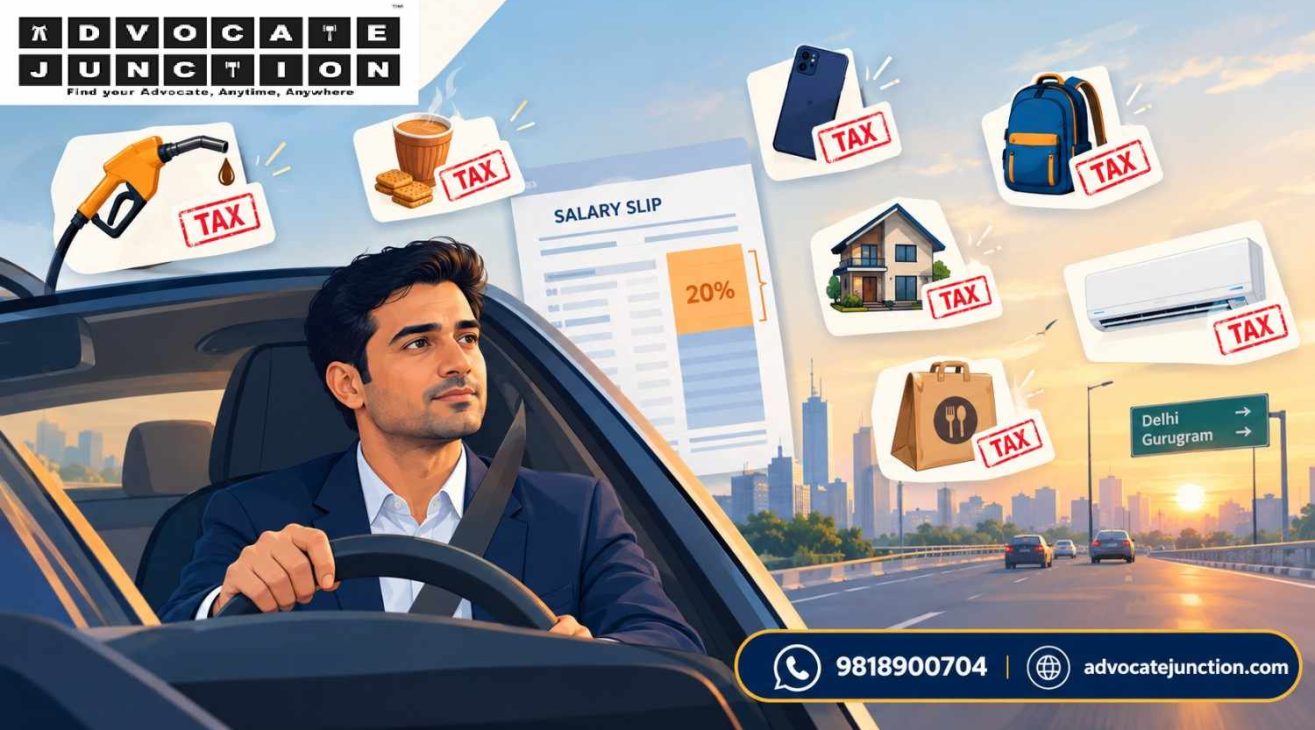
How Much Tax Does a Salaried Person Pay in India? A ₹25 Lakh Delhi–Gurugram Commuter’s Full Breakdown
How much tax does a salaried person pay in India? Other than a professional accountant or CA .most of people will simmply say Income Tax. Income tax is most visible and a direct tax but not the only tax. Every litre of petrol, every packet of biscuits, every mobile recharge and every ecommerce order carries an invisible tax which are hidden tax on all of us. Today in this we will image a situation of average saliried person based at Delhi NCR and try to calculate that how much tax does a person pay per annum including direct and indirect taxes in India.
QUICK ANSWER
A salaried person earning ₹25 lakh a year in Delhi NCR pays roughly ₹4.9–5 lakh in total tax every year — about 20% of CTC, or around ₹1,350 every single day. Roughly ₹3.2 lakh is income tax; the rest is hidden tax inside petrol, groceries, phone bills, the car, the house and everyday spends.
In this guide we take one realistic Delhi NCR professional, follow him from morning tea to late-night AC, and add up every rupee of tax he pays — direct and indirect. All rates used are as of October 2026 (new tax regime under the Income-tax Act, 2025, and GST 2.0 rates in force since 22 September 2025).
Meet Rahul: the profile we are calculating for
Rahul is a composite, not a real person. Change any assumption and the totals move — but the structure of the calculation stays the same. We had imagined this profile as a generic family man and more or less it remains the same and maximum readers may easily relate with this profile .
- Gross salary (CTC): ₹25,00,000 per year
- Lives / works: Lives in Delhi, works in Gurugram — drives daily
- Family: Spouse + 2 school-going children
- Car: Petrol compact SUV (under 4 m, ≤1200 cc), ex-showroom ₹11 lakh, registered in Delhi
- Home: ₹80 lakh flat in Delhi, home-loan EMI ₹30,000/month
- Commute: ~70 km/day round trip + weekend driving ≈ 1,850 km/month at 14 km/l ≈ 130 litres
- Tax regime: New regime (default) — we also compare the old regime below
Direct tax — income tax on a ₹25 lakh salary
Under the new regime, a salaried employee first gets a flat standard deduction of ₹75,000. Rahul’s taxable income becomes ₹24,25,000. Budget 2026 kept the slabs unchanged for FY 2026-27, so tax works out as follows:
- Up to ₹4,00,000 (0%): ₹0
- ₹4,00,001 – ₹8,00,000 (5%): ₹20,000
- ₹8,00,001 – ₹12,00,000 (10%): ₹40,000
- ₹12,00,001 – ₹16,00,000 (15%): ₹60,000
- ₹16,00,001 – ₹20,00,000 (20%): ₹80,000
- ₹20,00,001 – ₹24,00,000 (25%): ₹1,00,000
- Above ₹24,00,000 (30% on ₹25,000): ₹7,500
- Health & Education Cess @ 4%: ₹12,300
Total Income Tax: ₹3,19,800 per year (≈ ₹26,650/month)
Does the home loan change this?
Under the new regime, interest on a self-occupied home loan is not deductible. Under the old regime it is (up to ₹2 lakh), along with 80C, 80D and NPS. We ran Rahul’s numbers both ways:
- New Regime (default): Standard deduction of ₹75,000 → ₹3.20 lakh tax (incl. cess)
- Old Regime: Standard deduction ₹50k + 80C ₹1.5L + home-loan interest ₹2L + 80D ₹25k + NPS ₹50k → ₹4.37 lakh tax (incl. cess)
Takeaway: Even with a home loan, the new regime saves Rahul over ₹1 lakh a year. The home loan only tilts things towards the old regime at much larger interest amounts or with big HRA claims — always run both calculations before your employer’s declaration deadline.
Note: Neither Delhi nor Haryana levies professional tax, so there is no state-level salary tax on top.
Hidden Tax: Indirect Tax in Rahul’s life — tax at every step
This is the part most people never see. GST, excise and VAT are built into the price, so the bill shows one number while the government takes its share silently.
- 6:30 am — Tea with milk and biscuits: Fresh milk carries 0% GST. Biscuits carry 5% GST (down from 18% under GST 2.0).
- 7:00 am — Toothpaste, soap, shampoo: 5% GST on most personal-care items.
- 7:30 am — Kids leave for school: School tuition fees are GST-exempt.
- 8:15 am — Fills petrol on the way to Gurugram: ₹28.49 of every ₹102.12/L is central excise (₹11.90) + Delhi VAT (₹16.59 / 19.4%).
- 10:00 am — Phone calls, 5G data, office Wi-Fi at home: 18% GST on mobile and broadband bills.
- 1:30 pm — Orders lunch on a food app: 5% GST on restaurant food; 18% GST on delivery/platform fees.
- 6:30 pm — Picks up groceries: Packaged foods, ghee, butter, namkeen are mostly 5%; loose vegetables are 0%.
- 8:00 pm — Child’s fever (doctor visit + medicines): Doctor consultation is exempt. Most medicines carry 5% GST.
- 9:30 pm — Netflix on the TV: 18% GST on OTT subscriptions; TV itself was bought at 18% GST.
- 11:00 pm — AC runs all night: AC was bought at 18% GST; electricity bill carries 5% Delhi electricity tax on base energy charges.
Layer 3: Rahul’s monthly indirect tax bill
Here is what a realistic month of household spending looks like, and how much of it is tax inside tax-inclusive spends:
- Petrol (~130 litres @ ₹102.12): Monthly spend of ₹13,300 → ₹3,700 tax
- Packaged groceries & FMCG: Monthly spend of ₹15,000 → ₹700 tax
- Fresh vegetables, fruits, milk, atta: Monthly spend of ₹7,000 → ₹0 tax
- Home appliances & electronics (spread over the year): Monthly spend of ₹3,000 → ₹460 tax
- Property tax (MCD, monthly equivalent): ₹500 tax
- Travel / annual holiday (monthly share): Monthly spend of ₹8,300 → ₹420 tax
- Car insurance renewal + servicing (monthly share): Monthly spend of ₹2,700 → ₹400 tax
- Mobile, broadband, OTT: Monthly spend of ₹2,500 → ₹380 tax
- Eating out & food delivery: Monthly spend of ₹6,000 → ₹350 tax
- Clothing & footwear: Monthly spend of ₹4,000 → ₹350 tax
- Movies & outings: Monthly spend of ₹2,000 → ₹305 tax
- Electricity (5% MCD tax on base energy charges): Monthly spend of ₹4,000 → ₹190 tax
- School extras (uniforms, bags, stationery): Monthly spend of ₹1,500 → ₹100 tax
- Medicines (consultations & individual health insurance are tax-free): Monthly spend of ₹2,000 → ₹95 tax
- LPG cylinder: Monthly spend of ₹950 → ₹45 tax
- Bank & card charges: Monthly spend of ₹170 → ₹30 tax
Total Indirect Tax: ≈ ₹8,020/month ≈ ₹96,200/year
Notice the pattern: petrol alone accounts for a substantial share of Rahul’s monthly indirect tax. Because fuel is outside GST, central excise duty (₹11.90/L) and state VAT (19.4%) create a total tax levy of ₹28.49 per litre on the ₹102.12 pump price. For a daily Delhi–Gurugram commuter, the fuel tank is effectively a second tax deduction.
Layer 4: The big one-time taxes — car and home
These are paid once but are large enough that they belong in any honest calculation. We spread them over the years of use.
- Car GST (18% on compact petrol car): ₹1,67,800
- Car Delhi Road Tax (10% of ex-showroom for petrol above ₹10 lakh): ₹1,10,000
- Car Subtotal: ₹2,78,000 → Spread per year: ≈ ₹40,000 (over 7 years)
- Home Stamp Duty in Delhi (6% for a male buyer on ₹80 lakh – 3% Stamp Duty + 3% MCD Duty): ₹4,80,000 → Spread per year: ≈ ₹24,000 (over 20 years)
Total One-Time Taxes (Annualised): ≈ ₹64,000/year
Note: In Delhi, male buyers pay 6% total (3% stamp duty + 3% MCD transfer duty), female buyers pay 4% total (2% stamp duty + 2% MCD duty), and joint male-female buyers pay 5% total (2.5% + 2.5%), alongside a standard 1% registration fee.
Had Rahul bought a bigger SUV (above 4 metres or above the engine limits), GST would have been 40% instead of 18% — on the same ₹11 lakh price tag, roughly ₹3.1 lakh of GST instead of ₹1.7 lakh.
The grand total: how much tax does a salaried person pay in India?
- Income Tax + Cess: ₹3,19,800 per year (12.8% of CTC)
- Daily Indirect Taxes (GST, fuel excise & VAT, electricity, property tax): ≈ ₹96,200 per year (3.8% of CTC)
- Car & Home One-Time Taxes (annualised): ≈ ₹64,000 per year (2.6% of CTC)
Total Tax Paid: ≈ ₹4,80,000 per year (≈ 19.2% of CTC)
In plain words: out of every ₹5 Rahul earns, nearly ₹1 goes back to the government. That is roughly ₹40,000 a month or ₹1,315 a day — before he has saved a rupee.
What this number leaves out: Tax on investment returns (FD interest is taxed at slab rate; equity gains above ₹1.25 lakh at 12.5% long-term), alcohol (very high state excise), gold jewellery (3% GST), and tolls/parking, which are user charges rather than taxes. Add these and the real figure for many families easily crosses 20%.
What is tax-free in Rahul’s life
Not everything is taxed. After GST 2.0, several family essentials carry zero GST:
- School tuition fees — exempt from GST.
- Doctor consultations and diagnostic services — healthcare services are exempt.
- Individual and family-floater health insurance — GST-free since 22 September 2025 (group/employer policies still attract 18%).
- Individual term and life insurance — also GST-free since the same date.
- Fresh milk, vegetables, fruits, roti/chapati and packaged paneer — nil GST.
- The home-loan EMI itself — no tax on repayment (only the processing fee carries 18% GST).
5 legal ways to reduce this burden
- Compare both regimes every year. Default is not always optimal — run the numbers before the employer’s investment-declaration window.
- Ask HR for employer NPS contribution. Employer contribution to NPS is deductible even in the new regime, within prescribed limits.
- Consider an EV for the next car. EVs carry 5% GST, and the Delhi EV Policy 2026 waives road tax and registration fees for electric cars up to ₹30 lakh ex-showroom (till March 2030).
- Plan property ownership smartly. Delhi charges lower stamp duty when a woman is the buyer (4%) or co-owner (5%) compared to a male buyer (6%) — this can save lakhs on a single purchase. Get the title and registration reviewed by an advocate first.
- Buy individual health insurance. It is now GST-free and the premium is deductible under the old regime.
Where tax meets the law
Most of a salaried family’s biggest tax events are also legal events: buying or registering property (stamp duty, registration, title checks), drafting a rent or sale agreement, receiving an income tax notice, inheriting a house, or writing a will so the family is not stuck in succession disputes. Getting these right the first time is usually cheaper than fixing them later in court.
Frequently asked questions
Q1. How much income tax is payable on a ₹25 lakh salary in FY 2026-27?
Under the new regime, after the ₹75,000 standard deduction, income tax including 4% cess is about ₹3,19,800 a year, or roughly ₹26,650 a month.
Q2. How much total tax does a salaried person pay including GST and petrol?
For a ₹25 LPA earner in Delhi NCR who drives to work and has a home loan, the total of income tax, indirect taxes and annualised one-time taxes comes to roughly ₹4.8–5 lakh a year — about 19.2% to 20% of CTC.
Q3. How much of the petrol price in Delhi is tax?
At ₹102.12 per litre, Central Excise Duty is ₹11.90 per litre and Delhi VAT is 19.4% (approx. ₹16.59 per litre). Combined tax accounts for ₹28.49 per litre (about 27.9% of the retail price).
Q4. Is GST charged on school fees and doctor fees?
No. School tuition fees and healthcare services such as doctor consultations are exempt. Individual health insurance has also been GST-free since 22 September 2025.
Q5. Is the new tax regime better if I have a home loan?
Often yes at ₹25 lakh salary, as the example shows — but it depends on your interest amount, HRA and other deductions. Calculate both before choosing.
Q6. How much stamp duty can be saved by registering property in a woman’s name in Delhi?
In Delhi, buying a property solely in a woman’s name attracts a total stamp duty of 4% (2% Stamp Duty + 2% MCD Transfer Duty) compared to 6% for a male buyer. On an ₹80 lakh property, registering in a woman’s name saves ₹1.6 lakh upfront in stamp duty.
Q7. Is employer NPS contribution tax-exempt under the New Tax Regime?
Yes. Under Section 80CCD(2), employer contributions to your National Pension System (NPS) account up to 14% of basic salary + DA are deductible even under the New Tax Regime. This allows salaried employees to reduce taxable income further without switching back to the Old Regime.
Q8. Does switching to an Electric Vehicle (EV) reduce indirect tax in Delhi NCR?
Significantly. EVs carry only 5% GST compared to 18% to 28%+ for internal combustion engine (ICE) cars. Additionally, under the Delhi EV Policy, road tax and registration fees are waived for eligible electric cars, saving around ₹1 lakh to ₹2 lakh in one-time taxes alongside fuel savings.
Q9. Is there any Professional Tax applicable to salaried employees in Delhi or Gurugram?
No. Neither the Delhi Government nor the Haryana Government levies Professional Tax on salaried employees, unlike states like Maharashtra, Karnataka, or West Bengal.
Disclaimer: This blog is for general information only and does not constitute legal or tax advice. Figures are illustrative estimates based on rates as of October 2026 and the stated assumptions; your actual tax will differ. Consult a qualified professional for your specific situation.
AdvocateJunction services are available only in Delhi NCR (Delhi, Noida, Gurugram and Ghaziabad).