
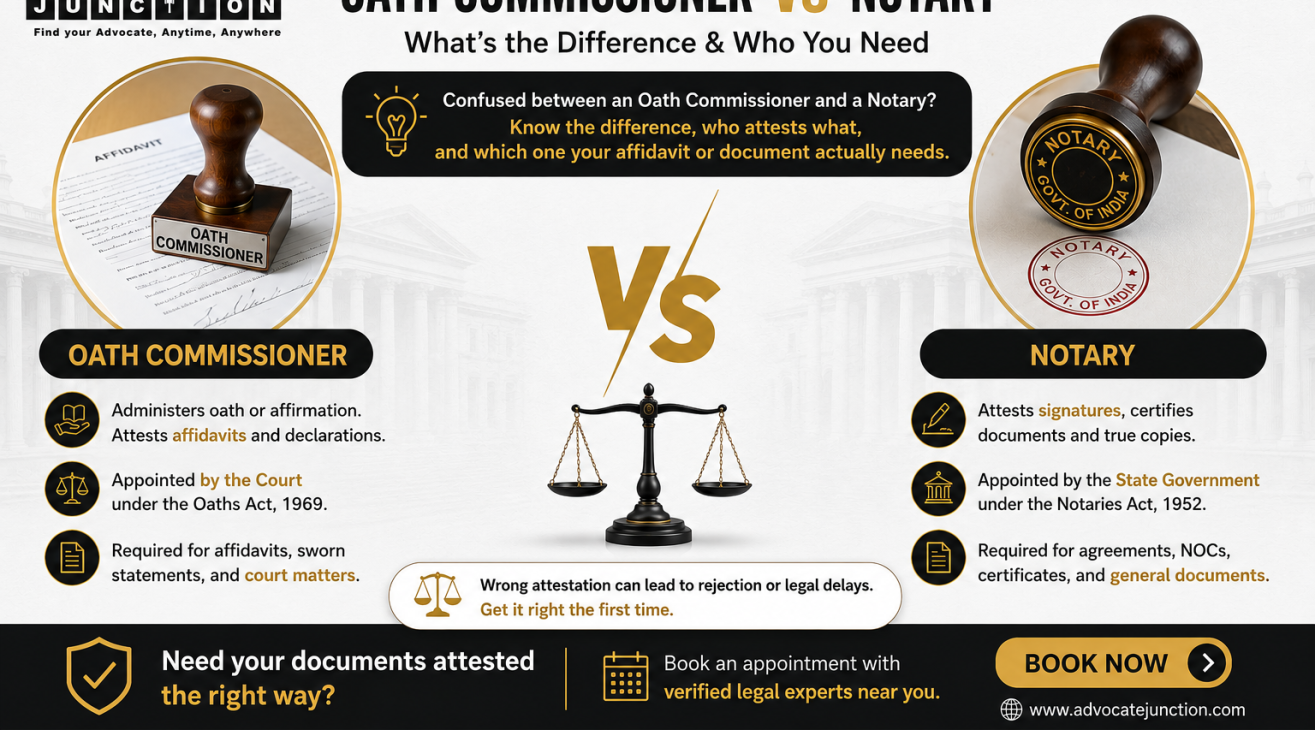
Oath Commissioner vs Notary: What’s the Difference and Who Do You Actually Need?
Confused about Oath Commissioner vs Notary? Learn the key differences, who attests what, and which one your affidavit or legal document actually needs.
The Confusion That Gets Documents Rejected
Someone hands you a form. It says the affidavit must be attested. You go to a lawyer’s stamp shop near the court, get a stamp, submit it — and it comes back rejected, because it needed a notary and you got an oath commissioner, or the other way round. A wasted trip, a wasted day, sometimes a missed deadline.
This confusion is everywhere, and it is understandable, because the two roles overlap. Both deal with affidavits. Both put a stamp on your document. Both are lawyers. But they are not the same, and knowing the difference saves you the rejection. Let me lay it out plainly.
What an Oath Commissioner Does
An oath commissioner — also called a commissioner of oaths — is usually a fresh advocate, appointed by the Registrar of the High Court under whose jurisdiction they work. Their job is narrow and specific: they administer oaths and attest affidavits that are meant for court and judicial proceedings.
So when you swear an affidavit that will go before a court, a tribunal, or a judicial or quasi-judicial forum, an oath commissioner is who attests it. They confirm that you, the deponent, swore the contents in their presence. That is their core function — sworn affidavits for legal proceedings, within their assigned court and jurisdiction.
- Appointed by: the Registrar of the High Court.
- Main job: attesting affidavits and administering oaths for court and judicial use.
- Works within: a specific court complex and jurisdiction, usually fixed hours.
- Cannot: authenticate or certify documents for general public use or for international purposes.
What a Notary Does
A notary — a notary public — has broader powers. A notary is appointed by the Central or State Government under the Notaries Act, 1952, and is typically a lawyer with substantial experience (generally at least ten years at the Bar). Their authority reaches well beyond court affidavits.
A notary can attest a wide range of documents used in everyday life — property papers, powers of attorney, agreements, contracts, declarations, and affidavits. A notary can also certify a copy of a document as a true copy, verify and attest signatures, and their attestation carries wider legal recognition. Importantly, notarised documents are the ones generally accepted for international use, visa and immigration paperwork, and abroad matters, often as a step before apostille or embassy attestation.
- Appointed by: the Central or State Government under the Notaries Act, 1952.
- Main job: authenticating, certifying and attesting a wide range of documents.
- Can do: affidavits, powers of attorney, agreements, true copies, signature attestation.
- Wider recognition: notarised documents are accepted broadly, including for international and official use.
| The one-line difference to remember
An oath commissioner mainly attests affidavits for court cases. A notary attests a much wider range of documents and their attestation is recognised more broadly, including for property, business, and international use. If your document is a court affidavit, an oath commissioner is usually fine. For almost everything else — property, POA, agreements, anything going abroad — you need a notary. |
So Which One Do You Actually Need?
Forget the theory for a moment. Here is the practical rule that keeps your documents from being rejected: read what the form or authority actually asks for, and match it exactly. Do not choose based on whichever stamp shop is closest.
- Affidavit for a court case → oath commissioner is generally sufficient.
- Affidavit for name change, DOB correction, lost documents, general official use → notary (widely accepted; some authorities specify).
- Power of Attorney →
- Rent agreement, business contract, agreement →
- True copy of a document →
- Anything for visa, immigration, or use abroad → notary (often followed by apostille or embassy attestation).
- The form literally says ‘notarised’ → notary, always.
When in doubt, a notary is the safer choice for anything that is not specifically a court affidavit, because notarised documents enjoy the wider acceptance. But if the form specifies one or the other, follow it precisely — that instruction is what the receiving authority will check.
| Notary & Attestation Help We Provide
Affidavits, notarisation and attestation across Delhi NCR — 2026 |
| Not sure whether you need a notary or oath commissioner → We tell you exactly what your document needs |
| Affidavit for a court matter → Correctly attested and court-ready |
| Document for visa, abroad, or property → Proper notarization, no rejection |
Frequently Asked Questions
Is a notary more powerful than an oath commissioner?
In terms of scope, yes. A notary has broader authority — they can attest and certify a wide range of documents, certify true copies, attest signatures, and their attestation is recognised more widely, including for international use. An oath commissioner’s role is narrower, focused mainly on attesting affidavits for court and judicial proceedings. Both are important, but the notary’s powers are wider.
Can an oath commissioner attest my property documents or power of attorney?
Generally no — that falls outside an oath commissioner’s role. Oath commissioners mainly attest affidavits for court use. For property documents, powers of attorney, agreements, and similar documents, you need a notary, whose attestation is recognised for these purposes. Using an oath commissioner for such documents risks rejection.
My document is going abroad. Notary or oath commissioner?
Notary. Documents for international use — visa, immigration, abroad matters — need notarisation, and often a further step of apostille or embassy attestation after that. An oath commissioner’s attestation is meant for domestic court use and is not the route for international documents. Always use a notary for anything going abroad.
The form just says ‘attested’. Which do I use?
It depends on what the document is and who is asking. If it is a court affidavit, an oath commissioner is usually fine. For most other documents and general official use, a notary is the safer choice because of wider acceptance. When the form or authority specifies one, follow that exactly. If you are unsure, it is worth a quick check rather than risking rejection — we can tell you which one your specific document needs.
Are notary and oath commissioner services expensive?
No, both are quite affordable for standard attestation — these are routine services with modest, regulated-style charges. The real cost of getting it wrong is not money but time: a rejected document means another trip and a delay. So the value is in getting it attested correctly the first time, by the right authority.
Get It Right the First Time
The whole problem here is a small one that causes big frustration — the wrong stamp on the right document. Oath commissioner for court affidavits; notary for the wider world of property, POA, agreements, and anything international. Match what the form asks, and your paperwork sails through.
At AdvocateJunction, we handle notarisation, affidavits, and attestation across Delhi NCR — and we tell you up front exactly which authority your document needs, so nothing gets rejected. We can draft the affidavit, get it correctly attested, and guide you on any further steps for documents going abroad. Because we come to you, you need not queue at a court complex. The first 15 minutes are free.
WhatsApp us at +91-9818900704.
Related Articles on AdvocateJunction
- Power of Attorney in India — Complete Guide
- How much Doorstep legal service cost in DelhiNCR
- NRI Property Dispute — Protect From Abroad