
Live-in Relationship vs Marriage: What’s the Legal Difference in India?
Live-in relationship vs marriage is not simply a question of personal choice or morality — it is about the legal rights, security, and obligations that come with each..You live together for few years. You share rent, expenses, family responsibilities and even a bank account. Then the relationship ends. What rights do you actually have?”
Many couples today choose between living together and marrying, and often the decision is made on emotion or convenience without understanding what changes legally. Here is a clear, practical comparison of how the two differ in the eyes of Indian law.
Is a live-in relationship the same as marriage?
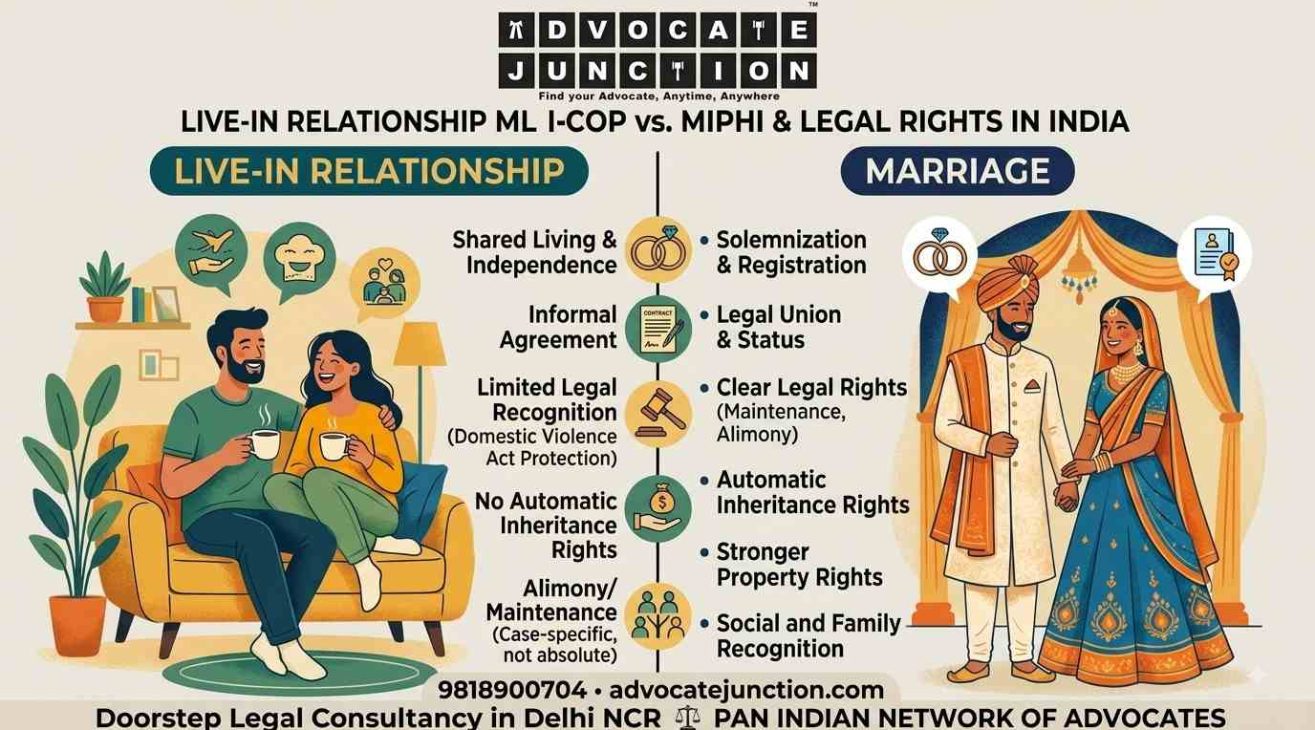
No. A live-in relationship and a marriage are legally distinct. Marriage is a formal legal status created by a ceremony or registration, and it automatically brings a defined set of rights and obligations. A live-in relationship is consensual cohabitation without that formal status; it is legal, but it does not automatically carry the full package of marital rights. Some protections extend to marriage-like live-in relationships — and recent Supreme Court rulings in 2026 have even extended certain protections against cruelty to such relationships — but they are still not identical to marriage.
What rights does marriage give that a live-in does not automatically?
- Automatic spousal status: a spouse has a defined legal position from day one; a live-in partner must often establish that the relationship was ‘in the nature of marriage’.
- Inheritance: a spouse has automatic inheritance rights in the other’s property; a live-in partner generally does not, and usually needs a will.
- Maintenance certainty: a wife’s right to maintenance is well-established; a live-in partner cannot generally use Section 125 CrPC and must rely on the domestic violence law, which depends on the relationship qualifying as marriage-like.
- Clear marital remedies: divorce, restitution, and other matrimonial remedies apply to marriage; a live-in relationship has no ‘divorce’ — it simply ends.
What protections does a live-in relationship still have?
A genuine, marriage-like live-in relationship is not without protection. A woman in such a relationship can seek protection under the Protection of Women from Domestic Violence Act, 2005 — including protection orders, residence rights, and monetary relief. She may, through that law, obtain maintenance-like support. Recent Supreme Court reasoning in 2026 has extended even the protection against cruelty (Section 498A / Section 85 BNS) to genuine marriage-like live-in relationships. And children born from the relationship are treated as legitimate, entitled to maintenance from the father, with custody decided on their best interest. So while a live-in gives less than marriage, it is far from giving nothing.
What is the difference for children?
Here the difference is smallest, because the law protects children regardless of their parents’ marital status. Children born within marriage are legitimate; children born from a long-term live-in relationship are also treated as legitimate for legal purposes, with the same right to maintenance from the father and to have custody decided on their welfare. In short, a child’s core rights do not depend on whether the parents married.
What about inheritance — the biggest practical gap?
This is the sharpest difference. A spouse automatically inherits from the other under succession law. A live-in partner generally does not inherit automatically the way a spouse does. So if partners in a live-in relationship want to provide for each other, they usually need to do so deliberately — most commonly through a will. This single gap is one of the strongest practical reasons couples in long-term live-in relationships take legal advice, even if they do not wish to marry.
Does a live-in relationship ever become a marriage?
Not automatically, but the law can presume a marriage. Where a couple has lived together for a long period as husband and wife, courts raise a strong presumption in favour of marriage, placing a heavy burden on anyone who denies it. This does not convert a live-in into a registered marriage, but it can give a long-term relationship marriage-like legal consequences — which is why a partner cannot always simply walk away claiming ‘we were never married’.
Which is better — live-in relationship or marriage?
There is no single answer for every couple. The better choice depends on how much legal security, freedom, and commitment you want.
If you want clear legal status, automatic spousal rights, stronger inheritance protection, and well-defined matrimonial remedies, marriage generally provides greater legal certainty.
If you prefer living together without the formal commitment of marriage, a live-in relationship gives you that freedom. But it is important to understand that some legal protections are conditional, and a live-in partner does not automatically receive all the rights of a spouse.
A simple way to look at it:
- Want maximum legal certainty? → Marriage generally offers more protection.
- Want fewer formal commitments? → A live-in relationship may suit you.
- In a long-term live-in relationship? → Consider practical safeguards such as a will and clear financial arrangements.
- Facing a dispute after separation? → Your rights may depend on the nature and duration of the relationship and the circumstances of your case.
So, the question is not really “Which is better?” It is “Which arrangement fits your life, and do you understand the legal consequences of choosing it?”
| Find Your Advocate, Anytime, Anywhere
AdvocateJunction — connect with verified advocates across Delhi NCR |
| Deciding between live-in and marriage → Understand the legal trade-offs with an advocate |
| In a long-term live-in andant to protect each other → Advice on wills and arrangements |
| Unsure of your rights in a live-in relationship → Get a clear assessment |
| Facing a dispute after a live-in ended → Connect with a family law advocate |
| The right advocate for your case is one message away. Book your slot on WhatsApp — online ₹499 or doorstep ₹999.
📱 WhatsApp: +91-9818900704 advocatejunction.com | Find Your Advocate, Anytime, Anywhere |
What You Should Know
Marriage automatically brings spousal status, inheritance, and clear maintenance rights. A live-in relationship is legal and carries real protection — domestic violence remedies, maintenance through the DV law, recent extension of cruelty protection, and full protection of children’s rights — but not automatic inheritance or full spousal status. The biggest practical gap is inheritance, which a will can address. Choose based on the security and freedom you actually want, with clear knowledge of the trade-off.
FAQs on Live-In Relationship vs Marriage in India
1. Is a live-in relationship legal in India?
Yes. A consensual live-in relationship between two adults is not illegal in India. Adults have the freedom to choose their partner and live together without getting married. However, a live-in relationship does not automatically give both partners all the legal rights and status that come with marriage.
2. Is a live-in relationship considered marriage in India?
No. A live-in relationship and marriage are legally different. However, where a couple has lived together for a long period as husband and wife, courts may draw a presumption in favour of marriage depending on the facts and evidence. A live-in relationship does not automatically become a registered marriage simply because the couple has lived together for many years.
3. Can a live-in partner claim maintenance under Section 125 CrPC?
Section 125 CrPC has been replaced by Section 144 of the BNSS from July 1, 2024. The important point is that maintenance under this provision is not automatically available to every live-in partner in the same way it is available to a legally recognized wife. Courts have considered the nature of the relationship and whether the parties can legally be treated as having a spousal relationship.
A woman in a marriage-like live-in relationship may also have remedies under the Protection of Women from Domestic Violence Act, 2005, depending on the circumstances.
4. Can a woman in a live-in relationship claim maintenance from her partner?
Yes, potentially. A woman in a genuine relationship in the nature of marriage can seek monetary relief and maintenance-related relief under the Domestic Violence Act, subject to the facts of the case. The court will consider factors such as the nature and duration of the relationship, shared household, financial arrangements and conduct of the parties.
5. Can a live-in partner claim maintenance under the Domestic Violence Act?
Yes, in appropriate cases. The Domestic Violence Act recognizes a relationship “in the nature of marriage” and provides remedies including protection orders, residence-related relief and monetary relief. However, merely living together for a short period does not automatically establish such a relationship. The facts of each case matter.
6. What is the difference between maintenance under Section 125 CrPC and the Domestic Violence Act?
The two remedies are different. Section 125 CrPC, now corresponding to Section 144 BNSS, provides a summary maintenance remedy for specified relationships, while the Domestic Violence Act provides a broader set of remedies for domestic violence, including monetary relief.
For a live-in partner, the Domestic Violence Act can be particularly relevant where the relationship qualifies as one in the nature of marriage. The exact remedy depends on the facts and circumstances.
7. Does Section 125 CrPC apply to a woman in a live-in relationship?
Not automatically. Section 125 CrPC is now replaced by Section 144 BNSS. A live-in partner cannot simply claim the same maintenance rights as a legally married wife solely because the couple lived together.
However, courts have examined long-term, marriage-like relationships in appropriate cases. A woman may also seek relief under the Domestic Violence Act where the relationship falls within its legal requirements.
8. Can a live-in partner claim a share in the other partner’s property?
Generally, living together does not automatically give one partner ownership of the other’s property. Property rights usually depend on ownership documents, contributions, agreements, succession rules or other legal circumstances.
A partner should therefore not assume that years of living together automatically create a right to half of the other partner’s property.
9. Does a live-in partner have inheritance rights in India?
Generally, a live-in partner does not automatically inherit the other partner’s property in the same way a legally recognized spouse may under applicable succession law.
If partners want to provide for each other, making a properly executed will can be an important step. The exact succession position can also depend on the personal law and circumstances involved.
10. Can a live-in relationship become a marriage in the eyes of law?
Not automatically. However, where a couple has lived together for a substantial period while holding themselves out as husband and wife, courts may draw a presumption of marriage based on the evidence.
This is different from saying that every long-term live-in relationship legally becomes a marriage. The court will examine the circumstances, conduct and available evidence.
11. What rights does a woman have after a live-in relationship ends?
Depending on the circumstances, a woman may have remedies relating to maintenance or monetary relief, residence, protection from domestic violence and other legal protections. She may also have rights concerning children born from the relationship.
However, these rights are not identical to those of a divorced wife or a spouse. The nature of the relationship and the facts surrounding the separation are important.
12. Are children born from a live-in relationship legally protected in India?
Yes. Children should not lose their basic legal rights merely because their parents were not married. Courts have recognized protections concerning maintenance, custody and the child’s welfare.
Where property or succession is involved, however, the legal position can depend on the circumstances and the applicable succession law. The child’s welfare remains an important consideration in custody matters.
13. Can a woman in a live-in relationship file a domestic violence case?
Yes, where the relationship falls within the scope of a relationship in the nature of marriage under the Domestic Violence Act. The Act provides remedies such as protection orders, residence-related relief and monetary relief.
The fact that two people simply lived together is not, by itself, enough in every case. Courts look at the nature of the relationship and the surrounding circumstances.
14. Can a live-in partner file a case for cruelty under Section 85 BNS?
In appropriate circumstances, yes. Recent Supreme Court developments have recognized that certain protections against cruelty can extend to women in genuine marriage-like live-in relationships.
However, this does not mean every live-in relationship automatically attracts Section 85 BNS. Whether the relationship qualifies and whether the ingredients of the offence are established will depend on the facts of the case.
15. Can a live-in partner claim residence rights after separation?
Potentially, yes. The Domestic Violence Act can provide residence-related remedies to a woman who is in a relationship in the nature of marriage.
The right is not the same as automatically becoming the owner of the property. Questions concerning residence can depend on the nature of the shared household, ownership, circumstances of the relationship and the relief sought.
16. Can a live-in partner claim maintenance after the relationship ends?
Yes, potentially. A woman in a qualifying marriage-like live-in relationship may seek monetary relief under the Domestic Violence Act. The court will consider the circumstances, including the nature of the relationship and the financial position of the parties.
The right is not automatic merely because two people lived together.
17. Can a live-in partner inherit property without a will?
Generally, a live-in partner should not assume that they will automatically inherit their partner’s property simply because they lived together for many years.
If partners want to ensure that the other receives particular assets, making a legally valid will is one of the most important precautions to consider.
18. Is a will necessary for partners in a live-in relationship?
It is not legally compulsory, but it can be very important from a practical perspective. Marriage can create succession rights depending on the applicable law, whereas a live-in partner may not have the same automatic inheritance position.
A properly prepared will can help clearly state who should receive particular assets and reduce uncertainty after death. Professional advice is useful where there are children, existing family members, substantial assets or complex succession issues.
19. Can a married person legally have a live-in relationship with someone else?
The legal consequences can be complicated. A person who is already married does not automatically acquire the legal status of a spouse with another partner simply by living together.
The situation can also have consequences under matrimonial law and, depending on the facts and applicable law, may raise issues concerning adultery, cruelty, maintenance or other legal proceedings. Anyone in such a situation should obtain case-specific legal advice rather than assuming that living together creates a second marriage.
20. What happens legally when a live-in relationship ends?
A live-in relationship does not require a formal divorce, so either partner can generally decide to end it. However, separation can still create legal issues. A woman in a marriage-like live-in relationship may be able to seek maintenance or monetary relief, protection from domestic violence, or residence-related relief under applicable law. Questions about jointly purchased property, financial contributions, belongings and other assets may also need to be resolved separately.
If the couple has children, the end of the relationship does not end the father’s responsibility toward the children. Their maintenance, custody and welfare can still be decided by the court.
So, while there is no divorce procedure for ending a live-in relationship, the legal responsibilities created during the relationship do not necessarily disappear when the couple separates. If there is a dispute about money, property, children or abuse, getting legal advice early can help protect your rights.
AdvocateJunction is a platform that helps you find and connect with the right advocate for your matter — including family law advocates who advise on live-in relationships, marriage, maintenance, and wills across Delhi NCR. Tell us your situation and we connect you with a verified advocate suited to your case.
How to book your consultation:
- Online consultation — ₹499 for a one-hour session with an advocate, from anywhere.
- Doorstep consultation — ₹999 for a one-hour session with an advocate at your home, across Delhi NCR.
To book your slot, WhatsApp us at +91-9818900704. We will understand your matter and connect you with the right advocate.
Related Articles on AdvocateJunction
- Court Marriage without parents consent
- Legal Rights of Women in India
- Major Court Marriage and Matrimonial law changes in 2026
© 2026 AdvocateJunction. All rights reserved. | advocatejunction.com | For informational purposes only. Not legal advice