
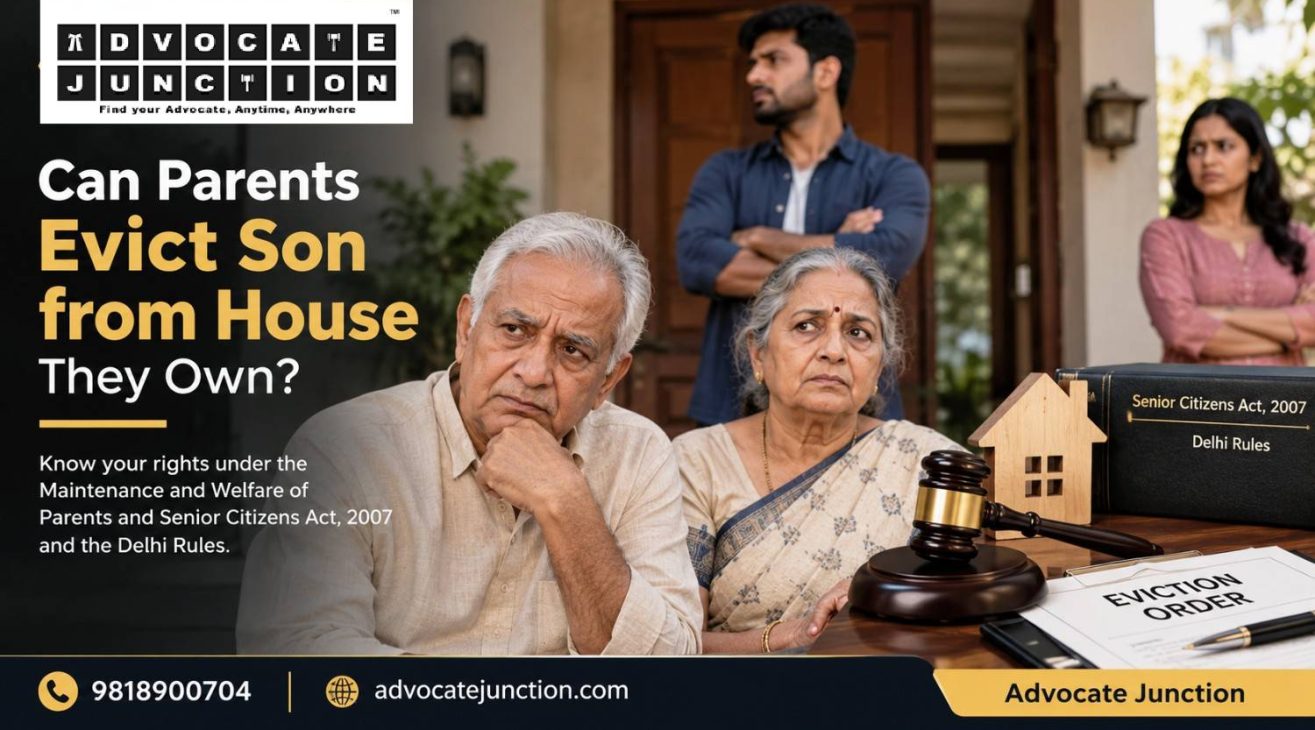
Can Parents Evict a Son or Daughter-in-Law From Their House? Senior Citizens Act Explained
Can parents evict son from house they own when he harasses them, refuses to look after them or tries to take over the home? In many cases, yes. The Maintenance and Welfare of Parents and Senior Citizens Act, 2007 gives elderly parents a fast route through a Maintenance Tribunal, and Delhi has gone further — its rules let a senior citizen ask the District Magistrate directly to evict a son, daughter or other legal heir.
But eviction is not automatic or just one day or one week process. The Supreme Court said in 2025 that tribunals should order it only when it is necessary to protect the parents, and a daughter-in-law’s right to live in the shared household has to be weighed separately. This guide explains when eviction works, the Delhi process, and what parents should prepare.
| Quick answer
Yes — elderly parents can seek eviction of a son, daughter or daughter-in-law who ill-treats them or fails to maintain them: • Anywhere in India: apply to the Maintenance Tribunal under the Senior Citizens Act, 2007 for maintenance and protection; tribunals can order eviction where it is necessary to protect the parents. • In Delhi: apply to the District Magistrate (Deputy Commissioner) under Rule 22(3) of the Delhi Senior Citizens Rules — for self-acquired or ancestral property. Appeal lies to the Divisional Commissioner within 60 days. • Daughter-in-law: her right to residence under the Domestic Violence Act is considered too; the authority may order alternative accommodation rather than simply evicting her. Eviction is ordered on facts — keep proof of ill-treatment, neglect and your right in the property. |
The law: what the Senior Citizens Act gives parents
| Provision | What it does |
| Who is covered | A senior citizen is anyone aged 60 or above. A parent (father or mother, including step- and adoptive parents) can claim against children whatever the parent’s age. |
| Sections 4–5: maintenance | Parents who cannot maintain themselves can claim monthly maintenance from children through the Maintenance Tribunal (usually the SDM). |
| Section 9: limit | The Act caps maintenance at Rs 10,000 a month. A 2019 amendment Bill proposed removing the cap but was not passed — check the current position. |
| Section 23: property transfers | If parents gift or transfer property on the condition that the child will look after them, and the child fails, the transfer can be declared void. |
| Section 24: abandonment | Abandoning a senior citizen is an offence punishable with up to 3 months’ imprisonment, a fine up to Rs 5,000, or both. |
The Act itself does not use the word “eviction”. Courts have read the power into it, because maintenance and protection mean little if the parent is being harassed in their own home. States, including Delhi, have also written eviction procedures into their rules.
When will an eviction order be passed?
Authorities look at the facts as a whole. The strongest cases usually show:
- Ill-treatment — physical abuse, threats, verbal harassment, locking parents out of rooms, cutting off food or medicine.
- Neglect — the child lives in the house but refuses basic care or money.
- The parent’s right in the property — ownership, co-ownership, or a right to live there (for example, a will or allotment in the parent’s name).
- Need — eviction is necessary for the parents to live safely, and lesser orders (such as restraining the son from certain rooms) are not enough.
| Samtola Devi v. State of Uttar Pradesh (2025)
The Supreme Court held that the Senior Citizens Act does not require eviction in every case. A tribunal may order eviction only where it is necessary and expedient to protect the senior citizen. Here, the son lived in one room and ran a shop in part of the house, and a restraint order already protected the parents — so the Court upheld the High Court’s decision setting aside the eviction. |
| Urmila Dixit v. Sunil Sharan Dixit (2025)
The Supreme Court cancelled a gift deed a mother had executed in favour of her son, because he failed to look after her as promised in a document signed the same day. The Court called the Act beneficial legislation that must be read liberally to protect senior citizens. |
The Delhi route: eviction through the District Magistrate
Delhi’s Maintenance and Welfare of Parents and Senior Citizens Rules, 2009 contain an action plan for protecting elderly people’s life and property. After amendments in 2016–2017, Rule 22(3) allows a senior citizen to apply for eviction of a son, daughter or other legal heir from self-acquired or ancestral property on grounds of non-maintenance or ill-treatment. The Delhi High Court has upheld this route and held that a separate maintenance claim is not a precondition.
- Prepare a written application to the District Magistrate / Deputy Commissioner of the district where the property is located, with the facts of ill-treatment or neglect.
- Attach proof — property papers, age proof, police complaints, medical records, photos, videos, messages and witness details.
- Verification — the DM’s office has the facts checked, usually through the SDM and local police, and calls both sides.
- Order — the DM can direct the son, daughter or legal heir to vacate, and police can help enforce it.
- Appeal — either side can appeal to the Divisional Commissioner within 60 days (Rule 22(3)(4)); the Delhi High Court has said this appeal should be used before approaching the High Court (Rakhi Sharma v. State, 2021).
The rules set short timelines for verification and decision, but in practice it can take longer. Parents facing immediate danger should also call the police — Delhi Police runs a senior citizen helpline (1291), and the national Elderline (14567) offers help across India.
What about the daughter-in-law?
This is where many families get stuck. Under the Protection of Women from Domestic Violence Act, 2005, a wife has a right to reside in the shared household — and the Supreme Court has held that this can include the in-laws’ house where she lived after marriage, even if the house belongs only to the in-laws (Satish Chander Ahuja v. Sneha Ahuja, 2020).
S. Vanitha v. Deputy Commissioner, Bengaluru (2020)
Case SummaryIn S. Vanitha v. Deputy Commissioner (2020), a three-judge bench of the Supreme Court addressed the clash between the Maintenance and Welfare of Parents and Senior Citizens Act, 2007 and the Protection of Women from Domestic Violence Act, 2005 (PWDV Act). The Court held that:
|
In practice, courts try to balance both sides:
- Where living together has become impossible, the authority or court may let the parents live in peace and direct the son to arrange alternative accommodation for his wife (Section 19, DV Act).
- Where the daughter-in-law herself is harassing the parents, eviction may be ordered — but expect her DV Act claim to be raised and examined.
- If a DV case or divorce is already pending, tell the DM or tribunal about it; orders in one case can affect the other.
Other options for parents
| Situation | Best route |
| Son harasses but parents own the house | Delhi: DM under Rule 22(3). Elsewhere: Maintenance Tribunal under the Act. |
| Parents gifted the house to the son, who now neglects them | Section 23 application to cancel the gift (stronger if the deed or a parallel document mentions care). |
| Child does not pay for the parents’ needs | Maintenance application under Sections 4–5, or BNSS Section 144 in the Magistrate’s court. |
| Threats, violence or locking parents out | Police complaint immediately, plus the DM / tribunal route. |
| Real dispute over who owns the property | Civil suit — the Act is not meant to settle complicated title disputes. |
| Mistakes parents should avoid
• Gifting the house without a care condition in writing — if you gift property to a child, record the expectation of care in the deed or a document signed with it. • Throwing belongings out or changing locks yourself — use the DM or tribunal route; self-help can lead to counter-complaints. • No record of ill-treatment — keep a diary, medical records, photos and police complaints. • Using the Act for a property fight between siblings — authorities will refuse; a civil suit is the right forum. • Missing the 60-day appeal window in Delhi. |
| Children abroad, parents in India?
• If a sibling or relative is harassing your elderly parents, the parents themselves must apply to the DM or tribunal — you can arrange the advocate, documents and follow-up from abroad. • Parents can authorise a family member to help with paperwork, but should attend hearings where asked; many authorities make allowances for age and health. • Register your parents with the local police station’s senior citizen scheme where available, and keep the 1291 / 14567 helplines handy. |
Frequently asked questions
Can parents evict son from house in India?
Yes, where the son ill-treats or neglects them and eviction is necessary for their protection. Parents can apply to the Maintenance Tribunal under the Senior Citizens Act; in Delhi, they can also apply to the District Magistrate under Rule 22(3).
Can parents evict a son from ancestral property?
In Delhi, Rule 22(3) covers both self-acquired and ancestral property. But where the son claims a share, authorities are careful, and a genuine title dispute may need a civil court.
Can in-laws evict a daughter-in-law from their house?
Possibly, but her right of residence under the Domestic Violence Act is considered first. Authorities often balance the two — for example, by directing alternative accommodation for her.
Do parents need to claim maintenance before seeking eviction?
No. The Delhi High Court has held that a maintenance claim is not a precondition for eviction under the Act and the Delhi rules.
Can parents take back a house they gifted to their son?
Yes, under Section 23, if the gift was made on the condition that he would look after them and he failed to. The Supreme Court applied this in Urmila Dixit (2025).
Is a lawyer required before the DM or tribunal?
Lawyers are often restricted before Maintenance Tribunals, and parents can apply themselves. An advocate still helps prepare the application and evidence, and handles appeals.
How long does eviction under the Senior Citizens Act take?
The rules set short timelines, but actual time depends on the district’s workload and on whether the son contests or appeals.
Can parents claim eviction if the property is in the name of a private trust or family company?
Can a son challenge an eviction order issued by the District Magistrate?
What happens if the son refuses to vacate after an eviction order is passed?
Can a parent seek eviction if they are not yet senior citizens (under 60 years old)?
Can parents revoke a gift deed if there was no written maintenance condition inside the deed?
Need Further Legal Guidance?
Advocate Junction offers flexible consultation options to help you understand your legal rights and options.
- Online / Telephonic Consultation or Office Visit (Delhi): ₹499 for 30 minutes.
- Priority Doorstep Consultation – Delhi: ₹1,499 for 45 minutes.
- Priority Doorstep Consultation – Noida, Gurugram & Ghaziabad: ₹1,999 for 45 minutes.
Consultation Fee Adjustment: If you retain the advocate for further legal services, your consultation fee will be fully adjusted against the agreed advocate’s professional fees. Court fees and third-party expenses are excluded.
Call / WhatsApp: +91 98189 00704
Website: www.advocatejunction.com
Appointments are subject to availability and location confirmation. Additional legal services are charged separately.
AdvocateJunction – Find Your Advocate Anytime Anywhere.
Related Blogs
- NRI Property Sold Using a Forged Power of Attorny
- Property Rights of children from first and second marriage in India
- How to Verify Property Title in India