POCSO vs Rape Case: What’s the Difference Under Indian Law?
The difference between POCSO vs rape case comes down to one decisive fact , the age of the victim and it changes the law, the court, the process, and the punishment.
People often use ‘POCSO case’ and ‘rape case’ loosely, as if they are the same thing. Legally, they are distinct, and understanding the difference helps families, and anyone trying to help a victim, know which law applies and what to expect. Here is a clear comparison.
The basic difference between POCSO Vs Rape case?
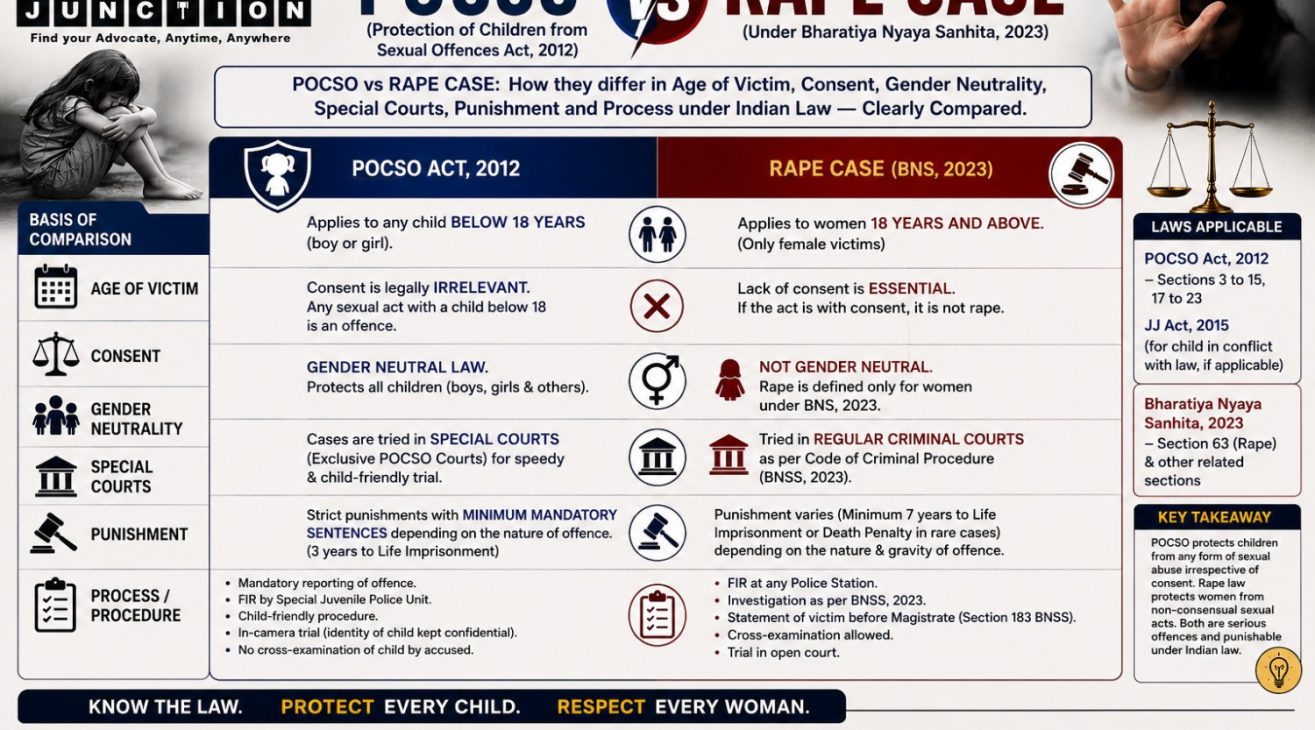
The decisive difference is the age of the victim. POCSO — the Protection of Children from Sexual Offences Act, 2012 — applies when the victim is a child, meaning anyone below 18. A ‘rape case’ in the ordinary sense refers to sexual offences against an adult, prosecuted under the general criminal law (now the Bharatiya Nyaya Sanhita, which replaced the Indian Penal Code). So if the victim is under 18, POCSO applies; if the victim is an adult, the general rape law applies. When the victim is a child, POCSO’s special provisions take precedence.
How does consent differ between the two?
This is a critical difference. In a rape case involving an adult, consent is central — the presence of genuine, free consent generally means no offence. Under POCSO, the consent of a child is legally irrelevant: because a person under 18 cannot legally consent to a sexual act, apparent ‘agreement’ by the child is no defence at all. This reflects the law’s core protective principle that a child cannot consent to their own abuse.
Is there a difference in gender protection?
Yes. POCSO is fully gender-neutral — it protects children of any gender, and offenders of any gender can be prosecuted. The general rape law, historically, has been framed largely around a female victim. So a boy who is sexually abused is protected squarely under POCSO, whereas the ordinary rape provisions have traditionally been structured differently. For child victims, POCSO’s gender-neutral protection is an important advantage.
Which court hears each type of case?
POCSO cases are heard by dedicated Special Courts set up under the Act (Section 28), designed to conduct child-friendly proceedings, protect the child’s identity, and shield the child from direct confrontation with the accused. Ordinary rape cases involving adults are tried in the regular Sessions Courts under the general criminal procedure. The special-court system for children exists precisely to reduce trauma and speed up child cases.
How do the punishments compare?
Both carry severe punishments, but POCSO’s are specifically graded to the child’s vulnerability and were made more stringent by the 2019 amendment. POCSO prescribes minimum sentences (for example, a minimum of 20 years for penetrative assault on a younger child) rising to life imprisonment or, in the most aggravated cases, the death penalty. Adult rape under the general law also carries heavy punishment including up to life imprisonment, and the death penalty in the rarest, most aggravated cases. A key feature of POCSO is its mandatory minimum sentences and enhanced punishment where the offender is in a position of trust.
Are the processes different for the victim?
Yes, significantly. POCSO builds in child-specific protections: sensitive recording of the child’s statement, a support person, identity protection, in-camera and child-friendly proceedings, time-bound trials, and compensation for the child’s rehabilitation. The adult rape process also has victim protections — such as recording the survivor’s statement sensitively and identity protection — but POCSO’s framework is built entirely around minimising trauma to a child. In both, protecting the victim’s identity is required by law.
What if the victim is close to 18, or it involves two adolescents?
This is a genuinely nuanced area, and one the Supreme Court itself is actively grappling with. POCSO’s strict under-18 rule can also catch consensual relationships between adolescents close in age, which is different from abuse by an adult. In the 2025 matter In Re: Right to Privacy of Adolescents, the Supreme Court — while firmly rejecting any idea of ‘non-exploitative’ sexual acts involving minors — took an exceptionally sensitive view of a specific consensual adolescent case, and directed an expert committee to examine the issue; the age-of-consent question was also re-examined in the Nipun Saxena proceedings. Where a case involves adolescents close in age rather than an adult exploiting a child, the facts matter enormously, and specific legal advice is essential. This is not a grey area to navigate alone.
Has the Supreme Court recently expanded POCSO’s scope?
Yes. In Just Rights for Children Alliance v. S. Harish (2024), a bench led by then Chief Justice D.Y. Chandrachud held that even viewing, possessing, and storing child sexual abuse material is an offence under Section 15 of POCSO and Section 67B of the IT Act — not just its creation or distribution. This is a significant expansion that strengthens protection against online child exploitation, and it applies specifically because the victims are children under POCSO. There is no equivalent provision in ordinary adult rape law, underlining how POCSO builds a wider, child-specific protective net.
| Find Your Advocate, Anytime, Anywhere
AdvocateJunction — connect with verified advocates across Delhi NCR |
| Unsure whether POCSO or ordinary law applies → An advocate can clarify for your situation |
| A child victim needs protection and justice → Guidance through the POCSO special-court process |
| A sensitive adolescent-relationship case → Get careful, specific legal advice |
| Seeking compensation for a victim → Understand the rights under each law |
| The right advocate for your case is one message away. Book your slot on WhatsApp — online ₹499 or doorstep ₹999.
WhatsApp: +91-9818900704 advocatejunction.com | Find Your Advocate, Anytime, Anywhere |
Top 5 FAQs: POCSO vs Rape Case
1. When does POCSO apply instead of ordinary rape law?
POCSO applies when the victim is below 18 years of age. For an adult victim, rape is dealt with under the applicable provisions of the general criminal law, including the Bharatiya Nyaya Sanhita (BNS).
2. Does a child’s consent matter under POCSO?
No. Under POCSO, a child is a person below 18, and the child’s consent does not make sexual activity legally permissible. The law is designed to provide special protection to children from sexual offences.
3. Is POCSO law gender-neutral?
Yes. POCSO is gender-neutral in relation to child victims and offenders. It provides protection to children against sexual offences regardless of the child’s gender.
4. How are POCSO cases different from ordinary criminal cases?
POCSO cases are tried before designated Special Courts and follow child-friendly procedures intended to reduce trauma and protect the child’s privacy and dignity. The Act also provides for stringent, graded punishments for different sexual offences against children.
5. What if both persons are teenagers and close in age?
Such cases require careful, fact-specific legal advice. Although POCSO legally applies to sexual activity involving a person below 18, cases involving adolescents close in age can raise different factual and legal considerations from cases involving an adult abusing a child. The circumstances should therefore be assessed individually by a qualified legal professional. For example, a relationship between two 17-year-olds may present very different factual circumstances from a case involving a 17-year-old and a substantially older adult. Nevertheless, because the statutory age of protection under POCSO is 18, specific legal advice is important before assuming that a close-in-age relationship is legally permissible or that POCSO cannot apply.
Real-life cases show why adolescent relationships require careful legal assessment. In In Re: Right to Privacy of Adolescents (2025), the Supreme Court recognised the difficult consequences that can arise when POCSO is applied to consensual relationships between adolescents and discussed the possibility of a “Romeo-Juliet clause” for genuine adolescent relationships. More recently, in Harmeet Singh v. State (NCT of Delhi) (2026), the Delhi High Court examined a case involving a 17-year-old girl and a 22-year-old man who later married and had a child, and emphasised that POCSO proceedings require a careful, fact-specific assessment. These decisions do not create a general exception to POCSO: a person below 18 remains a child under the Act. They demonstrate, however, that courts may consider the nature of an adolescent relationship and the surrounding circumstances when deciding questions such as bail or quashing of proceedings.
Key takeaway on POCSO Vs Rape for All readers
If the person involved is below 18, POCSO can apply. It does not matter whether the relationship was described as consensual, and a child’s consent does not make sexual activity legally permissible under POCSO. The law is gender-neutral and provides special procedures and Special Courts designed to protect children.
For a young man under 21, the important point is this: being close in age to a girl under 18 does not automatically take the case outside POCSO. For example, a 19-year-old or 20-year-old cannot assume that a relationship with a 17-year-old is legally safe simply because they are both young or in a consensual relationship.
At the same time, courts have recognised that consensual relationships between adolescents or young people close in age can be factually different from cases involving exploitation or abuse by an adult. Courts may therefore examine the individual circumstances carefully in appropriate cases.
The safest rule to remember: Under 18 means POCSO may apply. Do not assume that consent, love, or a small age difference automatically provides a legal exception. If the people involved are close in age, get specific legal advice based on the facts of the case.
AdvocateJunction is a platform that helps you find and connect with the right advocate for your matter — including advocates who handle POCSO cases, child protection, and related matters across Delhi NCR with full sensitivity. Tell us the situation and we connect you with a verified advocate suited to your case.
How to book your consultation:
- Online consultation — ₹499 for a one-hour session with an advocate, from anywhere.
- Doorstep consultation — ₹999 for a one-hour session with an advocate at your home, across Delhi.
To book your slot, WhatsApp us at +91-9818900704. We will understand your matter and connect you with the right advocate.
| Important helplines — save these
Police / Emergency: 112 Childline (children in distress): 1098 National Commission for Protection of Child Rights (NCPCR) POCSO e-Box Delhi Commission for Women: 181 AdvocateJunction, confidential: +91-9818900704 |
Related Articles on AdvocateJunction
- The POCSO Act Explained — How to Report Child Sexual Abuse
- Legal Rights of Women in India
- How to File a POSH Complaint — Step by Step
This blog is for general understanding only. Laws and individual circumstances may differ—consult a qualified advocate for advice specific to your case.