
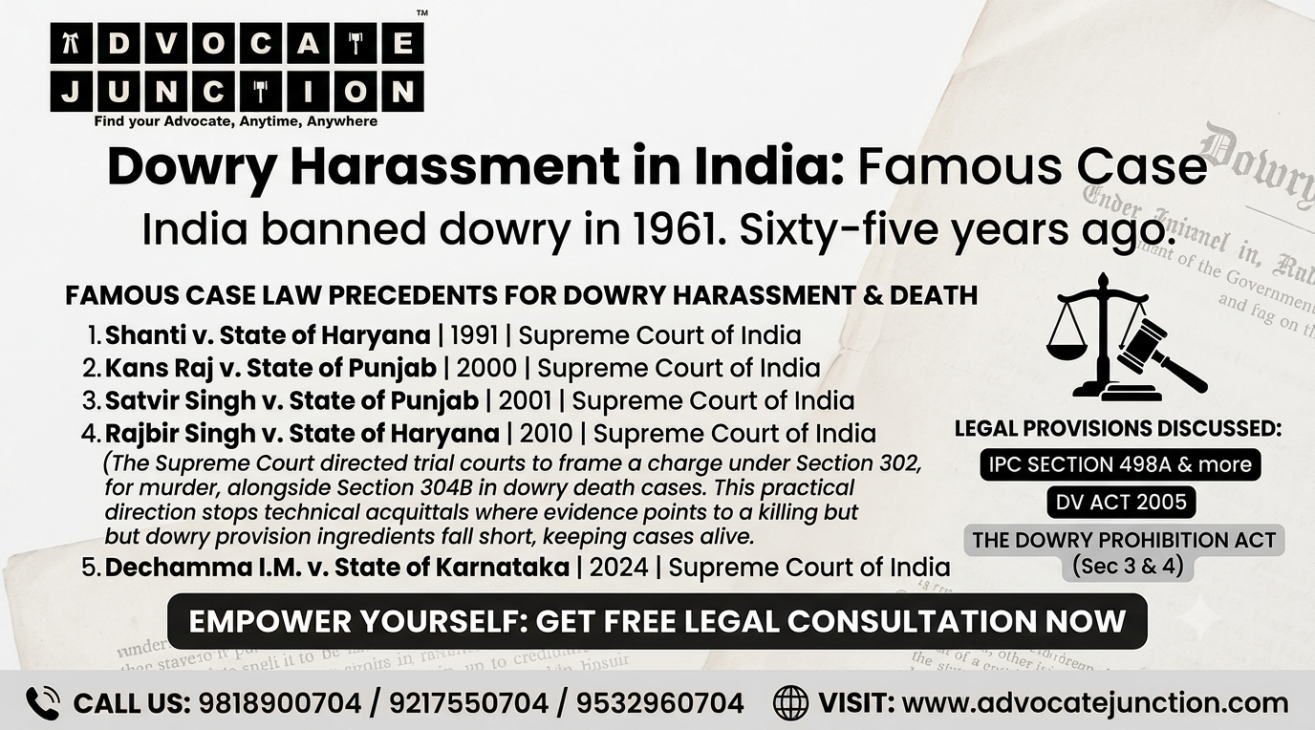
Dowry Harassment in India: What the Law Gives You That Nobody Tells You About
Dowry harassment is a crime in India — and if it is happening to you, the law holds far more in your favour than the people around you are letting on.
Sixteen women a day.
That is what the National Crime Records Bureau recorded for 2024 — 5,737 dowry deaths in a single year. Between 2017 and 2022, the figure was 35,493. Researchers who study how these deaths get classified believe the real number is higher still, because so much of it is recorded as something else, or never recorded at all.
India banned dowry in 1961. Sixty-five years ago.
In Delhi, harassment complaints under Section 498A nearly doubled across five years — from just over two thousand in a year to close to four thousand — while most other categories of crime stayed flat or fell. A newspaper once went through every one of the 1,330 such FIRs filed in the capital over six months, looking for a pattern in who this happens to. What they found was that there was no pattern. The demands ran from a gas cylinder worth fifteen hundred rupees to an Audi and two and a half crore in cash. Women with degrees, women from wealthy homes, women earning their own salaries — none of it made a difference.
One of those women was a civil engineer doing her PhD at IIT Delhi. She hanged herself in her hostel room. Her father, waiting outside the mortuary that evening, said that educating her had been his mistake, that he should have saved the money for her dowry instead.
If you are reading this in a house where the demands started a few months after the wedding, you already know what those numbers feel like from the inside. The gifts that turned into expectations. The comparisons to some other bride. The way your parents’ phone started ringing. The particular silence in a room when you have not brought what was wanted.
You may also have been told, by people who love you, to adjust. To wait. That it will settle. That every household has this.
Now the part nobody sits you down and explains
Everything above is the half of this you already live with. Here is the half that tends to stay hidden from the woman it belongs to.
What is happening in your house is not a domestic adjustment. It is a criminal offence, several times over, under four separate laws. And those laws do not merely disapprove of it in principle — they hand you specific, usable things. A court order that stops the harassment. The right to stay in your own home even if they want you out. Your jewellery back. Money every month. Custody of your children. Protection that can arrive in days rather than years.
Most women know one section number and nothing else. That gap is the single biggest reason people endure this for years — not lack of courage, just nobody ever laid out the full list.
So here is the full list.
First, what the law counts as dowry
Families rename things beautifully. It is not dowry, it is a gift. Not a demand, an expectation. Not for us, for the boy’s future.
Under the Dowry Prohibition Act, 1961, dowry is any property or valuable security given or agreed to be given in connection with the marriage. The Supreme Court has held that any demand for property or valuable security connected in any way with the marriage is a dowry demand. Whatever the family chooses to call it is irrelevant.
And this next point matters more than almost anything else on this page: the demand does not have to have been made before the wedding. Courts have settled that dowry demands made after the marriage are covered exactly the same way. The husband who starts asking for a car in the third year, the mother-in-law who keeps sending you to your parents for help with a property — that is a dowry demand. Not a family conversation.
Which means the woman who thinks she has no case because nothing was negotiated before her marriage almost certainly does have one.
The four laws standing behind you
Not one. Four. And they do different jobs, which is why using them together works better than reaching for the famous one alone.
Section 498A IPC, now Section 85 of the Bharatiya Nyaya Sanhita (Act No. 45 of 2023)
The criminal provision on cruelty by a husband or his relatives. It covers wilful conduct likely to drive a woman to suicide or cause grave injury to her life or health — and, separately, harassment aimed at coercing her or her family into meeting an unlawful demand for property or money. That second limb exists for exactly your situation.
It is cognizable and non-bailable, which means police can act without a warrant and bail is not automatic. That was a deliberate choice by Parliament, because of how severe the harm is.
One practical thing to know: since the Supreme Court’s Arnesh Kumar guidelines in 2014, police must work through a checklist before arresting under this section. So an arrest is not the automatic first consequence of a complaint. For many women that is a relief rather than a disappointment, because they want the harassment stopped, not a husband in custody.
Section 304B IPC, now Section 80 BNS
The gravest provision, and the reason the numbers at the top of this page exist as a legal category at all. If a woman dies of burns, bodily injury, or otherwise than in normal circumstances within seven years of marriage, and it is shown that soon before her death she faced cruelty or harassment connected to a dowry demand, that is a dowry death. The husband or relative is deemed to have caused it. Seven years minimum, extending to life.
Note what that word deemed is doing. It shifts the ground under the accused’s feet in a way very little else in Indian criminal law does.
The Dowry Prohibition Act, 1961
The dedicated statute. It prohibits giving, taking, and demanding dowry, and provides for Dowry Prohibition Officers appointed by state governments to prevent these practices. It is underused — reported violations are far fewer than the harm on the ground suggests — but courts have lately been pressing states on appointing and training these officers properly.
The Protection of Women from Domestic Violence Act, 2005
And this is the one hardly anyone tells you about, which is a shame, because for most women it is the tool that actually changes daily life.
It is civil, not criminal. Nobody goes to jail. What you get instead is a set of orders: a protection order restraining further abuse and contact, a residence order meaning they cannot throw you out of the matrimonial home, monetary relief, custody of your children, and compensation. It moves quickly. Protection orders can come within days in an urgent case.
For a woman who wants the harassment to stop, wants to keep her home, and wants money for her children — but does not want her husband arrested and does not want the marriage necessarily to end — this is the route. It exists precisely for her.
| Both routes can run together
You are not choosing one door. A criminal complaint and a domestic violence application can proceed at the same time, and often should. The criminal case addresses the wrongdoing; the civil route secures your home, your safety and your money while that grinds on. Women who use both tend to be far better protected than women who pick one and wait. |
The judgments that have already fought this argument for you
Each of these answers a defence that gets run in real courtrooms against real women. They were decided years ago, by the Supreme Court, and they are yours to stand on.
| Shanti v. State of Haryana | 1991 | Supreme Court of India
The Court held that ‘soon before’ a death does not mean immediately before. There must be reasonable proximity between the cruelty and the death, but not a matter of hours. It also confirmed that circumstantial evidence — what neighbour saw, what parents were told, earlier complaints — can sustain a conviction, and that a dying declaration is not mandatory. This matters because in these cases there is rarely a confession or an eyewitness. There is only the long pattern that everyone around her noticed. |
| Kans Raj v. State of Punjab | 2000 | Supreme Court of India
This closed off a defence that had been used repeatedly — that because the last identifiable incident was some weeks before the death, the chain was broken. The Court held that a continuous pattern of harassment over weeks or months satisfies the requirement. Sustained cruelty counts as a whole, not as isolated dates. |
| Satvir Singh v. State of Punjab | 2001 | Supreme Court of India
Two holdings, both useful. A dowry demand is not confined to what was negotiated at the time of marriage — demands made afterwards are equally covered. And on evidence, a dying declaration made to a relative rather than a magistrate is admissible if voluntary and coherent, though corroboration is preferred. Cases turn on both points regularly. |
| Rajbir Singh v. State of Haryana | 2010 | Supreme Court of India
The Supreme Court directed trial courts to frame a charge under Section 302, for murder, alongside Section 304B in dowry death cases. The reason is bluntly practical: it stops technical acquittals where the strict ingredients of the dowry death provision fall short but the evidence still points to a killing. This direction has kept alive cases that would otherwise have failed on a technicality. |
| Dechamma I.M. v. State of Karnataka | 2024 | Supreme Court of India
Included for honesty. The Court quashed proceedings against a woman who was not a ‘relative’ of the husband within the meaning of Section 498A, following its reasoning in U. Suvetha v. State that ‘relative’ means a relationship conferred by blood, marriage or adoption. The provision has boundaries. Knowing them helps you frame a complaint that survives challenge instead of one that invites it — which is in your interest, not against it. |
| What We Can Actually Do About It
Confidential legal help across Delhi NCR — 2026 |
| Demands from husband or in-laws, escalating → Criminal complaint and civil protection, together |
| Being threatened with being thrown out → Residence order, so the home stays yours |
| Jewellery and stridhan held back → It is legally yours and it is recoverable |
| You want it to stop without him being arrested → The domestic violence route exists for exactly this |
| You are not asking for a favour. You are claiming something the law already gave you.
FREE 15-Minute Case Assessment — Advocate Comes to You 📱 WhatsApp: +91-9818900704 advocatejunction.com | Delhi NCR Doorstep Legal Service |
Your Stridhan is yours. Not theirs. Not the family’s.
This gets exploited constantly, so let us be precise about it.
Stridhan is what a woman receives — jewelry, cash, gifts, items given at the wedding or afterwards, by her parents, her in-laws, anyone at all. It belongs to her absolutely. Not to her husband, not to her mother-in-law, not to some notion of the joint family. She owns it. She continues to own it whether the marriage survives or not.
What happens in practice is that she leaves, or is put out, and everything stays behind in an almirah she no longer has a key to. Possession then quietly becomes ownership in everyone’s mind except the law’s. It is not. Stridhan is recoverable, and withholding it against her wishes is a wrong she can act on.
Which is why, if you take one practical step this week, make it this: photograph what you have, find the bills, look through the wedding video for the jewelry. Women who can show what was theirs recover far more than women who cannot.
The hard number, and what it actually means for you
You should hear this from someone who will also tell you what to do about it, rather than discovering it later and losing heart.
The conviction rate in dowry-related violence cases is low. The NCRB’s own reporting puts it somewhere between eleven and seventeen percent — about one in six. When journalists examined why, the same reasons kept surfacing: difficulties with evidence, police apathy, witnesses turning hostile, trials dragging until everyone is worn out.
Read that and it is tempting to conclude the system is useless. That would be the wrong conclusion, and here is why.
That figure measures one specific thing — criminal convictions. It does not measure protection orders granted. It does not measure residence orders that kept a woman in her home. It does not measure maintenance secured, stridhan recovered, harassment that simply stopped once a legal notice arrived. Those outcomes are far more common than convictions, they come far faster, and for most women they are what actually changes life.
What the number does tell you is where cases weaken, which is almost always evidence. The cases that collapse are the ones where nothing was written down, the messages were lost when the phone was taken, the injury was never recorded, and the family witnesses softened under pressure two years later.
So the low conviction rate is not a reason to stay silent. It is an instruction: start documenting early, get independent witnesses rather than only family ones, and use the civil route alongside the criminal one instead of waiting years for a verdict to rescue you.
| From Adv. Priya Tomar
“The women whose cases hold up are almost never the ones with the most dramatic story. They are the ones who started keeping records early, told someone outside the house, and took advice before filing rather than after. I have sat with women who endured years and had nothing on paper, and with women who endured six months and had a folder. The second group does better, every single time. If you are not ready to act yet, at least start writing things down. That costs you nothing today and changes everything later.” |
Seven things you can do, starting tonight
None of these require confronting anyone, leaving anywhere, or making a decision you are not ready for.
- If you are in danger right now, call 112. Everything else assumes you are safe enough to plan. The Delhi Commission for Women helpline is 181, running around the clock. The National Women Helpline is 7827170170.
- Start a record today. Dates, what was demanded, who said it, who else was in the room. A note on your phone written the same evening is worth more later than a perfect memory reconstructed two years on. Cases are built and lost here.
- Back up every message. WhatsApp chats where money is asked for, voice notes, call logs, emails. Put them somewhere they cannot reach — a cloud account with a password they do not know, or your parents’ phone. Phones get taken. This happens constantly, and it is not an accident when it does.
- Get the medical record. Even if you told the hospital you fell. Go back and obtain it. An injury documented at the time carries a weight that describing it later never will.
- Tell one person outside the house. A parent, a sibling, a friend, a colleague. Not only because you need support, but because they become a witness. The isolation is part of how this works, and breaking it protects you in both senses.
- List and photograph your stridhan. Quietly, while you can. Afterwards, rebuild the list from bills and wedding photographs.
- Take advice before you file anything. Not because filing is wrong, but because sequence matters. Whether to lead with the criminal complaint or the protection application, what to include, what to hold back — those choices shape everything after. A complaint drafted in distress can take months to repair.
The things you are probably wondering right now
They keep asking my parents for money. Is that really harassment, or am I overreacting?
If money or property is being demanded in connection with your marriage, that is a dowry demand — whatever tone it is asked in and whatever it is called. The Supreme Court has settled that demands made after the wedding count exactly the same as demands made before it. When those demands come with taunts, pressure, threats, or mistreatment when they are not met, that is harassment under the law. You are not overreacting. You are describing an offence.
Do I have to send my husband to jail? I don’t want that.
No. That is precisely why the Protection of Women from Domestic Violence Act exists. It is civil. It gives you a protection order to stop the abuse, a residence order so you keep your home, monetary relief, and custody — without anyone being arrested. Many women start here, and some never go further. Wanting the harassment to end without wanting your husband imprisoned is a completely ordinary position, and the law has a route built for it.
They kept all my jewellery. Is it gone?
No. Stridhan belongs to you absolutely, and their holding it does not make it theirs. It is recoverable, and recovery is commonly pursued alongside other proceedings. The practical challenge is proof, which is why bills, photographs and wedding footage matter so much. The women who get their stridhan back are usually the ones who can show what it was.
If I file, will he be arrested immediately?
Not necessarily. Section 498A is cognizable and non-bailable, but since the Arnesh Kumar guidelines police must work through a checklist before arresting, so it is not automatic. If your goal is protection and relief rather than his custody, say that plainly to your advocate — the strategy can be built around what you actually want, not around what people assume every woman wants.
My family says filing will end any chance of the marriage surviving.
This fear keeps more women trapped than almost anything else, and it is not as clear-cut as it sounds. A protection order aims at stopping the harassment, not at ending the marriage, and a meaningful number of marriages continue afterwards. What genuinely destroys marriages is escalation that nobody checks. Before accepting that asking for protection means the end of everything, find out what the actual options are.
It has been years already. Have I left it too late?
Late is harder. Late is not hopeless. Evidence from long ago is weaker and some things become more difficult, but harassment that is ongoing is ongoing, and remedies exist for what is happening to you now. Do not conclude on your own that because you did not act in the first year, the door has closed on the sixth. Get it assessed properly.
We gave dowry at the wedding. Does that make my family guilty too?
The Act does penalize both giving and taking, and this worry keeps a lot of families quiet. But the entire purpose of the law is protective of the woman, and a family that gave under pressure and is now watching their daughter be harassed should not let a vague fear silence them. Discuss your actual facts with an advocate rather than deciding to stay silent — silence is exactly what the other side is relying on.
Where this leaves you
You began this page with sixteen a day and a father outside a mortuary. That is real and there is no softening it.
But look at what has accumulated since. Four laws, not one. Demands after the wedding count. A protection order in days. A residence order that keeps your home yours. Your jewelry is yours and it comes back. Money every month. Custody. Five Supreme Court judgments that already argued your corner before you ever needed them. And a civil route designed for the woman who wants the harassment to stop without her husband in a cell.
None of that is what you were told, is it. You were told to adjust.
You do not have to decide anything tonight. You do not have to confront anyone, or leave, or announce anything to your family. The first step is smaller than the one you have been dreading: write down what happened today, save the messages somewhere safe, and tell one person outside that house.
Those three things, done quietly this week, put more ground under your feet than another year of waiting ever will.
At AdvocateJunction, we handle dowry harassment matters across Delhi NCR — protection and residence orders, criminal complaints where they fit, stridhan recovery, maintenance and custody. We will tell you honestly which combination suits your situation instead of pushing you toward the loudest option. It is confidential, and because we come to you, nobody has to see you walk into an office. The first fifteen minutes are free.
WhatsApp us at +91-9818900704 — whenever you are ready. There is no hurry and no pressure from our side.
| Keep these numbers somewhere you can reach quickly
Police emergency: 112 Delhi Commission for Women helpline: 181 (24 hours) National Women Helpline: 7827170170 AdvocateJunction, confidential: +91-9818900704 |
Related Articles on AdvocateJunction & News
- Domestic Violence Legal Rights in India — What Every Woman Should Know
- Legal Rights of Women in India
- How to Claim Maintenance from Husband in Delhi
© 2026 AdvocateJunction. All rights reserved. | advocatejunction.com | For informational purposes only. Not legal advice.