
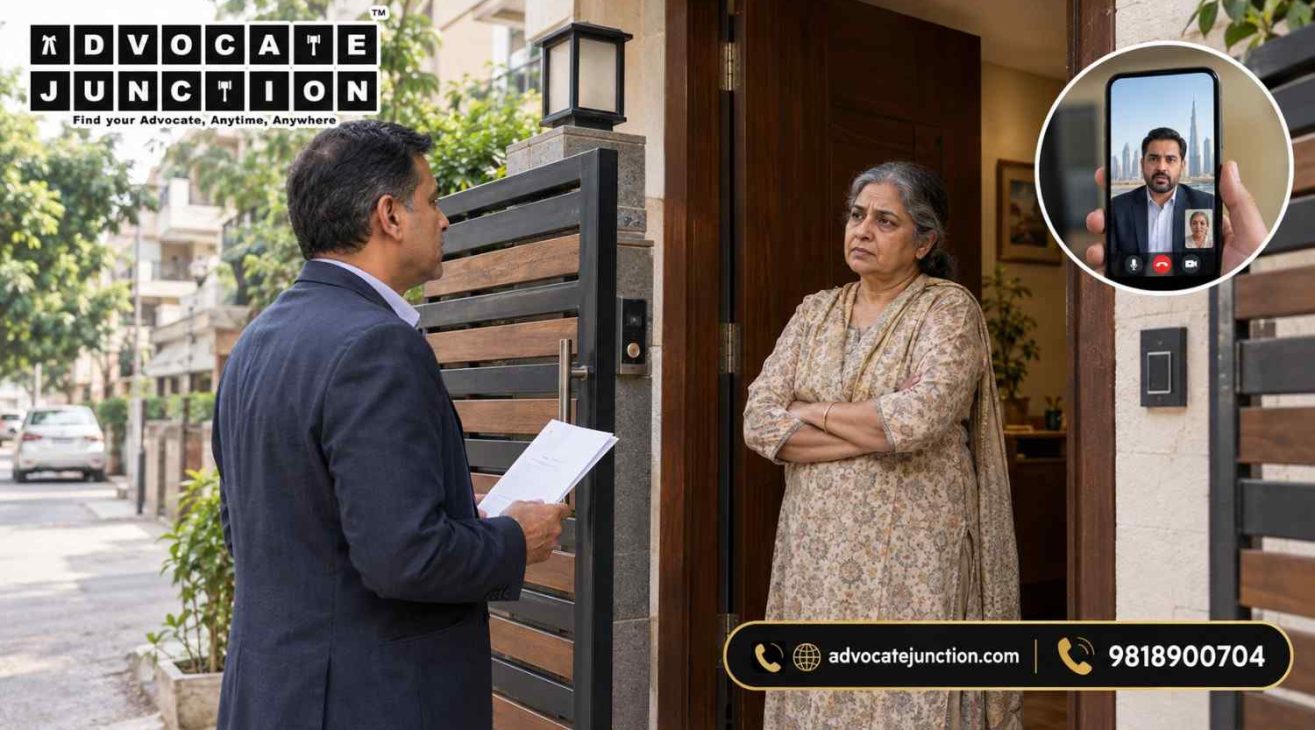
Relative Refusing to Vacate House? How to Get Your Property Back Legally in India
A relative refusing to vacate house property you own is one of the most common — and most painful — property problems in Indian families. It usually starts kindly: a cousin needs a place for a few months, an uncle looks after the flat while you are abroad, a brother-in-law moves in “temporarily”. Years later, they stop answering calls, refuse to leave, or ask for money to go.
Feel Safe: Indian law is always protects the genuine owner because it understands that the relative was only allowed to stay.
The Problem: A delay in case filing or informing to police, wrong steps and informal deals can weaken your case.
so here is exactly how to approach it and handle such situations.
| Quick answer
A relative who lives in your house with your permission is usually a licensee, not a tenant — and permission can be withdrawn. • Collect proof of your ownership and that their stay was by permission. • Send a legal notice revoking the licence with a clear date to leave. • If they stay on, file a civil suit for possession, with mesne profits (compensation for use) and an injunction. • Do not use force, change locks on them or cut utilities. Act early — and never accept “rent” from them. |
First question: licensee, tenant or co-owner?
Your Solution depends entirely on what the relative’s legal position is. Get this right before sending any notice.
| Licensee | Tenant | Co-owner / co-heir | |
| Typical example | Cousin or uncle allowed to stay free, caretaker relative | Relative paying fixed monthly rent under an agreement | Brother or sister living in a house inherited from parents |
| Law | Indian Easements Act, 1882 (Sec 52, 60) | Transfer of Property Act (Sec 105); Delhi Rent Control Act where it applies | Hindu Succession Act; partition law |
| Can you remove them? | Yes — revoke the licence, then a possession suit | Only on grounds the rent law allows | No eviction — the remedy is partition |
| Right claim | No interest in the property | Right to possession during tenancy | Share in the property |
Watch out for two traps.
-
The Tenancy Conversion Trap: Calling regular payments “rent” (or issuing rent receipts) changes a simple licensee into a tenant, granting them strict statutory protection against eviction under Rent Control laws.
-
The Section 60(b) Irrevocability Trap: Under Section 60(b) of the Indian Easements Act, 1882, if a licensee constructs a work of a permanent character using their own funds based on your consent, the license can become legally irrevocable.
-
Loss of Revocation Rights: Once Section 60(b) applies, the owner loses the basic right to revoke permission at will, tying the property up in lengthy civil suits over permanent improvements.
-
Essential Safeguard: Always execute written license agreements stating no tenancy is created, and retain invoices/bank proofs showing you (the title-holder) funded all permanent construction or repairs.
Famous Legal Case: Maria Margarida Sequeira Fernandes v. Erasmo Jack de Sequeira (2012)What Was the Case About?Suppose you had given a house key to a relative, family member, or caretaker to let them live in your property—either out of goodwill or to look after the place while you are away.
Over time, that person refuses to move out, claiming: “I’ve lived here for years, so you can’t just throw me out without a long court battle.”
This exact situation reached the Supreme Court of India. A dispute arose between family members where one party, who was allowed to live in and manage the property, refused to hand back possession to the actual owner.
What Did the Supreme Court Decide?The Supreme Court took a strong stand against people taking advantage of court delays to illegally hold onto property. Here are the 4 main takeaways for the common man:
1. A Caretaker or Relative Gets Zero RightsGiving someone permission to live in your house—whether for a few months or several decades—does not make them an owner or co-owner. They hold the property purely on your behalf as a custodian.
2. Time Does Not Grant OwnershipLiving in a property for 10, 20, or 30 years as a guest, caretaker, or relative does not create any legal title or right over the property. Length of stay means nothing if the original entry was purely permissive (a gratuitous license).
3. Occupants Cannot Ask the Court to Block the Real OwnerThe court held that a guest or caretaker cannot go to court and ask for an “injunction” (a court order) to stop the true owner from entering or reclaiming their own house.
4. Courts Must Protect True Owners FastThe Supreme Court urged lower courts to act swiftly in property disputes. It ruled that courts should immediately restore possession to the lawful owner and heavy costs should be imposed on occupants who file frivolous suits just to delay eviction.
Why Is This Ruling So Important Today? Before this judgment, dishonest occupants frequently abused slow court processes by filing civil suits to get stay orders, forcing real owners into decades of litigation.
This ruling acts as a shield for property owners:
In One Sentence we can say that
|
A question may come into mind of readers now that
What if a senior citizen has given it to his relative and now he wants that person to vaccate and he is living there since last 5 years, and that person is not ready to do so want to go for a legal case ? who has advantange ? such situations are very common in Delhi NCR and in Kolkata and Mumbai !
The Answer- If a senior citizen allowed a relative to live in their property for 5 years (or even longer) and now wants them to vacate, the senior citizen holds a strong legal advantage under current Indian jurisprudence.
1st. 5 Years of Living There Does NOT Create Ownership Rights
Under the rule established in Maria Margarida Sequeira Fernandes (2012), permissive stay as a relative or caretaker is purely custodial. Whether the relative lived there for 5 months or 5 years, they remain a gratuitous licensee—they acquire zero interest, title, or possessory rights in the property.
2nd. Fast-Track Remedy: The Senior Citizens Act, 2007
Instead of filing a slow civil eviction suit that can take years, the senior citizen can approach the Maintenance Tribunal (headed by the District Magistrate / SDM) under Section 23/21 of the 2007 Act:
-
Summary Eviction Orders: Maintenance Tribunals have administrative powers to issue summary eviction orders against relatives or adult children to ensure the peace, dignity, and security of the elderly parent.
-
Supreme Court Position: In landmark decisions (S. Vanitha, reaffirmed in Ravi Kant Gupta), the Supreme Court confirmed that senior citizens can evict permissive occupants if their presence causes distress, harassment, or denies the senior citizen full enjoyment of their property.
3rd. Will the Relative’s 5-Year Stay or Section 60(b) Defense Work?
-
Length of Stay: Simply living in the house for 5 years is not a valid defense against a Senior Citizens Act summary eviction proceeding.
-
Section 60(b) Defense: The relative can only block eviction under Section 60(b) if they prove they built a permanent structure at their own expense with the owner’s permission. If no such construction was done, Section 60(b) offers them zero protection.
Key Takeaway for readers
“A relative residing in a senior citizen’s home for 5 years is legally just a permissive user. Under the Senior Citizens Act, 2007, the senior citizen can seek summary eviction through the Maintenance Tribunal without getting bogged down in lengthy civil court trials.”
Step-by-step: what to do when a relative is refusing to vacate house
Step 1 — Collect your proof
- Title deed, allotment letter or inheritance papers in your name.
- Property tax receipts and utility bills in your name — keep paying them yourself.
- Messages, emails or letters showing you allowed them to stay for a limited purpose or period.
- Any written arrangement, even an informal one, and proof of who paid for repairs or construction.
Step 2 — Try a calm, written conversation first
Many of these disputes end with a fixed move-out date or a small relocation amount. Put any offer in writing. If talks stall, court-annexed mediation in Delhi is free and confidential — but do not let “talks” drag on for years.
Step 3 — Send a legal notice revoking the licence
Through an advocate, send a notice by registered post and email or WhatsApp, saying the permission to stay is withdrawn and giving a reasonable date to leave (often 15–30 days). The notice fixes the date from which their stay becomes unauthorised — which also starts your claim for compensation.
Step 4 — File a suit for possession
If they stay on, file a civil suit in the court where the property is located, asking for:
- Recovery of possession of the property;
- Mesne profits — compensation for every month they occupy after revocation, usually linked to market rent;
- Injunction — stopping them from altering the property, letting it out or creating third-party rights while the case runs.
If the relative admits in writing or in their reply that you own the property and they were only permitted to stay, your advocate can ask for an early decision on that admission (Order XII Rule 6, Code of Civil Procedure).
Step 5 — Execute the decree
Once you win, file an execution petition. The court’s bailiff, with police help if needed, hands over possession.
What about the police?
Police usually treat possession between family members as a civil dispute and will not remove someone who entered lawfully. File a police complaint if there are threats, damage, forced entry or forged documents — criminal trespass (Section 329, Bharatiya Nyaya Sanhita) can cover someone who unlawfully stays on to intimidate or annoy the owner — but use it alongside the civil case, not instead of it.
| Do not do these things
• Change the locks, remove their belongings or use “bouncers” — self-help eviction can lead to criminal cases against you. • Cut electricity or water. • Accept monthly payments described as rent. • Sign a “settlement” or affidavit drafted by the relative without your own advocate reading it. • Give them a general power of attorney “to look after the house”. |
Special situations
When the house belongs to elderly parents
Senior citizens can approach the Maintenance Tribunal under the Maintenance and Welfare of Parents and Senior Citizens Act, 2007. The Supreme Court has accepted that the tribunal can order a child or relative to leave where that is needed to protect the parents — but a daughter-in-law’s right to live in the shared household under the Domestic Violence Act is weighed separately (S. Vanitha v. Deputy Commissioner, Bengaluru, 2020).
When the relative claims the house was gifted or willed to them
A gift of immovable property must be by a registered deed (Section 123, Transfer of Property Act). An oral gift or an unregistered paper will not stand. If they produce a will, it has to be proved in court like any other will.
When the relative claims 12 years of possession
Adverse possession needs open, continuous possession hostile to the owner for 12 years (Article 65, Limitation Act). A stay that began with your permission is not hostile. Even so, file within time and keep proof of permission — do not test the 12-year line.
| Living abroad? You can do all of this without travelling
• Specific power of attorney to a trusted person in India to send the notice, file the suit and attend court — signed at the Indian consulate, or notarised and apostilled abroad, and stamped in India within three months. • Check the records first — get an encumbrance certificate and property-tax status to make sure no sale, lease or loan has been registered on your property without your knowledge. • Cancel old POAs you gave relatives, by a registered revocation deed and notice to them and the sub-registrar. • Hearings can often be attended by your advocate and attorney holder; you give evidence by video or on a visit if needed. |
Frequently asked questions
Can the police remove a relative who is refusing to vacate my house?
Usually not. If the relative entered with your permission, police treat it as a civil dispute. You need a court order for possession, which the court then enforces.
Is a legal notice compulsory before filing a possession suit?
It is strongly advised. It records the date the permission ended, starts your compensation claim and often settles the matter without a case.
My brother lives in our late father’s house and won’t leave — can I evict him?
No, if he is a co-heir. He has a share in the property. Your remedy is partition — by agreement or through a partition suit.
Can a relative who has lived in my house for 15 years claim ownership?
Not if the stay began with your permission. Permissive possession does not become adverse possession. Keep your proof of permission and act quickly.
Can I claim money for the time they stayed after I asked them to leave?
Yes. You can claim mesne profits — compensation for use from the date of revocation until they hand over possession.
How long does a possession suit take?
It depends on the court and on how hard the relative contests it. Interim orders protecting the property can come early; an admission by the relative can shorten the case considerably.
I live abroad — do I have to come to India for the case?
Not for most of it. A properly attested power of attorney lets someone in India act for you, and many courts allow video appearance.
| A relative occupying your home in Delhi NCR?
AdvocateJunction’s verified advocates draft the revocation notice, check the property records and file the possession suit — at your doorstep, or remotely for NRI owners. WhatsApp: 9818900704 · advocatejunction.com ( We are a Paid Platform and We charge for legal services ) |
AdvocateJunction’s doorstep legal services are currently available only in Delhi NCR (Delhi, Noida, Greater Noida, Gurugram, Ghaziabad and Faridabad).
Related Articles
- Rent Agreement in India , what it must contain ?
- NRI Property Dispute in India , How to protect and Recover it from Abroad