
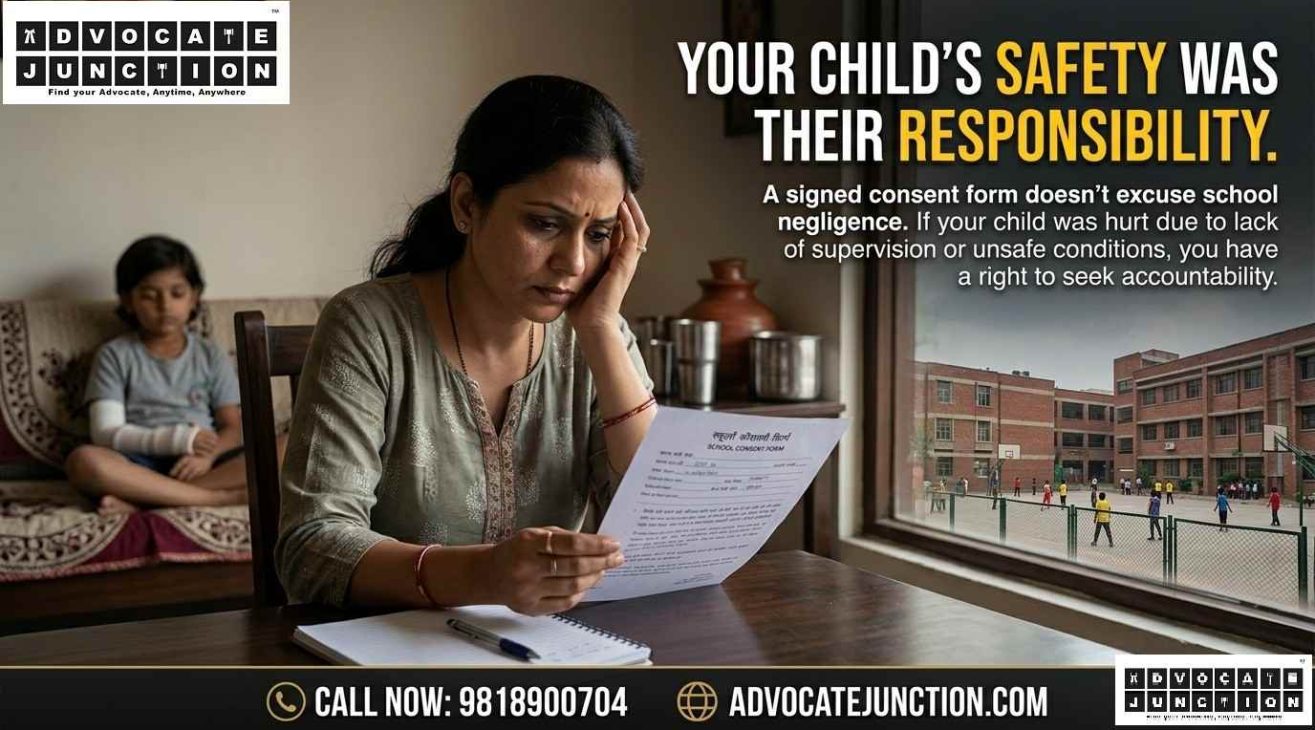
Child Safety in the school , know more about it.
Everyday you send your chikd to school and feel safe but do you really understand that who is responsible for your child safety in school ? When a child is seriously injured during a school game, sports event, or trip, the school is legally responsible or not ? if the injury was caused by its negligence — and a consent form the parents signed, does it make any difference ?
Imagine a phone call in the middle of an ordinary day., Your child was fine at breakfast, went off to school, and now there is a voice on the line saying there has been an accident — during the football match, on the sports ground, on the way to an inter-school competition. In the hours that follow, between the hospital and the fear, one question eventually surfaces and refuses to leave: this happened while the school was supposed to be looking after my child. Are they not responsible? And then a second thought also come that I had signed that form. at the start of the year, the one that said participation is ‘at own risk’. Have I signed away my child’s rights?
These are exactly the right questions, and the answers are more in your favour than you fear. Indian law places a real, enforceable duty on a school to keep your child safe while in its care, and that consent form does far less than schools would like parents to believe. Here is precisely where a school stands liable, where it does not, what that signed form actually covers, and what compensation a family can claim.
AdvocateJunction currently provides doorstep legal consultations only across Delhi NCR (Delhi, Noida, Gurgaon, Ghaziabad and Faridabad). The legal position explained below applies nationwide.
The starting point: a school’s ‘duty of care’
The moment you hand your child over to a school, the law hands the school a responsibility called a duty of care. In simple terms, while your child is in the school’s charge — in the classroom, on the playground, at a sports event, or travelling for a competition under the school’s arrangement — the school must take the same reasonable care of that child that a careful, prudent parent would take of their own. This is not a vague moral expectation; it is a legal standard, and breaching it has legal consequences.
This duty does not switch off at the school gate. Courts have recognised that it travels with the child — onto the sports field, into the school bus, and on the trip to another city for a tournament. Wherever the school has taken charge of the child, the duty of care follows.
When the school is liable — negligence
A school does not become liable simply because a child got hurt. Injuries happen in sport and in life. The school becomes liable when the injury was caused by its negligence — a failure to take the reasonable care it owed. In practice, four things have to line up, and understanding them tells you whether you have a case:
- Duty: the school owed a duty of care to your child — established the moment the child is in its charge.
- Breach: the school failed in that duty — through something it did, or failed to do.
- Causation: that failure actually caused the injury — the harm flowed from the school’s lapse, not from something wholly unconnected.
- Damage: the child suffered real harm — injury, disability, medical expense, trauma.
What does a ‘breach’ actually look like on a sports ground or a school trip? The recurring examples are depressingly familiar:
- No proper supervision: children left to play a contact sport or use equipment with no teacher or coach actually watching and controlling the activity.
- Unsafe or badly maintained equipment or grounds: broken goalposts, damaged play equipment, a hazardous field, missing protective gear.
- No safety measures or first aid: no trained staff, no first-aid arrangement, no plan for a medical emergency — so that a treatable injury becomes a serious one through delay.
- Foreseeable danger ignored: a known risk that a reasonable school would have guarded against, simply left unaddressed.
- Negligent supervision on a trip or in transport: children inadequately supervised while travelling to or at an out-of-school event.
| Vicarious liability — the teacher’s lapse is the school’s lapse
Parents often think, ‘but it was the coach’s fault, not the school’s’. In law, that usually makes no difference to the school’s responsibility. Under the principle of vicarious liability, an employer is answerable for the negligence of its employees acting in the course of their duties. So when a teacher, coach, or accompanying staff member is negligent in caring for a child, the school itself is held liable and must pay the compensation. A consumer commission has, in a real case, held an educational institution vicariously liable for the gross negligence of teachers who failed to get timely medical help for a student in their care, and ordered it to pay substantial compensation. You are not left chasing an individual teacher — the institution answers for its staff. |
The consent form you signed: what it really does (and does not do)
This is the part schools rely on, and the part parents most misunderstand, so let it be said plainly: signing a form that says your child participates ‘at his own risk’ does not give the school a free pass for its own negligence.
Here is the distinction the law draws. When you sign such a consent or waiver form, you accept the ordinary, inherent risks of the activity — the risks that exist even when everything is done properly. A child playing football may collide with another and sprain an ankle; a child on a trek may slip despite good supervision. These are the normal hazards of the activity itself, and by consenting you accept that they can happen without the school being at fault.
What you do not — and legally cannot fully — sign away is the school’s responsibility for its own negligence. A waiver does not licence the school to supervise carelessly, use broken equipment, ignore safety, or fail to arrange medical help. A clause that tries to protect a school from the consequences of its own negligence, especially where a child’s safety is concerned, runs against public policy and is generally not enforceable to that extent. In other words: the form covers the accident that no one could prevent; it does not cover the harm the school’s carelessness caused.
| The one-line truth for worried parents
If your child was hurt because the school was careless — no supervision, unsafe equipment, no first aid, a known danger ignored — the consent form you signed does not stop you from claiming. You accepted the ordinary risks of the game; you did not accept the school’s negligence, and no piece of paper can make you accept it on your child’s behalf. |
When the School Is NOT Liable — The Honest Picture
Not every injury at school means the school is legally responsible. Sometimes accidents happen even when the school has taken reasonable care.
A school may not be liable where:
- It was a genuine and unforeseeable accident — something that could not reasonably have been predicted or prevented, even when proper care was taken.
- The school had taken reasonable safety measures — such as adequate supervision, safe equipment, proper facilities and appropriate first-aid arrangements — but the injury still happened.
- The injury was caused by another child or a third party without any negligence by the school — for example, a sudden act that reasonable supervision could not have prevented. However, the school’s supervision and safety arrangements can still be examined.
- The injury was part of an ordinary and accepted risk of the activity — particularly in sports or physical activities, where some risk of injury is naturally involved, provided the school did not ignore a known or avoidable danger.
The real question is negligence
The important question is not simply, “Did the child get injured at school?”
The real question is:
“Did the school take the reasonable care that a responsible school and a prudent parent would expect in the circumstances?”
If the school took reasonable precautions and the accident could not reasonably have been prevented, a compensation claim may not succeed.
But if the injury happened because of poor supervision, unsafe premises, defective equipment, failure to follow safety rules, or some other avoidable lapse, the position can be very different.
Every case depends on its facts. If your child has suffered a serious injury at school, it is sensible to preserve medical records, photographs, CCTV details, school communications and other evidence, and take advice from a qualified advocate before deciding whether to pursue a claim.
What compensation can a family claim?
There is no fixed figure and no simple formula — compensation is assessed on the actual harm, and in serious cases it can be substantial. When a court or consumer commission fixes the amount, it weighs factors such as:
- Medical expenses already incurred and likely future costs — surgery, rehabilitation, long-term care.
- The extent and permanence of disability — a temporary injury and a permanent, life-altering one are treated very differently.
- The impact on the child’s future — education, earning capacity, and prospects affected by the injury.
- Pain, suffering, and loss of amenities suffered by the child.
- The mental agony and trauma of the parents — recognised as a real, compensable harm.
- The cost of litigation.
In cases of gross negligence causing serious or permanent harm, consumer commissions and courts in India have awarded compensation running into many lakhs, and in the gravest cases involving death or catastrophic disability, into crores. The stronger and better-documented the evidence of negligence and harm, the fuller the compensation tends to be.
Where and How to Make the Claim
A parent may have more than one legal route after a child is injured at school. These remedies are not necessarily mutually exclusive. The correct route depends on what happened, who was responsible, how serious the injury was, and what the evidence shows.
1. Civil claim for compensation
Where a child’s injury was caused by negligence, a parent may pursue a civil claim for damages against the school and, depending on the facts, other persons who may be legally responsible.
The basic question is one of duty of care and negligence. A school that has custody and supervision of children is expected to take reasonable precautions for their safety. If it fails to do so and that failure causes injury, compensation may be claimed.
For example, the facts may become important where:
- a dangerous area was left without proper protection;
- defective sports or laboratory equipment was being used;
- a child was left without reasonable supervision;
- the school knew about a safety hazard but failed to correct it;
- required safety procedures were ignored; or
- an activity was conducted without precautions appropriate to the children’s age and circumstances.
The compensation in a civil claim can depend upon the actual loss suffered. Medical expenses, future treatment, disability, loss of earning capacity in an appropriate case, pain and suffering, and other consequences of the injury may all require consideration.
The school, however, is not automatically liable simply because the accident happened on school premises. The evidence must establish negligence or another legally recognised basis of liability.
2. Consumer Commission — an important legal issue
The Consumer Protection Act, 2019 provides a remedy for a “deficiency” in a qualifying service. However, parents should not assume that every dispute involving a fee-paying school can automatically be taken to the Consumer Commission.
The legal position concerning educational institutions has been the subject of important Supreme Court decisions.
In Bihar School Examination Board v. Suresh Prasad Sinha, (2009) 8 SCC 483, the Supreme Court considered the nature of functions performed by an examination board under the consumer law framework.
In Maharshi Dayanand University v. Surjeet Kaur, (2010) 11 SCC 159, the Supreme Court held that imparting education does not fall within the meaning of “service” under the Consumer Protection Act.
The question subsequently came before the Supreme Court in Manu Solanki v. Vinayaka Mission University, Civil Appeal No. 3504 of 2020, raising broader issues concerning the application of consumer law to educational institutions.
There have also been decisions of consumer fora taking different approaches to particular educational services and activities.
The practical takeaway is simple: paying school fees does not, by itself, guarantee that a school-injury complaint is maintainable before a Consumer Commission. The facts and the latest applicable law should be examined before choosing this forum.
Where a complaint is maintainable under consumer law, the Consumer Commissions provide a specialised mechanism for seeking appropriate relief. The present pecuniary jurisdiction under the applicable rules is based on the value of the goods or services paid as consideration, rather than simply the amount of compensation a complainant chooses to demand.
3. Criminal complaint in serious cases
A school accident can, in some circumstances, also raise a question of criminal negligence.
Where a rash or negligent act causes death, Section 106 of the Bharatiya Nyaya Sanhita, 2023 (BNS) may become relevant. This provision replaced the earlier Section 304A of the Indian Penal Code dealing with causing death by a rash or negligent act.
Where a rash or negligent act endangers human life or the personal safety of others and causes hurt or grievous hurt, Section 125 BNS may be relevant.
But an important distinction must be understood:
Every accident is not a criminal offence.
A child falling during a game or suffering an unexpected injury does not automatically mean that the teacher, principal or school has committed a crime. The facts must disclose the level of rashness or negligence required by the relevant criminal provision.
A criminal proceeding is also different from a civil claim for compensation. Depending on the facts, the two may proceed independently.
4. What about the principal, teacher or coach?
Responsibility does not automatically attach to every teacher or principal merely because an accident occurred during school hours.
The particular role of the person concerned matters.
For example, if a teacher or coach was specifically responsible for supervising a sporting activity and ignored an obvious safety risk, that evidence may be relevant. Similarly, if school management had repeatedly been informed about a broken railing, unsafe staircase, defective equipment or another serious hazard and did nothing, the evidence may point towards a wider institutional failure.
The question is not simply “Who was present?”
The more important questions are:
Who had the duty to take precautions? What precautions were reasonably expected? Were they actually taken?
5. Check the school’s insurance
Parents should also ask the school whether the child is covered by any:
- student accident insurance;
- group personal accident policy;
- sports or activity-related insurance;
- educational-trip insurance; or
- other student welfare or accident cover.
Do not assume that an insurance policy automatically means that compensation will be paid. Coverage depends on the policy wording, exclusions, insured events and claim procedure.
Ask the school for the relevant policy details and preserve all medical documents and bills.
What Parents Should Do — Step by Step
1. Get the child the best medical care first
The child’s health comes before the legal case.
Get appropriate medical treatment and preserve every medical record, prescription, diagnostic report, scan, discharge summary and bill.
These documents are important not only for treatment but also for establishing the nature, seriousness and financial impact of the injury.
2. Write down exactly how the accident happened
Do it as soon as possible, while the details are still fresh.
Record:
- where the accident happened;
- date and approximate time;
- what activity was taking place;
- which teacher, coach or staff member was supervising;
- what went wrong;
- who saw the incident; and
- what the school did immediately afterwards.
Do not rely on memory months later.
3. Preserve the evidence
Take photographs or videos of the place, equipment, playground, staircase, laboratory, swimming pool or other relevant area, where appropriate.
Also preserve:
- CCTV footage or requests for its preservation;
- school emails and WhatsApp messages;
- incident reports;
- circulars and instructions issued for the activity;
- consent forms;
- school rules or safety instructions;
- fee receipts;
- medical records and bills; and
- names of witnesses.
CCTV can be particularly important. If cameras were operating at the location, make a written request to the school to preserve the relevant footage before it is overwritten or deleted.
4. Do not simply accept “You signed the consent form”
A school may sometimes point to a consent or undertaking signed by the parent and argue that the risk had already been accepted.
But a consent form does not automatically give a school permission to be negligent.
There is a difference between accepting an ordinary and inherent risk of an activity and consenting to avoidable negligence or an unsafe condition.
The exact wording of the document and the circumstances of the accident should therefore be examined before accepting the school’s explanation.
5. Send a written notice to the school
A parent should consider sending a written communication setting out what happened and asking the school to preserve relevant records and CCTV footage.
Depending on the circumstances, a formal legal notice may also be appropriate.
This creates a written record and can prevent an important dispute later about whether the school was informed about the incident or the safety concern.
6. Consult an advocate early
An advocate can help determine:
- whether the facts establish negligence;
- who may be legally responsible;
- what compensation can reasonably be claimed;
- whether a civil, consumer or criminal remedy is appropriate;
- what evidence should be preserved; and
- which limitation or procedural requirements apply.
Good evidence and proper legal strategy can turn a genuine grievance into a legally sustainable claim.
Find Your Advocate, Anytime, Anywhere
When a child is injured, the early legal steps can make a real difference. Evidence can disappear, CCTV can be overwritten, medical records can become difficult to collect, and legal time limits can continue to run.
The aim is not to make a false promise of compensation. The aim is to understand whether the school was actually negligent, what remedy is available, and what should be done next.
Talk to an Advocate Junction advocate
- ₹499 — Focused 45-minute consultation on Google Meet, or visit our Legal Studio at our Rohini office.
- ₹999 — 45-minute doorstep legal advice across Delhi.
- ₹1,499 — 45-minute doorstep legal advice in Noida, Gurgaon, Ghaziabad and Faridabad.
All consultations are by prior appointment.
To book, WhatsApp: 9818900704
Or visit advocatejunction.com and submit your enquiry.
The Questions Parents Ask
My child was injured during a school sports event. Can I claim compensation from the school?
Possibly — but the injury itself is not enough. You have to establish negligence or another legal basis of liability.
A school has a duty to take reasonable care of children who are under its supervision. The degree of care expected can depend on the child’s age, the nature of the activity and the risks involved.
For example, the position may be very different if a child is injured during a normal game despite proper supervision, compared with a situation where:
- dangerous or defective equipment was used;
- there was inadequate supervision;
- a known safety hazard was ignored;
- the activity was conducted without reasonable precautions; or
- appropriate medical assistance was unreasonably delayed.
The Supreme Court’s decision in M.S. Grewal & Anr. v. Deep Chand Sood & Ors., (2001) 8 SCC 151 is an important authority on the responsibility of a school towards children under its care. The case arose from the drowning of schoolchildren during an excursion, and the school management was held liable. The Supreme Court has subsequently referred to M.S. Grewal as a case where negligence was fixed upon the school that organised the excursion.
But this does not mean that every injury suffered during school sport or an excursion automatically makes the school liable.
The real question is:
Did the school take the reasonable precautions that the circumstances required?
If the accident was genuinely unavoidable despite reasonable care, a compensation claim may not succeed.
I signed a form saying my child plays “at his own risk”. Can I still claim?
Yes, a signed consent or undertaking does not automatically end the matter.
Parents can accept that sports and other school activities carry certain ordinary and inherent risks. A child can fall while playing football, collide with another player, or suffer an injury despite proper supervision.
That is different from accepting negligence.
For example, a parent agreeing that a child participates in a sport “at his or her own risk” does not necessarily mean that the parent has agreed to:
- defective equipment;
- an unsafe playing area;
- inadequate supervision;
- a known danger being ignored; or
- other avoidable failures in reasonable care.
The wording of the document matters, as do the circumstances in which it was signed.
So the correct legal question is not simply “Did the parent sign a form?”
It is:
“What risk did the parent actually agree to, and was the injury caused by that ordinary risk or by the school’s failure to take reasonable care?”
A consent form should therefore be examined along with the actual facts of the accident. It should not be treated as a blanket waiver of every possible claim arising from negligence.
The coach was negligent, not the school management. Who is liable?
The school may be liable for the negligence of its teacher or coach where the employee was acting in the course of employment. This is the principle of vicarious liability.
A parent does not necessarily have to prove that the principal personally caused the accident.
If, for example, a coach was appointed by the school to supervise students during a sporting activity and negligently failed to provide the supervision reasonably required, the school may be held responsible for the employee’s negligence.
Indian courts have recognised this principle in the educational context.
In R. Elumalai v. State of Tamil Nadu, the Madras High Court explained that a teacher is expected to take care of pupils much like a careful parent, and that the age of the pupil and nature of the activity are relevant in determining the degree of supervision required. The Court also recognised the application of ordinary vicarious liability where negligence is committed by a teacher.
There is an important qualification, however.
The school is not automatically liable merely because an employee happens to be involved.
The facts must establish that the teacher, coach or other employee was acting within the scope of the employment or assigned duty when the negligent act occurred.
The exact legal position can also differ where the person responsible was an independent contractor rather than an employee.
How much compensation can we get for a serious school injury?
There is no single fixed amount.
Compensation depends upon the nature of the injury and its consequences.
A court may consider factors such as:
- actual medical and treatment expenses;
- future medical treatment;
- permanent disability, if any;
- pain and suffering;
- loss of amenities of life;
- psychological or emotional consequences where legally compensable;
- impact of a serious disability on the child’s future;
- future earning capacity in an appropriate case; and
- other proven financial losses flowing from the injury.
In a serious case, the child’s age can become particularly important because a permanent disability suffered during childhood may affect the person’s education, employment and earning capacity for many years.
That is why parents should not look only at today’s hospital bill.
A serious injury can have consequences that continue for decades.
At the same time, parents should be cautious about websites or people promising a particular compensation figure before seeing the medical records and evidence. There is no automatic “rate” of compensation for a school injury.
The stronger the evidence of both negligence and actual harm, the stronger the compensation claim.
Is there a time limit to file the claim?
Yes — and parents should not wait unnecessarily.
For a consumer complaint, the Consumer Protection Act generally provides a two-year limitation period from the date on which the cause of action arose, subject to the statutory provisions concerning condonation of delay.
But this does not mean that every school-injury case has a two-year limitation period.
Civil claims have their own limitation rules, and criminal proceedings are governed by the applicable criminal-law provisions and procedural rules.
There may also be circumstances affecting when limitation begins to run or whether delay can legally be excused.
This is why a parent should not simply assume:
“I have two years, so I can deal with it later.”
Early legal advice is important because evidence can disappear, CCTV may be overwritten, witnesses’ memories fade, and medical consequences may become harder to document.
Your Child’s Safety Was the School’s Responsibility
Come back to the fear many parents have at the very beginning — that signed form, the consent letter, the small print saying that the child participates “at his or her own risk”.
Signing that document does not mean you handed the school a free pass.
What a parent may accept is that school life and sport carry ordinary risks.
What that does not automatically mean is that a parent has agreed to unsafe premises, defective equipment, inadequate supervision or other negligent conduct.
The Supreme Court’s decision in M.S. Grewal v. Deep Chand Sood is a powerful reminder that a school cannot simply treat its responsibility towards children as ending once an activity begins. In that case, the Supreme Court dealt with the tragic drowning of schoolchildren during an excursion and upheld the finding of liability against the school management.
Of course, every case is different.
A child being injured does not automatically prove negligence. Schools are not insurers against every accident, and children inevitably face some ordinary risks while playing, travelling or taking part in activities.
But if you look back at what happened and think:
“No one was properly watching.”
“That equipment should never have been used.”
“The school knew about the danger.”
“Help came far too late.”
— do not dismiss those concerns simply because you signed a form at the beginning of the school year.
Keep the medical records. Write down what happened while the details are fresh. Preserve photographs, messages, CCTV information and names of witnesses.
Then have the facts assessed by an advocate.
The law does not promise compensation merely because a child was injured. But where a school failed in its duty of reasonable care and that failure caused the injury, the law can provide a genuine path to accountability and compensation.
Must understand —
Related Articles on AdvocateJunction
- Consumer Complaint in India — The Complete Guide to Compensation
- How much does a legal service cost in Delhi NCR
- POCSO ACT explained
Few famous News paper coverage on this topic
-
10-yr-old punished at school for not carrying book, falls sick and dies; CM orders action
-
Boy assaulted at day care in Delhi; principal, 3 others booked under POCSO
This article explains the general legal position and is not a substitute for advice on your specific facts. All content verified under current Indian law 2026.
© 2026 AdvocateJunction. All rights reserved. | advocatejunction.com | For informational purposes only. Not legal advice.