
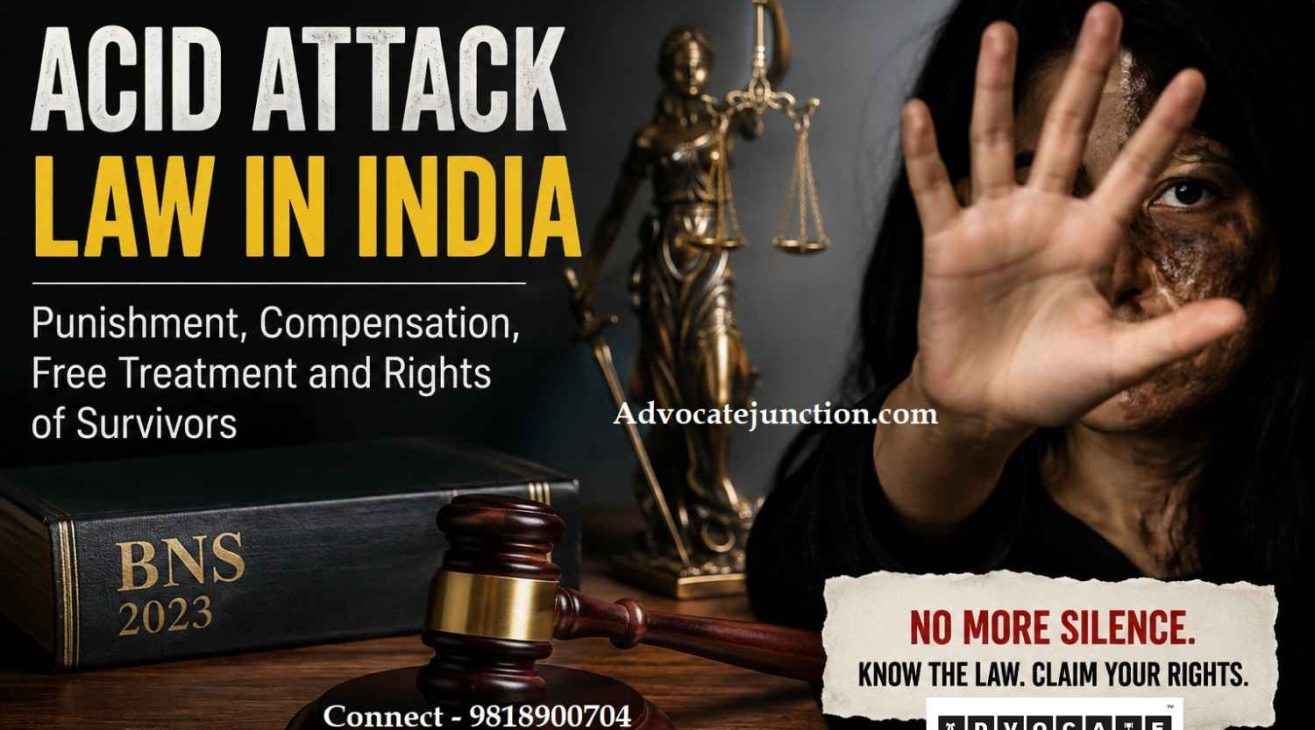
Acid Attack Law in India: Punishment, Compensation, Free Treatment, Bail and Rights of Survivors
Acid attack is one of the most severely punished crimes in India.
For a completed acid attack causing the injuries covered by law, the punishment can be a minimum of 10 years’ imprisonment extending to life imprisonment, along with a fine. The law also provides for compensation, medical treatment and rehabilitation for survivors.
But behind every acid-attack case is something much more human than a section number.
Almost every acid attack begins with the same ugly logic: a person believes that another person’s face, body, future or choices belong to them.
A proposal is rejected.
A relationship ends.
Someone says no.
And the attacker decides to punish that person for exercising a choice that was entirely and rightfully theirs to make.
The consequences can last a lifetime.
The survivor may face severe burns, permanent scarring, disfigurement, loss of eyesight, disability, repeated surgeries, psychological trauma, difficulty returning to work and enormous medical expenses.
There is, however, an important story of resistance behind India’s acid-attack laws.
The woman whose legal battle became central to India’s modern acid-attack jurisprudence was Laxmi, who survived an acid attack after rejecting a marriage proposal. Her fight eventually reached the Supreme Court and resulted in landmark directions concerning acid sales, compensation, medical treatment and rehabilitation.
India’s legal framework has since developed considerably.
And since 1 July 2024, the criminal-law framework has changed from the IPC/CrPC system to the Bharatiya Nyaya Sanhita, 2023 (BNS) and the Bharatiya Nagarik Suraksha Sanhita, 2023 (BNSS).
This is what the law currently provides.
What Does the Law Count as an Acid Attack?
Under Section 124 of the Bharatiya Nyaya Sanhita, 2023 (BNS), acid attack is a specific criminal offence.
Section 124(1) deals with voluntarily causing grievous hurt by using acid or another means with the intention or knowledge of causing the specified injuries.
It covers conduct causing:
- permanent or partial damage or deformity;
- burns;
- maiming;
- disfigurement;
- disability;
- grievous hurt; or
- a permanent vegetative state.
The statutory definition is also broader than the ordinary meaning of the word “acid”.
The BNS explains that “acid” includes any substance having acidic or corrosive character or burning nature capable of causing bodily injury leading to scars, disfigurement or temporary or permanent disability.
The law therefore does not depend merely on whether the substance was commercially labelled as “acid”. The nature and effect of the corrosive or burning substance are legally relevant.
What Is the Punishment for an Acid Attack Under BNS Section 124?
Section 124(1) BNS — Actual Acid Attack
Where the ingredients of Section 124(1) are established, the punishment is:
Imprisonment of not less than 10 years, which may extend to imprisonment for life, and fine.
The law contains an important survivor-focused provision regarding the fine.
The fine must be just and reasonable to meet the medical expenses of the treatment of the victim, and any fine imposed under this subsection is to be paid to the victim.
This is significant because the criminal law does not merely punish the offender. It also recognizes the enormous medical burden placed upon the survivor.
What If the Acid Attack Is Attempted but the Victim Is Not Seriously Injured?
The law does not require the attacker to successfully cause permanent disfigurement before criminal liability arises.
Section 124(2) BNS — Attempted Acid Attack
Section 124(2) covers a person who:
- throws or attempts to throw acid;
- attempts to administer acid; or
- attempts to use another means,
with the intention of causing permanent or partial damage, deformity, burns, maiming, disfigurement, disability or grievous hurt.
The punishment is:
Imprisonment of not less than 5 years, which may extend to 7 years, and fine.
So if the acid misses, the victim moves away in time, or the intended injury does not ultimately occur, that does not necessarily mean that the offender escapes serious criminal liability.
Is Acid Attack a Cognizable and Non-Bail-able Offence?
Yes.
The classification of offences under the BNSS treats the Section 124 offences as cognizable and non-bail able, with the matter triable by the Court of Session.
“Cognizable” means that the police have statutory power to arrest without warrant in accordance with law and investigate the offence.
“Non-bail able” does not mean that bail is impossible.
It means that bail is not an automatic right in the manner it is for a bail able offence. The accused may apply for bail, and the competent court considers the application under the applicable law and circumstances of the case.
The seriousness of the injuries, evidence against the accused, possibility of influencing witnesses, risk of tampering with evidence, criminal antecedents and other relevant factors can become important in a bail hearing.
What Happened to IPC Sections 326A and 326B?
Readers researching older acid-attack cases will frequently encounter:
- Section 326A IPC — voluntarily causing grievous hurt by use of acid; and
- Section 326B IPC — voluntarily throwing or attempting to throw acid.
These were the specific IPC provisions dealing with acid attacks.
With the new criminal laws coming into force on 1 July 2024, Section 124 BNS is the corresponding current provision for offences governed by the new law.
Therefore, when reading an older judgment, you may see Sections 326A and 326B IPC. For a new incident occurring under the BNS regime, Section 124 BNS should be examined.
The exact law applicable to an individual case can depend on the date of the offence and the applicable transitional provisions.
The Survivor’s Right to Immediate Medical Treatment
This is one of the most important protections, and far too few people know about it.
Under Section 397 BNSS, hospitals are subject to statutory duties concerning immediate first aid and medical treatment for victims of specified offences, including acid attacks.
The Supreme Court has also repeatedly emphasized the obligation to ensure immediate medical treatment for acid-attack survivors.
In its continuing proceedings concerning acid-attack victims, the Supreme Court has directed the authorities to ensure that both government and private hospitals provide immediate treatment to acid-attack victims.
The practical message is simple:
If someone has suffered an acid attack, do not waste precious time searching for the “right” hospital. Get the survivor to the nearest hospital immediately.
Treatment should come first.
The criminal case, FIR and compensation process can follow alongside the medical response.
What Should You Do Immediately After an Acid Attack?
The first few minutes and hours can matter enormously.
1. Get away from the attacker
Move the survivor to a place of safety and prevent further exposure to the substance.
2. Flush the affected area with plenty of clean running water
Immediate decontamination is a medical emergency.
Do not waste time applying oils, creams or home remedies.
The priority is to obtain appropriate medical assistance as quickly as possible.
3. Go to the nearest hospital
Do not delay treatment because you are waiting for the police.
The survivor’s health comes first.
4. Call emergency services
In India, 112 is the national emergency response number.
5. Preserve evidence
Where safely possible, preserve:
- clothing;
- the container or object involved;
- CCTV footage;
- photographs;
- threatening messages;
- call records and relevant communications;
- names of witnesses;
- details of the vehicle used by the attacker;
- photographs documenting injuries.
Do not put yourself in danger to collect evidence.
6. Ensure that the incident is reported to the police
An acid attack covered by Section 124 BNS is a cognizable offence.
The survivor or family should ensure that the complaint is properly recorded and that the investigation begins.
7. Seek legal assistance early
A lawyer can help the survivor or family understand:
- the criminal provisions;
- medical rights;
- compensation;
- evidence preservation;
- legal-aid options;
- rehabilitation benefits; and
- the progress of the criminal case.
Can an FIR Be Filed for an Acid Attack?
Yes.
An acid attack covered by Section 124 BNS is a cognizable offence.
The complaint should, as far as possible, contain:
- date and time of the incident;
- location;
- identity or description of the accused;
- circumstances leading to the attack;
- details of the substance used, if known;
- names of witnesses;
- previous threats or harassment, if relevant;
- CCTV or electronic evidence;
- details of medical treatment.
If the accused is unknown, the victim should still report the incident.
The police investigation can then attempt to identify the perpetrator through CCTV, witnesses, electronic evidence, forensic evidence and other investigative methods.
Compensation for Acid-Attack Survivors
Compensation is an essential part of the legal response to acid attacks.
Under Section 396 BNSS, the State Government is required to prepare a victim-compensation scheme, in coordination with the Central Government, for victims or their dependents who have suffered loss or injury as a result of a crime and require rehabilitation.
Acid-attack survivors have also received specific protection through Supreme Court directions and government schemes.
The Supreme Court in Laxmi v. Union of India directed that acid-attack victims should receive at least ₹3 lakh as compensation for aftercare and rehabilitation.
Importantly, this should not be treated as an absolute ceiling.
Depending on the circumstances and applicable scheme, higher compensation may be available.
Is Compensation Separate From the Fine Imposed on the Accused?
Yes.
This distinction is important.
There may be:
- Fine imposed under Section 124(1) BNS, which must be just and reasonable to meet medical expenses and is to be paid to the victim; and
- Victim compensation under the statutory compensation framework and applicable State/UT scheme.
These should not automatically be treated as the same thing.
The Supreme Court has continued to monitor implementation of compensation for acid-attack survivors. In a 2025 proceeding, the Court directed State Legal Services Authorities and District/Taluk Legal Services Authorities to implement victim compensation with reference to its directions in Laxmi v. Union of India.
Can Interim Compensation Be Sought?
Yes.
The victim-compensation framework is intended to provide rehabilitation and is not simply something that becomes relevant after the criminal trial has ended.
Acid-attack survivors may require immediate money for:
- surgeries;
- medicines;
- hospital expenses;
- reconstructive procedures;
- travel;
- loss of income;
- rehabilitation;
- psychological support.
The Supreme Court’s acid-attack jurisprudence recognizes the need for timely financial assistance rather than making survivors wait indefinitely for the conclusion of a criminal trial.
The precise procedure and timing can depend upon the applicable State or Union Territory victim-compensation scheme.
The Landmark Case: Laxmi v. Union of India
Any serious discussion of acid-attack law in India must mention:
Laxmi v. Union of India
The case became a landmark in India’s response to acid violence.
Laxmi herself was an acid-attack survivor. Her legal battle eventually resulted in important Supreme Court directions concerning:
- regulation of acid sales;
- compensation;
- medical treatment;
- rehabilitation; and
- implementation of safeguards for survivors.
The Supreme Court directed that acid-attack victims should receive at least ₹3 lakh as aftercare and rehabilitation compensation.
The case fundamentally changed the legal conversation around acid attacks.
It established that the response cannot stop at punishing the offender.
The State must also address the survivor’s treatment, rehabilitation and long-term recovery.
Regulation of Acid Sales in India
One of the important issues addressed in the Laxmi litigation was the uncontrolled availability of acid.
The Supreme Court issued directions concerning regulation of acid sales, including measures relating to identification of purchasers, records and restrictions on sale.
The purpose was straightforward:
A substance capable of permanently destroying someone’s face or body should not be freely available without safeguards.
However, the exact regulatory requirements and enforcement mechanisms can involve applicable government rules, notifications and State-level implementation.
Therefore, it is safer to say that acid sales are regulated rather than suggesting that every violation can be described identically across every State.
What Does the Law Say About the Intention Behind an Acid Attack?
Acid attacks are generally not accidental events.
The prosecution still has to establish the ingredients of the relevant offence through admissible evidence.
The facts surrounding:
- threats;
- previous harassment;
- rejection of a relationship or proposal;
- communications;
- stalking;
- the manner in which the substance was obtained;
- the manner of the attack; and
- the conduct of the accused before and after the incident
may all become relevant to establishing the prosecution case.
The legal assessment ultimately depends on the evidence in the individual case.
Can an Acid Attack Be Committed Against a Man?
Yes.
The protection under Section 124 BNS is not restricted to women.
Although many publicly known acid-attack cases involve women, the statutory provision is framed around the act and the injury rather than restricting the victim to one gender.
Men and other persons can also be victims of acid attacks and can receive protection under the law.
Is Acid Attack Only a Crime Against Women?
No.
Acid attacks disproportionately affect women in many reported cases, often in circumstances involving rejection, relationship disputes or gender-based violence.
But legally, Section 124 BNS is not restricted to female victims.
The offence can apply regardless of the victim’s gender.
A Well-Known Survivor: Rangoli Chandel
Acid attacks have affected people from every section of society.
A well-known example is Rangoli Chandel, sister of actor and BJP MP Kangana Ranaut, who survived an acid attack in Dehradun in 2006.
Contemporary reports said she suffered serious injuries in the attack. Rangoli later spoke publicly about the physical and psychological consequences and the long process of rebuilding her life.
The case is a reminder that acid violence is not simply a statistic in a crime report.
Behind every case is a person whose:
- appearance;
- health;
- confidence;
- employment;
- relationships;
- mental well-being; and
- family life
can be affected for years.
The identity of a famous person’s survivor should not overshadow the thousands of ordinary survivors whose stories never receive national attention.
The law has to protect all of them equally.
What Evidence Is Important in an Acid-Attack Case?
Evidence can be critical in establishing what happened and identifying the accused.
CCTV footage
CCTV may establish:
- the attack;
- the identity of the accused;
- the route taken by the accused;
- vehicles used;
- the presence of witnesses.
Electronic evidence
This may include:
- WhatsApp messages;
- SMS;
- emails;
- social-media communications;
- call records;
- threatening messages;
- photographs;
Medical evidence
Medical records can establish:
- burns;
- extent of disfigurement;
- loss of eyesight;
- disability;
- grievous injuries;
- surgeries;
- future medical requirements.
Witness evidence
People who saw the attack or its immediate aftermath can become important witnesses.
Physical evidence
Clothing, containers and other objects connected with the incident may also become relevant to the investigation.
What If the Attacker Was an Ex-Partner or Rejected Suitor?
The relationship between the victim and accused does not justify an acid attack.
A person cannot lawfully use acid because:
- a marriage proposal was rejected;
- a person refused to enter into a relationship;
- a relationship ended;
- sexual advances were rejected;
- a person refused to meet them;
- a spouse or partner wanted to separate.
A person’s decision to say “no” is not a justification for violence.
Can the Accused Get Bail?
Because Section 124 BNS offences are non-bailable, bail is not automatic.
However, non-bailable does not mean “no bail.”
The accused can apply for bail before the competent court, and the court considers the application according to the law and circumstances of the case.
Factors may include:
- seriousness of injuries;
- strength of the prosecution evidence;
- criminal history;
- possibility of influencing witnesses;
- possibility of tampering with evidence;
- risk of absconding;
- stage of investigation;
- period of custody; and
- other circumstances.
Every bail application must therefore be assessed on its own facts.
Can an Acid-Attack Case Be Settled Privately?
A private settlement between the accused and survivor does not automatically terminate a serious criminal prosecution.
Whether an offence can legally be compounded or proceedings can otherwise be brought to an end depends upon the statutory framework and the orders of the competent court.
Because Section 124 BNS carries severe punishment, a survivor should obtain independent legal advice before signing any settlement, compromise or undertaking.
Can an Acid-Attack Survivor Get Free Legal Aid?
Yes, eligible survivors can seek free legal services through:
- National Legal Services Authority (NALSA);
- State Legal Services Authorities (SLSA);
- District Legal Services Authorities (DLSA).
NALSA has also formulated a dedicated Legal Services to Victims of Acid Attacks Scheme.
Legal aid can be particularly important for survivors who need assistance with:
- FIR and investigation;
- compensation;
- bail proceedings;
- criminal trial;
- rehabilitation;
- applications before Legal Services Authorities; and
- enforcement of court directions.
What If the Police Do Not Properly Register or Investigate the Case?
If a survivor or family believes that the police have failed to properly record the complaint or investigate the offence, legal remedies may be available.
Depending on the circumstances, the person may approach:
- senior police authorities;
- the appropriate Magistrate;
- the High Court;
- the Legal Services Authority; or
- a lawyer for appropriate procedural remedies.
The exact remedy depends upon what has happened in the particular case.
What Rights Does an Acid-Attack Survivor Have?
Depending on the circumstances and applicable State/UT schemes, an acid-attack survivor may have rights relating to:
- immediate medical treatment;
- compensation;
- rehabilitation;
- legal assistance;
- criminal investigation;
- participation in the criminal process;
- protection from intimidation;
- access to applicable welfare schemes; and
- recovery of the fine directed to be paid to the victim under Section 124(1) BNS.
The survivor should not have to navigate all of this alone.
Frequently Asked Questions About Acid Attack Law in India
1. What is the punishment for acid attack in India?
Under Section 124(1) BNS, causing the specified injuries through acid can result in 10 years’ imprisonment to life imprisonment, along with fine.
The fine must be just and reasonable to meet the victim’s medical expenses and is to be paid to the victim.
2. What is the punishment for attempted acid attack?
Under Section 124(2) BNS, throwing or attempting to throw acid, or attempting to administer acid, with the required intention is punishable with 5 to 7 years’ imprisonment and fine.
3. Is acid attack a bailable offence?
No. The Section 124 BNS offences are non-bailable.
This does not mean that bail can never be granted. It means that bail is not an automatic right and must be considered under the applicable law.
4. Is acid attack a cognizable offence?
Yes. Section 124 offences are classified as cognizable, meaning the police have statutory powers of arrest and investigation without a warrant in accordance with law.
5. Can a victim get compensation after an acid attack?
Yes.
Victim compensation is available under the applicable legal framework and State/UT victim-compensation schemes.
The Supreme Court directed in Laxmi v. Union of India that acid-attack victims should receive at least ₹3 lakh as aftercare and rehabilitation compensation.
Higher compensation may be available depending on the applicable scheme and circumstances.
6. Is the ₹3 lakh compensation the maximum amount?
No.
The ₹3 lakh figure established through the Supreme Court’s directions should not automatically be treated as a ceiling.
The actual amount available may depend upon the applicable State or Union Territory compensation scheme and the facts of the case.
7. Can an acid-attack survivor get compensation before the trial ends?
Victim compensation is intended to address rehabilitation needs and need not simply be treated as something available only after conviction.
Interim relief may be available under the applicable victim-compensation framework.
The survivor or family should approach the appropriate Legal Services Authority without unnecessarily waiting for the criminal trial to conclude.
8. Does the survivor have to pay for emergency medical treatment?
The legal framework requires immediate treatment for covered victims, and the Supreme Court has specifically directed authorities to ensure immediate treatment of acid-attack victims in government and private hospitals.
In an emergency, the priority should be immediate medical care rather than delaying treatment while arranging payment.
9. Can a private hospital refuse an acid-attack survivor?
The Supreme Court has directed that both government and private hospitals must ensure immediate treatment for acid-attack victims.
If a hospital refuses or delays treatment, the survivor or family should seek immediate legal assistance and document the refusal if it can be done safely.
10. Can acid be freely purchased from a shop?
No.
Acid sales are subject to regulatory safeguards following the Supreme Court’s directions in Laxmi v. Union of India.
The regulatory framework includes requirements concerning identification and records and restrictions intended to prevent misuse.
The precise rules and enforcement can depend upon the applicable regulatory framework.
11. Can an attempted acid attack be prosecuted even if the acid misses?
Yes.
Section 124(2) BNS specifically covers throwing or attempting to throw acid or attempting to administer acid with the required intention.
The fact that the intended injury did not occur does not automatically eliminate criminal liability.
12. Does the law apply only when the victim is a woman?
No.
Section 124 BNS is not restricted to female victims.
A man can also be a victim of an acid attack and receive protection under the provision.
13. What if the accused is the victim’s former boyfriend or husband?
The relationship does not provide any defense to an acid attack.
A former relationship, rejection, marital dispute or refusal to reconcile does not give anyone the right to use acid against another person.
14. What if the attacker is not known?
The victim should still report the incident.
The police can investigate using CCTV, witnesses, electronic evidence, forensic material and other investigative methods.
15. What evidence should an acid-attack victim preserve?
Where safely possible, preserve:
- CCTV footage;
- photographs;
- threatening messages;
- call details;
- social-media communications;
- clothing;
- relevant objects;
- witness details;
- medical records.
Do not put yourself at risk to preserve evidence.
16. Can the survivor get free legal assistance?
Eligible survivors can approach NALSA, the State Legal Services Authority or District Legal Services Authority for legal assistance.
Acid-attack survivors are specifically covered by NALSA’s legal-services framework.
17. What are the old IPC provisions for acid attack?
The old provisions were:
Section 326A IPC — voluntarily causing grievous hurt by use of acid.
Section 326B IPC — voluntarily throwing or attempting to throw acid.
For offences governed by the new criminal laws after 1 July 2024, the relevant provision is generally Section 124 BNS.
18. What is the difference between Section 124(1) and Section 124(2) BNS?
The basic distinction is:
Section 124(1) — the completed offence causing the specified injury or hurt: 10 years to life imprisonment + fine.
Section 124(2) — throwing or attempting to throw/administer acid with the required intention: 5 to 7 years + fine.
19. Can the fine imposed on the accused be paid to the survivor?
Yes.
Section 124(1) expressly provides that the fine should be just and reasonable to meet the victim’s medical expenses and that any fine imposed under the subsection is to be paid to the victim.
20. Who can help an acid-attack survivor with compensation and legal rights?
The survivor can approach:
- a qualified criminal lawyer;
- District Legal Services Authority;
- State Legal Services Authority;
- NALSA;
- police authorities;
- the appropriate court.
Early legal assistance can help the survivor understand compensation, medical rights, evidence and the criminal process.
Acid Attack Law in India: At a Glance
| Issue | Current Law |
| Actual acid attack | Section 124(1), BNS |
| Attempted acid attack | Section 124(2), BNS |
| Punishment for actual attack | 10 years to life + fine |
| Punishment for attempt | 5–7 years + fine |
| Fine under Section 124(1) | To meet medical expenses; paid to victim |
| Nature of offence | Cognizable |
| Bail | Non-bailable |
| Trial | Court of Session |
| Victim compensation | Section 396 BNSS + applicable State/UT scheme |
| Medical treatment | Section 397 BNSS + Supreme Court directions |
| Earlier IPC law | Sections 326A and 326B IPC |
| Landmark case | Laxmi v. Union of India |
| Important later case | Parivartan Kendra v. Union of India |
| Legal assistance | NALSA / SLSA / DLSA |
She Said No — And the Law Stands With Her
Strip these cases down to their core and the same truth appears again and again:
A person exercised their right to refuse.
Someone else decided that refusal deserved punishment.
The law’s answer is unambiguous.
Ten years to life imprisonment for the completed offence.
Five to seven years for the attempt.
Compensation and rehabilitation mechanisms.
Medical treatment protections.
Regulation of acid sales.
Legal assistance for survivors.
None of this can undo what happened.
No sentence can restore a face exactly as it was.
No compensation can erase the trauma.
No surgery can simply return the years lost.
But the purpose of the law is not merely to punish the attacker.
It is also to tell the survivor:
You did not deserve this.
Your refusal was not a crime.
Your life does not end with the attack.
And you do not have to fight the legal system alone.
Important Helplines and Legal Assistance
Police / Emergency: 112
Legal Aid: NALSA / State Legal Services Authority / District Legal Services Authority
National Legal Services Authority Helpline: 15100
AdvocateJunction: +91-9818900704
Website: advocatejunction.com
AdvocateJunction Legal Consultation
AdvocateJunction currently provides doorstep legal consultations across Delhi NCR — Delhi, Noida, Gurgaon, Ghaziabad and Faridabad, subject to availability and prior appointment.
In a case involving an acid attack, early legal guidance can help a survivor or family understand the FIR, evidence, compensation, medical rights and the next steps in the criminal case.
For case-specific legal advice, consult a qualified lawyer.
Important Legal Disclaimer
This article is intended for general legal awareness and educational purposes only. It does not constitute legal advice and does not create an advocate-client relationship.
Criminal cases are fact-specific. The applicable law may depend upon the date of the incident, the injuries suffered, the evidence available, the stage of investigation or trial, and the applicable State or Union Territory compensation and regulatory framework.
If you or someone you know has suffered an acid attack, seek immediate medical treatment and contact the police/emergency services without delay. For case-specific advice, consult a qualified criminal lawyer.
Read More
- Legal Right of Women in India
- How to file a POSH Complaint
-
Supreme Court seeks government response on plea to ban retail sale of acid
- हाथरस में महिला पर तेजाब फेंकने वालों को सजा:दो आरोपियों को न्यायालय ने सुनाई 10-10 साल की कैद और अर्थदंड की सजा
© 2026 AdvocateJunction. All rights reserved. | advocatejunction.com | For informational purposes only. Not legal advice.