
Contract Law in India: What Makes an Agreement Legally Valid and Enforceable
Understanding contract law in India — what makes an agreement legally valid and enforceable — can protect you from costly disputes in business and everyday dealings alike.
Every Deal You Make is a Contract
Most people think ‘contract’ means a thick document full of legal language, signed in a boardroom. In truth, you enter into contracts constantly — when you order goods, hire a service, rent a shop, take a loan, or agree to supply something to a customer. Many are verbal, many are informal, and most work out fine. But when a deal goes wrong, the difference between a valid, enforceable contract and a weak or void one decides whether you can protect yourself.
Contract law in India is governed primarily by the Indian Contract Act, 1872 — an old but robust law that still forms the backbone of every commercial and personal agreement. Let me explain, in plain terms, what makes an agreement a legally enforceable contract, what makes it fail, and what you can do when the other side breaks it.
The Essentials of a Valid Contract
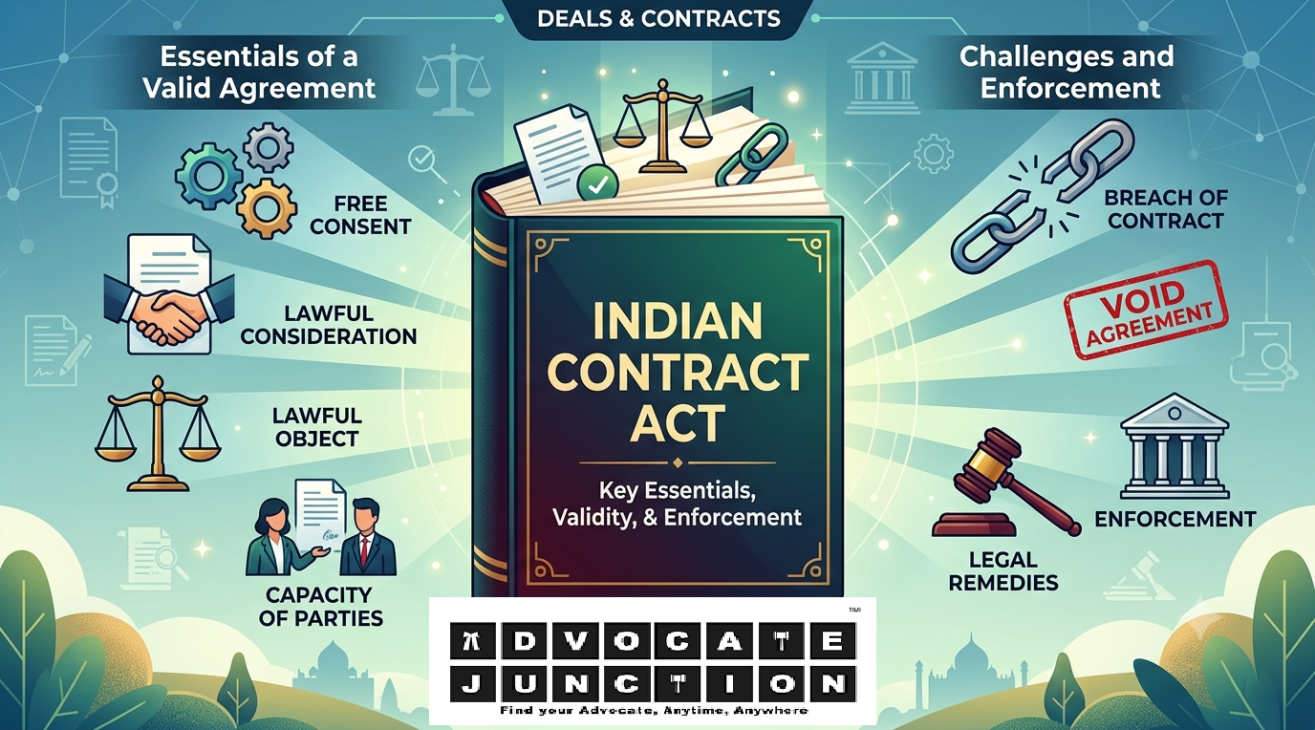
Not every agreement is a contract the law will enforce. For an agreement to become a valid, enforceable contract, certain essentials must be present:
- Offer and acceptance — one party makes a clear offer, and the other accepts it unconditionally. This is the meeting of minds at the heart of every contract.
- Lawful consideration — something of value passes between the parties (money, goods, services, a promise). An agreement generally must be supported by consideration to be enforceable.
- Free consent — both parties agree freely. Consent obtained by coercion, undue influence, fraud, misrepresentation, or mistake is not free, and can make the contract voidable.
- Capacity of parties — the parties must be competent to contract: of the age of majority, of sound mind, and not disqualified by law. A contract with a minor, for example, is generally not enforceable.
- Lawful object — the purpose of the agreement must be legal. An agreement for an unlawful purpose is void.
- Intention to create legal relations — the parties must intend the agreement to be legally binding, not merely a social or casual understanding.
- Certainty and possibility — the terms must be clear and capable of being performed.
| A Verbal Contract Can Be Valid — But Hard to Prove
Many valid contracts in India are verbal, and the law does recognize them. The problem is not validity but proof. When a verbal deal goes wrong, it becomes one person’s word against another’s. This is exactly why putting agreements in writing — even a simple written record or exchange of messages confirming the terms — is so valuable. It does not make the contract ‘more valid’; it makes it far easier to enforce. |
What Makes a Contract Void or Voidable?
Understanding what can defeat a contract is as important as knowing what makes one valid.
- Void agreements are not enforceable by law at all — for example, agreements without consideration (subject to exceptions), agreements with an unlawful object, agreements with a person incompetent to contract, or agreements whose terms are uncertain.
- Voidable contracts are valid until the affected party chooses to set them aside — for example, where consent was obtained by coercion, undue influence, fraud, or misrepresentation. The wronged party can choose to enforce or to rescind the contract.
Knowing which category your situation falls into shapes your remedy. If you were induced into a deal by fraud, for instance, the contract may be voidable at your option, and you may be able to rescind it and claim damages.
When the Other Side Breaks the Contract
A breach of contract happens when one party fails to perform their obligations without lawful excuse. When this happens to you, the law provides real remedies:
- Damages (compensation) — you can claim compensation for the loss caused by the breach. The aim is to put you, as far as money can, in the position you would have been in had the contract been performed.
- Specific performance — in appropriate cases, a court can order the defaulting party to actually perform their obligation, rather than just pay damages. This is common in property matters, where the property itself is what you bargained for.
- Injunction — a court order restraining a party from doing something in breach of the contract.
- Rescission — cancelling the contract and being restored to your original position, often combined with damages.
The right remedy depends on your contract and your goal — whether you want compensation, performance, or simply to be released from the deal. This is where careful legal advice makes a real difference to the outcome.
| Contract Situations We Handle
Business and personal contract disputes across Delhi NCR |
| Business partner or supplier broke the agreement → Claim damages or specific performance |
| Induced into a deal by fraud or misrepresentation → The contract may be voidable — you can act |
| Verbal deal gone wrong, no written contract → We assess proof and your options |
| Drafting an important agreement → Get it drafted right to protect you if things go wrong |
| A well-drafted contract prevents disputes. A well-argued case resolves them.
FREE 15-Minute Case Assessment — Advocate Comes to You WhatsApp: +91-9818900704 advocatejunction.com | Delhi NCR Doorstep Legal Service |
Frequently Asked Questions
Is a verbal contract legally valid in India?
Yes, verbal contracts are generally valid and enforceable in India, provided the essentials of a valid contract are present. The difficulty is proof — when a dispute arises, a verbal contract is hard to establish. This is why written contracts, or even written confirmation of terms through messages or emails, are strongly advisable. Some specific types of contracts, however, are required by law to be in writing or registered.
What can I do if someone breaches a contract with me?
You have several remedies depending on the situation: claim damages (compensation) for your loss, seek specific performance to compel the other party to perform (common in property deals), obtain an injunction, or rescind the contract. The best remedy depends on your contract and what you want to achieve. An advocate can assess your agreement and advise the strongest route, and often a well-drafted legal notice itself prompts the other side to perform or settle.
What makes a contract void?
A contract is void — unenforceable from the start — if it lacks essential elements: for instance, an unlawful object, an agreement with someone not competent to contract, uncertain terms, or (subject to exceptions) an absence of consideration. A void agreement creates no legal rights or obligations. This is different from a voidable contract, which is valid until the affected party chooses to set it aside.
How important is it to have a written contract for business deals?
Very important. While verbal business agreements can be valid, they are difficult to prove and are a frequent source of disputes. A clear written contract records exactly what each side agreed — scope, price, timelines, payment, and what happens if things go wrong — and makes enforcement far easier. For any business dealing of significance, a properly drafted written contract is a small investment that prevents large disputes.
Get Your Agreements Right — Before and After a Dispute
Contracts govern the deals that run your business and your life. Getting them right at the start — clear terms, proper drafting, the essentials in place — prevents most disputes. And when the other side breaks a deal, knowing your remedies and acting decisively is what turns a broken agreement into recovered money or enforced performance.
At AdvocateJunction, we draft, review, and enforce contracts across Delhi NCR — business agreements, supply and service contracts, and personal dealings — and we pursue remedies when a contract is breached. We come to you, understand your deal, and protect your side of it. The first 15 minutes are free.
WhatsApp us at +91-9818900704.
Related Articles on this topic
- Cheque Bounce Case — Section 138 Explained
- How to file a consumer Complaint in India
- Cheque Bounce mistakes in India – The Legal Guide
© 2026 AdvocateJunction. All rights reserved. | advocatejunction.com | For informational purposes only. Not legal advice.