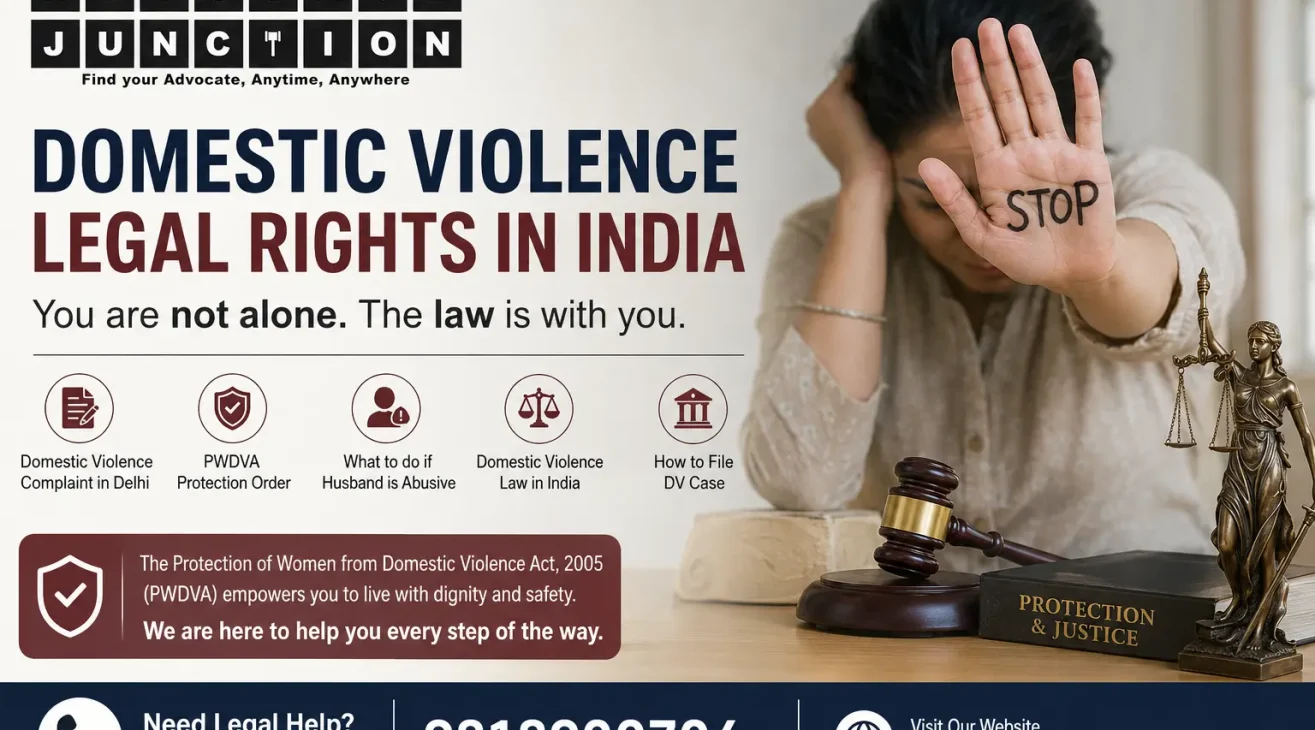
Domestic Violence Legal Rights in India: What Every Woman Should Know
Knowing your domestic violence legal rights in India can change everything — the law protects you far more than most women realise, and you can act on it even before you are ready to leave.If your husband is abusive, Indian law gives you protection and probably you must have heard women cell or Mahila Thana word in your day to day life. These all are specially for women support. Delhi women can always call on women helpline numbers for instantly lodging a complaint .
Let us start with the most important thing.You Do Not Have to Be Physically Beaten to File a Case. Most women who call us say the same thing: He has never actually hit me. He controls all the money. He screams at me every day. He threatens to take the children. But is that really domestic violence? Yes. Under Indian law — specifically the Protection of Women from Domestic Violence Act 2005, which everyone calls the PWDVA — domestic violence is not just physical assault. It is four things:
- Physical abuse: hitting, slapping, pushing, kicking, throwing objects, any act that causes bodily pain or injury.
- Sexual abuse: any sexual act forced on you without your consent, including within marriage.
- Emotional and verbal abuse: constant insults, humiliation, name-calling, threats to harm you or your children, isolating you from family and friends.
- Economic abuse: controlling all household money, not giving you money for basic needs, stopping you from working, taking your salary, forcing you to sign property documents.
- If your husband does any of these things — consistently, or even once in a severe form — you have a right to file a domestic violence case. The law does not require you to have a hospital report or police complaint before filing. Your statement, supported by whatever evidence you have, is enough to begin. Thappad (2020) a Bollywood movie , beautifully captures how ‘minor’ instances of domestic disrespect erode a woman’s self-worth, sparking an essential conversation on why drawing hard boundaries matters.
Who is Protected Under the PWDVA?
The law covers more women than most people realise. You are protected if you are or were in a domestic relationship with the person — meaning you lived together in a shared household at some point.
- Wives — legally married women, regardless of religion.
- Women in live-in relationships — the Supreme Court confirmed this in Indra Sarma v. V.K.V. Sarma (2013). The Centre has told the Supreme Court that live-in relationships should be seen as an acceptable norm.
- Daughters, sisters, mothers — any female family member living in the shared household.
- Widows — living with in-laws after husband’s death.
- Divorced women — for acts that occurred during the marriage.
Importantly — the person committing the abuse is called the respondent under PWDVA. It can be your husband, but also his parents, his brothers, or any male relative living in the shared household. Even a female relative can be made a respondent in certain circumstances — a landmark 2016 Supreme Court judgement confirmed this.
Five Landmark Cases That Shaped Domestic Violence Law in India
These are the Supreme Court and High Court decisions that directly affect how your case will be handled in Delhi. Adv. Priya Tomar recommends every woman facing domestic violence read at least the summary of each.
| Indra Sarma v. V.K.V. Sarma | 2013 | Supreme Court of India
This was the case that extended PWDVA protection to women in live-in relationships. The Supreme Court held that a woman in a long-term live-in relationship, especially one where she gave up opportunities to maintain that relationship, is entitled to the same protection as a legally married wife. If you are in a live-in relationship and facing abuse — this case protects you. |
| S.R. Batra v. Taruna Batra | 2006 | Supreme Court of India
This case established the boundaries of the right of residence under PWDVA. The Supreme Court held that a wife’s right of residence is in the shared household — the matrimonial home where the couple actually lived. Your mother-in-law’s independent property is not your matrimonial home. Understanding this distinction is critical before you file a residence order application. |
| Hiral P. Harsora v. Kusum Narottamdas Harsora | 2016 | Supreme Court of India
Before this judgement, only adult male respondents could be named in a DV case. The Supreme Court struck down that restriction. Now you can name your mother-in-law, sister-in-law, or any other family member — male or female, adult or not — who participated in the abuse. This is extremely relevant in joint family situations where in-laws are actively involved in the domestic violence. |
| Rupali Devi v. State of Uttar Pradesh | 2019 | Supreme Court of India
This judgement is life-changing for women in Delhi NCR who fled abuse and returned to their parents’ home. The Supreme Court held that a woman can file a DV case in the city where she currently lives — even if the abuse happened in a different city. So if you were abused in Lucknow but are now living with your parents in Delhi, you can file in Delhi. You do not have to go back. |
| Aruna Parmod Shah v. Union of India | 2008 | Delhi High Court
This Delhi High Court judgement specifically addressed the duties of Protection Officers — the government-appointed officers who are supposed to help DV victims file complaints and access services. The court held that Protection Officers cannot be passive. They must actively assist women in distress. This judgement is your leverage if a Protection Officer in Delhi is unresponsive to your complaint. |
What Can You Actually Get From a DV Case?
This is the practical question that matters most. Filing a domestic violence case gives you access to five types of legal relief — and you can apply for all five in a single application.
1. Protection Order
This is the most immediate relief. A protection order is a court directive prohibiting your husband from committing any further act of domestic violence against you, your children, or any other family member you specify.
It also prohibits him from contacting you — phone calls, messages, emails — and from approaching your workplace, your children’s school, or your parents’ home. Violation of a protection order is a criminal offence carrying imprisonment of up to one year.
How fast: Courts can pass an ex-parte protection order — meaning without hearing the husband — on the very first hearing if there is evidence of immediate danger. In Delhi NCR, this can happen within 3 to 7 days of filing.
2. Residence Order
If you are living in the matrimonial home and afraid he will throw you out — or if he has already thrown you out — a residence order is what you need.
A residence order does two things. First, it prohibits your husband from dispossessing you from the shared household. Second, it can direct him to find you alternative accommodation of the same standard if living together is no longer safe.
Important: Under S.R. Batra v. Taruna Batra (2006 SC), your right of residence is in the shared household — the home where you and your husband actually lived together. If he is trying to claim that home belongs to his parents, your advocate needs to establish it was your matrimonial home.
3. Monetary Relief
Domestic violence cases are not just about stopping the abuse. They also give you financial protection. Under PWDVA you can claim:
- Loss of earnings — if the abuse caused you to lose your job or stopped you from working.
- Medical expenses — treatment costs for injuries caused by the abuse.
- Maintenance — monthly financial support for you and your children, in addition to or as an alternative to filing a separate maintenance case.
- Damage to property — if your husband damaged your belongings, jewellery, or stridhan.
This monetary relief is separate from maintenance under Section 144 BNSS — you can claim both simultaneously. Courts in Delhi regularly award both.
4. Custody Order
A DV complaint automatically gives you the right to apply for temporary custody of your children. Courts recognise that children in a household with domestic violence are at psychological risk — and they act accordingly.
An interim custody order can be passed at the same hearing as the protection order — so your children are protected at the same time as you.
5. Compensation Order
Beyond immediate monetary relief, courts can award compensation for the mental anguish, pain, and suffering caused by the domestic violence. This is a lump sum payment — separate from monthly maintenance — that courts award in cases of proven severe or sustained abuse.
Delhi courts have awarded compensation ranging from ₹50,000 to ₹5,00,000 depending on the severity and duration of abuse. Adv. Priya Tomar’s note: “Always include a compensation application. Even when courts do not award the full amount asked, they almost always award something — and it sends a strong signal to the respondent about the court’s view of his conduct.”
How to File a Domestic Violence Case in Delhi — Your First Steps
Filing a DV case sounds intimidating. It is not — especially with an advocate guiding you. Here is exactly what happens, step by step.
Step 1 — Your Safety First
Before anything else — if you are in immediate physical danger, call 112. Delhi Police has a domestic violence cell and must respond. You can also call the Delhi Commission for Women helpline at 181 — they operate 24 hours.
If you need to leave the house, take these with you if it is safe to do so: your Aadhaar card, children’s birth certificates, marriage certificate, any medical records of injuries, photographs, and your phone with all message histories backed up.
Step 2 — Document Everything You Can
Courts work on evidence. Start building your evidence file from today — even before you decide whether to file.
- Photographs of injuries, dated and clear. Even old photographs are useful.
- Medical records from any treatment for abuse-related injuries.
- WhatsApp messages, voice notes, emails showing threats, abuse, or controlling behaviour. Screenshot and save to cloud storage immediately.
- Witness names — neighbours who heard shouting, family members who saw injuries, anyone who can speak to the pattern of abuse.
- Financial documents showing economic abuse — bank statements, salary accounts he controls, property documents in his name only.
You do not need all of this to file. You can file with just your statement. But the more evidence you have, the faster and stronger your relief.
Step 3 — Reach a Protection Officer or Advocate
In Delhi, every district has a government-appointed Protection Officer under PWDVA. You can approach them directly at no cost — they will help you file the Domestic Incident Report (DIR) which is the formal record of your complaint.
Alternatively — and this is what we strongly recommend — consult a family law advocate first. An advocate will file a more complete application covering all five types of relief simultaneously, which gives you far better outcomes than a self-filed DIR.
AdvocateJunction’s advocates come to your home. You do not have to travel to a court or office. The first 15 minutes discussion on phone is free and completely confidential.
Step 4 — Filing the Application in Court
Your advocate files an application under PWDVA in the Magistrate’s Court or Family Court of the district where you live or where the abuse occurred — or where you currently reside if you have fled, thanks to the Rupali Devi v. State of UP (2019 SC) judgement.
The application includes: your statement of the abuse, the relief you are seeking (protection order, residence order, monetary relief, custody, compensation), and your supporting evidence.
Step 5 — First Hearing and Interim Order
The court issues notice to your husband and sets a first hearing date — typically within 3 days to 3 weeks depending on urgency. At the first hearing, the court can pass interim orders immediately — protection order, residence order, interim custody — without waiting for the full case to conclude.
This is critical to understand. You do not have to wait months to get relief. Interim orders provide immediate protection while the main case proceeds.
Step 6 — Final Order
After hearing both sides, examining evidence, and potentially ordering a social welfare report, the court passes the final order. This is a comprehensive document covering all the relief you applied for — with specific amounts, specific prohibitions, and specific consequences for violation.
Final DV orders typically come within 3 to 9 months in Delhi Magistrate Courts — significantly faster than divorce or maintenance cases.
What About a Criminal Case — Should You File an FIR as Well?
This is a question ladies ask with our advocates always in almost every domestic violence case. The answer depends on your situation and output you want . PWDVA is a civil law. It gives you protection orders, residence rights, and financial relief. Your husband faces no jail time under PWDVA unless he violates a court order.
Section 498A IPC (now Section 85 BNS) is criminal law. Filing an FIR under 498A means your husband and potentially his family can be arrested. It is a non-bailable offence. Cases take longer. The process is more public and more adversarial.
Many women file both simultaneously — PWDVA for immediate civil relief and 498A for criminal accountability. Others file only PWDVA, especially when the primary goal is safety and financial support rather than imprisonment.
| Adv. Priya Tomar’s Practical Advice:
In my experience, filing PWDVA first gives you faster, more practical relief — protection order, money, custody. Filing 498A simultaneously is appropriate when the abuse is severe and repeated, when you want the husband’s family held accountable, or when criminal prosecution is genuinely your goal. But never let fear of 498A’s complexity stop you from filing PWDVA. PWDVA alone is extremely powerful and much faster to act on. |
Concerns That Stop Women from Filing — Addressed Honestly
We hear these concerns every day. They are valid. Here is the honest answer to each.
“I am worried about my children if I file a case.”
Your children’s welfare is actually protected, not harmed, by filing. A domestic violence case allows you to immediately apply for interim custody. Courts are acutely aware that children in homes with domestic violence suffer psychological damage even if they are not directly abused. Filing actually strengthens your custody position — not weakens it.
“My in-laws will create more problems if I file.”
This is exactly why PWDVA allows you to name in-laws as respondents. A protection order covers all named respondents — not just your husband. If your in-laws are part of the problem, include them. The same court order restricts all of them simultaneously.
“I cannot afford a lawyer.”
Legal aid is available free of charge through the Delhi State Legal Services Authority (DSLSA) for women who cannot afford advocates. Additionally, Protection Officers are government-appointed and available at no cost. AdvocateJunction also offers a free first assessment — with transparent, fixed fees for full representation that are significantly lower than traditional law firm rates.
“I still love him. I just want the abuse to stop.”
You do not have to want a divorce to file a DV case. PWDVA is not a divorce law. Many women file DV cases, get a protection order that stops the immediate abuse, and continue the marriage. The case gives you legal leverage — which often changes the husband’s behaviour more effectively than anything else. Filing is not the end of your marriage unless you want it to be.
“What if no one believes me?”
Courts do not require you to prove domestic violence beyond reasonable doubt the way a criminal case requires. The standard under PWDVA is lower — your consistent, credible statement supported by any corroborating evidence is enough for interim relief. Courts in Delhi have become significantly more sensitive to domestic violence complaints in the last five years. You will be heard.
Frequently Asked Questions
Can I file a DV case if I am already divorced?
Yes — for acts that occurred during the marriage. Divorce does not retrospectively wipe out the abuse you suffered. You can file a complaint for past domestic violence even after the marriage has legally ended, provided the acts complained of happened when you were in a domestic relationship.
My husband is a government employee ( a police officer ). Will anyone take my complaint seriously?
Yes. PWDVA applies equally regardless of the respondent’s profession or status. In fact, for government employees, courts can attach salary and direct the department to ensure compliance with maintenance and protection orders. Delhi courts have passed strong orders against police officers and government officials in DV cases. Do not let his profession intimidate you.
Can my parents support me during the DV case proceedings?
Absolutely. You have the right to be accompanied by a support person — a family member, friend, or NGO representative — at all proceedings. Courts are required to ensure your safety and dignity throughout. Your parents can sit with you during hearings and support you throughout the case.
What if my husband files a false counter-case against me?
Counter-cases — typically false theft claims, 406 IPC for dowry articles, or false allegations of adultery — are a common tactic by respondents in DV cases. Courts are aware of this pattern. Your advocate will address these simultaneously. A false counter-case does not stop or delay your DV case — both proceed independently.
How long will the DV case take?
Interim relief — protection order, interim custody, interim maintenance — typically within 2 to 6 weeks of filing. Final order — 3 to 12 months depending on whether the case is contested. If your husband does not contest, it can conclude significantly faster. The interim relief, which you get quickly, is often the most important protection you need.
I live in Noida or Gurgaon — not Delhi. Does this law still apply?
Yes. PWDVA is a central law applicable across India. Noida falls under UP jurisdiction — Family Courts in Gautam Buddha Nagar ( NOIDA) district. Gurgaon falls under Haryana jurisdiction — Family Courts in Gurugram district. AdvocateJunction covers all these courts. The process is identical — only the court location changes.
You Have Already Taken the First Step
Reading this blog was a step. Not a small one.
Many women spend years not knowing that what they are experiencing has a name, has a law, and has a solution. You now know all three.
The law in India has never been more equipped to protect you than it is in 2026. Protection orders come fast. Courts take domestic violence seriously. And you do not have to navigate any of this alone.
AdvocateJunction was built for this. We come to you — your home, your time, your comfort. No court corridors to walk through. No strange offices. Just a calm, private conversation with an advocate who has seen this situation many times and knows exactly how to help.
Your first 15 minutes are free. Everything you share is completely confidential.
WhatsApp us at +91-9818900704. Right now, if you are ready. Or save the number for when you are.
| Emergency Contacts — Save These Right Now
Police Emergency: 112 Delhi Commission for Women Helpline: 181 (24 hours) National Women Helpline: 7827170170 Delhi State Legal Services Authority (Free Legal Aid): 011-23385038 AdvocateJunction — Confidential Legal Help: +91-9818900704 |
Related Articles on AdvocateJunction
- Child Custody Rights in India — Complete Legal Guide
- How to Claim Maintenance from Husband in Delhi
- Can working wife May claim maintenance
© 2026 AdvocateJunction. All rights reserved. | advocatejunction.com | For informational purposes only. Not legal advice. If you are in immediate danger call 112.