
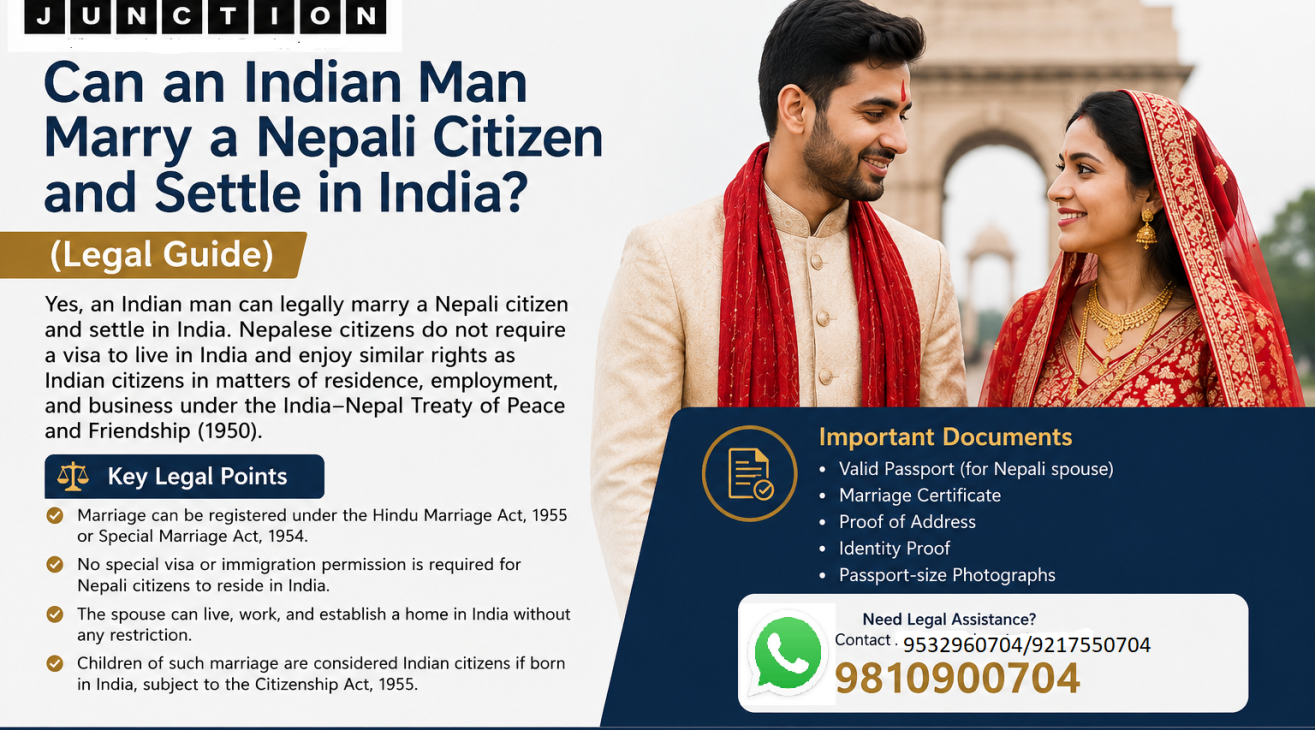
Can an Indian Man Marry a Nepali Citizen and Settle in India? (Legal Guide)
Quick Answer: Yes, an Indian man can legally marry a Nepali citizen and settle in India, but the marriage must be registered under the Special Marriage Act, 1954 in India to have full administrative recognition. While couples can live together under the 1950 India-Nepal Treaty, a Nepali wife cannot legally hold an Indian Voter ID or vote without formally acquiring Indian Citizenship under the Citizenship Act, 1955. Recent strict electoral roll revisions in border states make proper legal documentation mandatory for safety.
Introduction
The India-Nepal border is not just a line on the map—it is a bridge connecting families, cultures, and lives. For centuries, the “roti-beti” relationship has flourished, with marriages between Indian men and Nepali women being commonplace, particularly in border states like Uttar Pradesh, Bihar, Uttarakhand, and West Bengal.
But, while the marriage itself may be simple, the legal recognition, documentation, and rights that follow can be complicated. This guide addresses a specific scenario: An Indian citizen (male) working or living in Nepal marries a Nepali citizen (female), and the couple later decides to settle in India.
What happens to the wife’s legal status in India? How do you register the marriage in India? What problems might arise with voter IDs, passports, or even the wife’s rights in Nepal if the marriage fails?
This blog provides authentic, fact-oriented answers based on the latest legal positions in both countries.
Part 1: Getting Married in Nepal – The First Step
Before discussing the post-move challenges, let’s briefly cover how the marriage itself should be registered in Nepal, as this forms the foundation for everything that follows.
The Correct Procedure for an Indian-Nepali Marriage in Nepal
An Indian citizen marrying a Nepali citizen in Nepal must register the marriage through the District Court (not the local Ward Office, which is only for Nepali-Nepali couples). The process requires:
-
15-day residency in Nepal before applying
-
Single Status Certificate (proving you are unmarried) from the Indian Embassy in Kathmandu or from Indian authorities
-
Personal appearance of both parties before the District Court judge
-
Two witnesses with valid identification
Upon completion, you receive a Nepali Marriage Certificate (issued by the District Court). This document is critical—it is your primary proof of marriage for Indian authorities.
Why This Matters
If you skip this step or only have a religious ceremony, you have no legal proof of marriage. Without a registered marriage certificate, your wife cannot:
-
Obtain a dependent visa or residency in India
-
Claim rights to property or inheritance
-
Access government schemes or services
Part 2: Registering the Marriage in India – Why Registration is Mandatory
Once you relocate to India, simply possessing the Nepali marriage certificate is not sufficient for most legal and administrative purposes. You must register the marriage in India.
The Governing Law: Special Marriage Act, 1954
Under Indian law, marriages between an Indian citizen and a foreign national (including a Nepali citizen) are governed by the Special Marriage Act, 1954. This is distinct from personal laws (Hindu Marriage Act, etc.) because it applies across nationalities and religions.
Step-by-Step Registration Process in India
Step 1: Residency Requirement
At least one party must have resided in the district of the Marriage Officer for 30 days prior to giving the notice of intended marriage.
Step 2: Notice of Intended Marriage
You and your wife must file a “Notice of Intended Marriage” with the Marriage Registrar in your district. This notice is then published publicly for 30 days to allow for objections.
Step 3: Waiting Period
If no objections are received within 30 days, you can complete the marriage before the Marriage Officer within the next 60 days.
Step 4: Final Registration and Certificate
On the appointed date, both parties must appear with three witnesses. After completing the formalities, the Marriage Officer issues the Marriage Certificate under the Special Marriage Act.
Documents Required for Registration in India
For both parties, you will need:
-
Valid passport or other proof of nationality
-
Birth certificate or age proof
-
Address proof (ration card, voter ID, Aadhaar, etc.)
-
For the Nepali spouse: A No Objection Certificate (NOC) or Single Status Certificate from the Embassy of Nepal in India, confirming her marital status
-
Affidavits confirming marital status, nationality, and that the parties are not within prohibited degrees of relationship
-
Divorce decree or death certificate of former spouse (if applicable)
-
The Nepali marriage certificate (from the District Court), duly translated into English if not already in English
Can You Skip the Special Marriage Act Registration?
Technically, a marriage certificate issued by a competent authority in Nepal is recognized in India under the principle of “comity of nations”. But, for practical purposes—such as applying for your wife’s visa, opening joint bank accounts, updating passports, or claiming spousal benefits—Indian authorities will insist on an Indian-registered marriage certificate under the Special Marriage Act.
Practical Advice: Do not skip this step. Register the marriage in India as soon as possible after relocating.
Part 3: The Major Problem – Voter ID and Citizenship Documentation for the Nepali Wife
This is where many Indo-Nepali couples face their biggest hurdle. The issue has gained significant media attention recently, with reports from Uttar Pradesh, Bihar, and Uttarakhand highlighting the confusion and distress caused by electoral roll revisions.
The Special Intensive Revision (SIR) Problem
The Election Commission of India (ECI) periodically conducts a Special Intensive Revision (SIR) of electoral rolls to remove the names of ineligible voters, including foreign nationals who should not be on the rolls.
The problem arises because the SIR requires voters to establish their citizenship, often by tracing their family history back to the 2003 electoral rolls. For a Nepali woman who married an Indian man and moved to India after 2003, she faces an impossible situation:
-
Her name is not in the 2003 voter list (because she was not in India at that time)
-
Her parents’ names are also not in the 2003 list (as they are Nepali citizens living in Nepal)
-
She may have obtained a voter ID card years ago, but now it may be at risk of cancellation
Ground Reports: What Is Happening on the Ground
-
In Bahraich, Uttar Pradesh (November 2025): The SIR created widespread confusion among Indo-Nepali couples. Many women who had been living in India for years, had identity cards, PAN cards, and even voter IDs, suddenly faced the prospect of being removed from the electoral rolls because they could not produce the required documentation linking them to the 2003 rolls. One resident, Taufiq Shah, who married a woman from Kathmandu in 2018, said: “My wife’s name is in the 2025 voter list, but not in the 2003 one. Her parents’ names are also not there. I don’t know how to proceed.”
-
In Madhubani, Bihar (July 2025): The situation was even more dramatic. A woman who was the elected mukhiya (village head) of her village—a position of significant authority—found her status questioned because she originally came from Nepal. Despite having a voter ID, identity, and PAN card, she could not produce the required lineage documents. A Booth Level Officer in Madhubani admitted: “Every family has at least one daughter-in-law from Nepal. We have at least 50-100 such cases in each booth.”
-
In Pithoragarh, Uttarakhand (February 2026): At a government outreach camp, Nepali brides repeatedly raised the issue of being unable to obtain identity cards and other documents. One social worker noted: “Earlier, the number of Nepali women marrying into Indian families was small, and documentation was not an issue. They lived without papers. Now, documents have become mandatory for even basic services.”
The Root Cause: A Cultural Practice
Why is this so widespread? Because in Nepal, many families do not obtain citizenship certificates or passports for their daughters, assuming they will marry and move away, after which their in-laws will handle documentation. This leaves these women with no “home” documentation to present to Indian authorities.
The Official Position: What the Authorities Say
District Magistrates and Election Officials have tried to reassure affected couples. The Bahraich DM clarified: “Those who came from Nepal after marriage and whose relatives’ names are not in the 2003 list can still fill their enumeration form. They will have another chance to submit their documents when the next round of notices is issued.”
But, the Sitamarhi DM was more blunt: For those born after specific dates, they need to show documents for themselves and their parents proving place of birth. “They should have one parent born in India and the other should not be an illegal immigrant.”
The reality is that many Nepali women married to Indian men will not be able to remain on the electoral rolls unless they can produce the required proof of Indian lineage—which they cannot.
The Big Question: Should the Nepali Wife Apply for Indian Citizenship?
The Citizenship Act, 1955 allows foreign nationals (including Nepali citizens) to acquire Indian citizenship through registration or naturalization after meeting certain residency and other requirements. But, this process is lengthy, bureaucratic, and rarely pursued.
A local lawyer in Madhubani explained: “There is a lack of awareness and literacy, and the process to get citizenship is also difficult and hectic. So they skip the process and manage to get an identity card, Voter ID, PAN card, etc., to avail facilities like Indian citizens without having citizenship.”
Critical Point: The 1950 India-Nepal Treaty of Peace and Friendship grants Nepali citizens certain privileges in India (residence, property ownership, movement, etc.). But, voting rights require Indian citizenship under Article 326 of the Constitution. A Nepali national cannot legally vote in Indian elections, regardless of how long they have resided in India.
What Should the Nepali Wife Do?
-
Do not claim Indian citizenship or voting rights unless you have formally acquired it through the legal process. Doing so can lead to legal consequences.
-
Obtain a Nepali passport if you do not already have one. This is your primary proof of nationality.
-
Apply for an Overseas Citizen of India (OCI) card if eligible. While OCI does not grant voting rights, it provides multiple-entry lifelong visas and parity with NRIs in economic matters.
-
Be prepared to lose voter ID status if you cannot produce the required lineage documents. This is not discrimination—it is the correct application of citizenship law.
Part 4: What Problems Will the Nepali Wife Face in Nepal?
One of the most overlooked aspects of cross-border marriage is what happens to the Nepali wife’s rights in her own country—particularly if the marriage fails.
Issue 1: Citizenship Rights for Children
Under Nepal’s citizenship laws (governed by the Constitution of Nepal 2015 and the Nepal Citizenship Act 2006), there is a provision that affects children born to Nepali mothers with foreign fathers.
According to Article 11(5) of the Nepali Constitution: “a child born to a Nepali mother whose father is not identified, such children may be given citizenship by descent.” But, if the father is identified as a foreigner, the child’s citizenship status becomes complicated.
Also, Section 5(2) of the Citizenship Act denies Nepali women the equal right to confer their citizenship to their children by descent. Instead, such children must seek naturalization, a process that is discretionary, bureaucratic, and often unsuccessful.
Practical Implication: If your Nepali wife gives birth to your child in Nepal (or even in India), and the child’s father is identified as an Indian citizen, the child may not automatically receive Nepali citizenship by descent. This can create statelessness issues.
Issue 2: Property Rights in Nepal
Under the Muluki Civil Code 2074 (2017) of Nepal, a married woman has rights to her husband’s property during the marriage and upon divorce.
But, if the couple resides in India and the marriage is governed by Indian law, what happens to property located in Nepal that belongs to the wife (e.g., inherited property from her parents)? The answer lies in the lex situs principle—property located in Nepal is governed by Nepali law.
If the marriage ends in divorce in India, will that divorce decree be recognized in Nepal for the purpose of property rights? This is a complicated area. Under Section 706 of the Muluki Civil Code, foreign judgments (including divorce decrees) may be recognized if they meet certain requirements: they must be issued by a competent authority, be final and enforceable, and not violate public policy.
Recent Supreme Court of Nepal decisions have clarified that if a partition of property case is filed in Nepal before a foreign divorce is finalized, the spouse retains standing. But, if the foreign divorce is finalized first, the issue remains unclear.
Practical Implication: If your Nepali wife owns property in Nepal, she should ensure that any divorce proceedings in India do not affect her rights in Nepal. It may be advisable to file a protective partition case in Nepal before the Indian divorce is finalized.
Issue 3: Maintenance and Alimony Claims in Nepal
If the couple separates and the Nepali wife returns to Nepal, can she claim maintenance from her Indian husband under Nepali law?
Under Sections 93-95 of the Muluki Civil Code, a wife can file for divorce (with or without consent) and claim maintenance. But, the husband must be within the jurisdiction of the Nepali court for the order to be enforceable. If the husband resides in India, enforcement becomes a cross-border issue.
Practical Implication: Maintenance claims are best pursued in the country where the husband resides or where his assets are located. The Nepali wife should ideally file for maintenance in India under Indian law (which has robust maintenance provisions under the CrPC and special marriage laws) before returning to Nepal.
Part 5: The Indian Husband’s Liability – Potential Legal Issues
As the Indian husband, you are not entirely free from legal exposure in Nepal, especially if things go wrong in the marriage.
Potential Claim 1: Maintenance Obligations
If your Nepali wife remains in Nepal (or returns there) and files for maintenance in a Nepali court, and if you have assets in Nepal (e.g., property, bank accounts, investments), those assets could be attached to satisfy a maintenance order.
Under the Muluki Civil Code, the obligation to provide maintenance is based on “reputation” and the husband’s income. While enforcement against a husband residing in India is difficult, if you ever visit Nepal or have business interests there, you could face legal proceedings.
Potential Claim 2: Partition of Property
If you and your wife jointly own property in Nepal (or if you have invested in property in her name), a divorce in Nepal could trigger partition proceedings. The Civil Code provides for equal division of property among coparceners (husband, wife, children).
Potential Claim 3: Criminal Proceedings
Under Nepali law, certain matrimonial offenses (such as abandonment without cause, failure to provide maintenance, or physical abuse) can attract criminal liability. While less common, there is no absolute immunity simply because the husband is a foreign national residing outside Nepal.
Practical Advice: If the marriage turns sour, do not simply abandon your wife in Nepal without formal legal closure. Settle maintenance and property matters through a legally binding agreement to avoid future claims.
Part 6: Summary and Practical Recommendations
For the Marriage Itself
| Action | Timeline | Cost (Approx.) |
| Register marriage in Nepal District Court | 18-20 days | NPR 13,700-31,000 |
| Authenticate Nepali marriage certificate (Notarization + MFA) | 3-5 days | NPR 2,000-5,000 |
| Register marriage in India under Special Marriage Act | 30 days (notice) + processing | INR 500-1,000 + legal fees |
For the Nepali Wife’s Documentation in India
| Document | Recommended Action | Feasibility |
| Voter ID | Do not claim unless you have Indian citizenship; be prepared for removal from rolls | Low |
| Identity Card | Obtain based on residence proof, not citizenship claim | High |
| PAN Card | Obtain if required for financial transactions | High |
| Indian Passport | Requires proof of Indian citizenship—generally not available | Very Low |
| OCI Card | Apply if eligible; provides lifelong residency and multiple benefits | Moderate |
| Nepali Passport | Essential—renew and maintain at all costs | High |
Final Thoughts
Marriage between an Indian man and a Nepali woman is a beautiful union of two neighboring cultures, but it comes with legal complexities that many couples discover only when a crisis arises. The key to a trouble-free life is proactive documentation: register the marriage in both countries, maintain your wife’s Nepali passport, and do not rely on voter ID as proof of Indian citizenship. Recently Uttrakhand Govt allowed Nepali Bhutani citizens to register their marriage under Civil Code.
As one Booth Level Officer in Madhubani wisely noted: “Agar sarkar proof mangegi, toh yeh shaadiyan ruk jayengi.” Do not let your marriage be one of those that stops. Do the paperwork, get the legal recognition, and build your life on a solid foundation.
Need Legal Help with Cross-Border Marriage Documentation?
If you are an Indian-Nepali couple facing documentation challenges, voter ID issues, or need help registering your marriage under the Special Marriage Act, 1954, don’t navigate the legal hurdles alone.
Talk to the legal experts at Advocate Junction. We provide authentic legal assistance for cross-border matrimony and documentation in India.
-
📞 Call / WhatsApp Us: +91-9810900704
-
🌐 Visit Our Portal: advocatejunction.com
-
📧 Email: contactadvocatejunction@gmail.com
- Disclaimer: This article is for informational purposes only and does not constitute legal advice. Laws in both India and Nepal are subject to change. Please consult qualified legal professionals at Advocate Junction for advice specific to your situation.
Suggested Reading-
- NRI Court Marriage in India
- Difficulties faced by Nepali women married into Indian family
- Pattern of caste and ethnic intermarriage in Nepal