Husband Stopped Giving Money? How to Get Court Support ?
Husband not giving money after separation: How to Get Emergency Financial Support from Court?
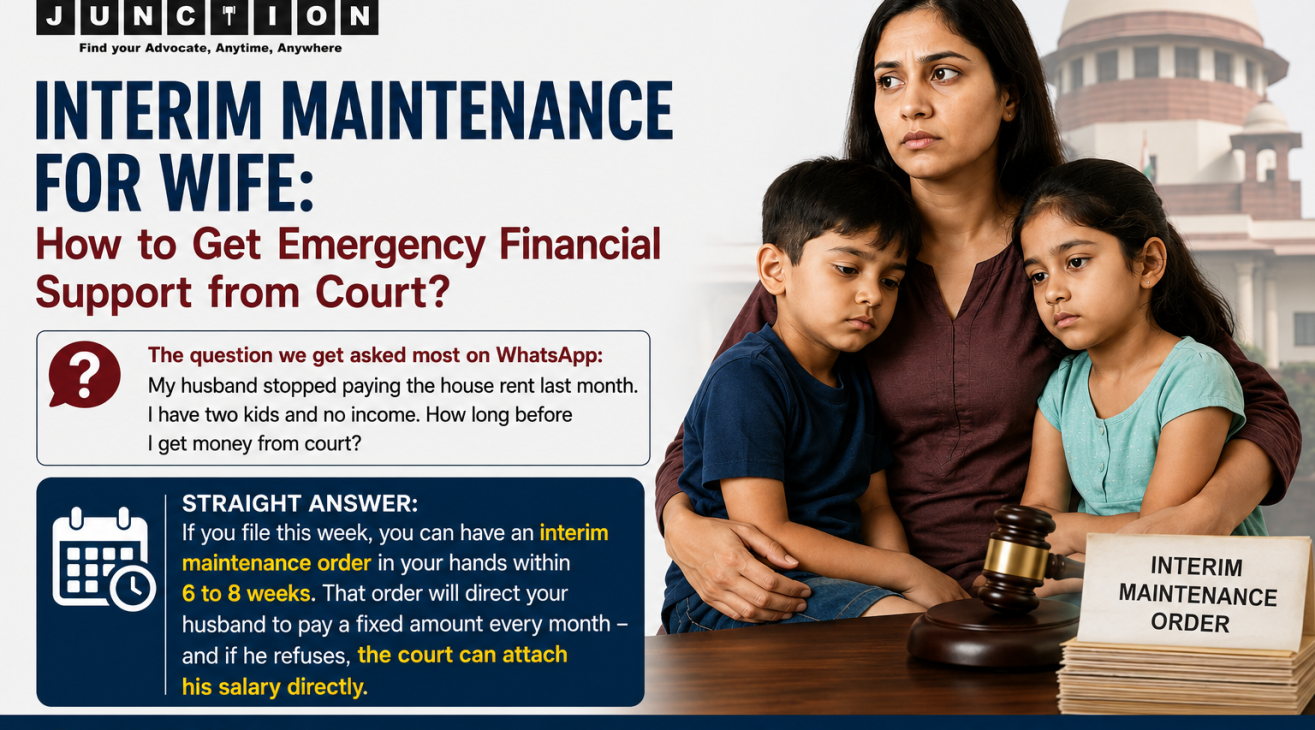
The question we get asked most on WhatsApp:
My husband stopped paying the house rent last month. I have two kids and no income. How long before I get money from court?
Straight answer: if you file this week, you can have an interim maintenance order in your hands within 6 to 8 weeks. That order will direct your husband to pay a fixed amount every month — and if he refuses, the court can attach his salary directly.That is what interim maintenance is. It is not a lengthy court battle. It is an emergency financial order designed for exactly the situation you are in right now.
The rest of this blog answers every other question we hear — in the same direct way.
How quickly can I actually get money?
its easy and faster than we all think. Here is the realistic timeline in Delhi NCR Family Courts in 2026:
- Week 1: You consult an advocate and file your main maintenance application plus an urgent interim application on the same day.
- Week 2: Court issues notice to your husband. He has 30 days to appear and respond.
- Week 3–4: Both parties file financial affidavits disclosing income and expenses. This is mandatory under the Rajnesh v. Neha Supreme Court guidelines.
- Week 5–8: Interim maintenance hearing. The court examines both affidavits and passes the order — specifying the exact monthly amount your husband must pay.
- Within 30 days of order: First payment is due. If he misses it, enforcement proceedings can be filed the next day.
The most important thing to understand about this timeline: every day you delay filing is a day of maintenance you cannot recover. Courts award arrears from your filing date — not from the date of the order. So filing today versus filing three months from now is a difference of three months of unpaid maintenance that is gone permanently.
How much will I actually get?
This is always the second question. The honest answer is: it depends on your husband’s income — proven or imputed — and your specific needs. But Delhi courts follow a consistent benchmark that gives you a realistic working range.Interim maintenance is typically set at 25% to 30% of the husband’s net monthly income when the wife has no independent income. When the wife earns independently, courts look at the income gap and typically award 15% to 25%.
In practical terms for Delhi NCR:
- Husband earns ₹30,000–₹50,000/month: Wife typically gets ₹8,000–₹14,000/month. Each child adds ₹4,000–₹7,000/month.
- Husband earns ₹50,000–₹1,00,000/month: Wife typically gets ₹14,000–₹28,000/month. Each child adds ₹7,000–₹12,000/month.
- Husband earns ₹1,00,000–₹2,00,000/month: Wife typically gets ₹28,000–₹50,000/month. Each child adds ₹12,000–₹22,000/month.
- Husband earns above ₹2,00,000/month: Wife typically gets ₹50,000–₹1,00,000+/month. Children assessed separately based on their established lifestyle.
| Important: These are interim figures — not your final entitlement.
Interim maintenance is intentionally set lower because courts are working with limited evidence at the first hearing. Think of it as the floor. Your advocate simultaneously builds the complete evidence case so your final order — passed 12–18 months later — is significantly higher. The difference between interim and final amounts, multiplied by every month, is recovered as arrears. |
My husband says he earns only ₹15,000. What can I do?
This is one of the most common situations we handle at AdvocateJunction. Income concealment is widespread in maintenance cases — husbands show a low declared income while living a completely different lifestyle.Delhi courts are fully aware of this pattern. They have a tool called income imputation — and they use it aggressively.
Here is how it works in practice. Even if your husband’s salary slip shows ₹15,000, the court will look at:
- His monthly rent or EMI. A ₹40,000/month flat tells the court he earns far more than ₹15,000.
- Car loan or vehicle registration. EMIs, insurance, fuel — these are documented monthly expenses.
- Children’s school fees. If your child studies in a school charging ₹15,000/month, the father’s income cannot be ₹15,000.
- Credit card statements. Monthly spending patterns reveal real income far more accurately than declared salary.
- Social media and travel. Foreign holidays, restaurant outings, and lifestyle posts are admissible as lifestyle evidence.
Courts have consistently held — most recently said under the Rajnesh v. Neha (2020) Supreme Court judgement guidelines — that when a husband’s declared income is inconsistent with his lifestyle, the court will impute a realistic income figure and base maintenance on that.
Now its your job and your advocate’s job is to build that lifestyle evidence file from day one and produce it .
Can I get interim maintenance even if I am working?
Yes. A working wife can absolutely claim interim maintenance. This is one of the most misunderstood aspects of maintenance law in India.
The law does not ask whether you earn. It asks whether you can maintain your established standard of living on your own income alone. If you cannot — and in most cases you cannot, because your husband earns significantly more than you — you are entitled to maintenance.
| Example: Sunita works as a school teacher earning ₹24,000/month. Her husband is a corporate professional earning ₹1,20,000/month. They lived in a South Delhi 3BHK, their daughter studies in a private school at ₹14,000/month fees. Sunita filed for maintenance after separation.
The Delhi Family Court awarded Sunita ₹32,000/month maintenance plus ₹16,000/month child maintenance — despite her own salary. The judge’s reasoning: her income alone cannot maintain the established standard of living. This is consistent with how Delhi courts apply the income gap principle in 2026. |
What if he simply refuses to pay after the court order?
No one is above the law in India . Then you have to go back to court immediately. A maintenance order is not a suggestion. It is a court directive. Refusing to comply is contempt of court, which is a criminal offence under Indian law.
Your enforcement options, in order of quick actions to be taken:
- File a contempt petition. Do this after the very first missed payment — not after three or four. Courts move fast on contempt. Your husband faces fines and up to one month imprisonment per default.
- Salary attachment. The court orders his employer to deduct the monthly maintenance directly from his salary and pay it to you. This is the most effective tool for salaried employees — he cannot avoid it.
- Bank account attachment. Courts can freeze his account and release funds directly to you.
- Property attachment. If he owns property, it can be attached and sold to recover arrears.
- Passport impoundment. If there is a risk he will flee to another country, apply for this immediately.
The biggest mistake women make is waiting and hoping that he will come around, not wanting to escalate. Not escalating the issue makes situation much messy . Do not wait. Every month of non-payment is recoverable debt, but only if you pursue it actively.
| How Does Your Situation Compare?
Real outcomes from Delhi Family Courts — 2026 |
| Husband earning ₹40,000/month, wife not working, 1 child → Typical interim: ₹10,000–₹14,000/month wife + ₹5,000/month child |
| Husband earning ₹80,000/month, 2 children with wife → Typical interim: ₹20,000–₹28,000/month wife + ₹14,000/month children |
| Husband earning ₹1,50,000/month, wife earns ₹20,000 → Typical interim: ₹28,000–₹40,000/month |
| NRI husband, income unknown, wife in Delhi → Court imputes income, typical interim: ₹30,000–₹50,000/month |
| Your case is unique. Get a free personalised assessment.
FREE 15-Minute Case Assessment — Advocate Comes to You / Book Doorstep Legal Support I Call or WhatsApp: +91-9818900704 advocatejunction.com | Delhi NCR’s First Doorstep Legal Service Provider |
What documents do I need to file?
You do not need a perfect file to start. File with what you have — your advocate will build the rest. But the more you bring on day one, the stronger your interim application.
- Your documents: Marriage certificate, Aadhaar card, children’s birth certificates, proof of your current address, your income proof if employed.
- Evidence of your husband’s income: Any salary slips, ITR copies, or bank statements you have access to. Even photographs of his lifestyle — car, house, holidays — are useful.
- Evidence of your monthly needs: Rent receipts, school fee receipts, medical bills, utility bills. These establish what you actually need every month.
- Evidence of separation: Any messages, emails, or documents that establish the date you separated or he stopped paying.
If you have almost none of these — if you left the house with only your phone — you can still file. Courts understand that women in distress do not always have the mindset of collecting documents. Your advocate will work with what is available.
My husband filed for divorce. Does that affect my maintenance claim?
Not only does it not hurt your claim — it actually gives you an additional, often faster route to maintenance.
Once divorce proceedings are filed, you can claim pendente lite maintenance under Section 24 of the Hindu Marriage Act — maintenance during the pendency of divorce proceedings. This runs simultaneously with your Section 144 BNSS application. Courts typically combine both and pass a single interim order covering all your financial needs during the divorce.
The one thing to remember: your husband filing for divorce does not end your maintenance rights. Even after a final divorce order, you continue receiving maintenance unless you remarry or the court modifies the order.
Your financial security is your peace of mind. Before you leave, let us secure both
If you have read this far, you are probably sitting with a very specific situation in mind. A specific amount your husband used to give you. A specific date he stopped. A specific number of children whose fees are now your problem alone.That situation has a legal solution. It is not instant — nothing in court is — but it is faster and more certain than most people think.
AdvocateJunction advocates cover all of Delhi NCR — Rohini, Dwarka, Noida, Gurgaon, Ghaziabad, Faridabad. We come to your home. The first 15 minutes are free. No commitment, no pressure — just a clear picture of what you can claim and how fast. After discussion you may book doorstep Legal support .
WhatsApp us right now at +91-9818900704.
© 2026 AdvocateJunction. All rights reserved. | advocatejunction.com
Disclaimer: The information on this website is for educational purposes only and does not constitute legal advice. Reading this blog or contacting us does not create an advocate-client relationship.
Also Read