
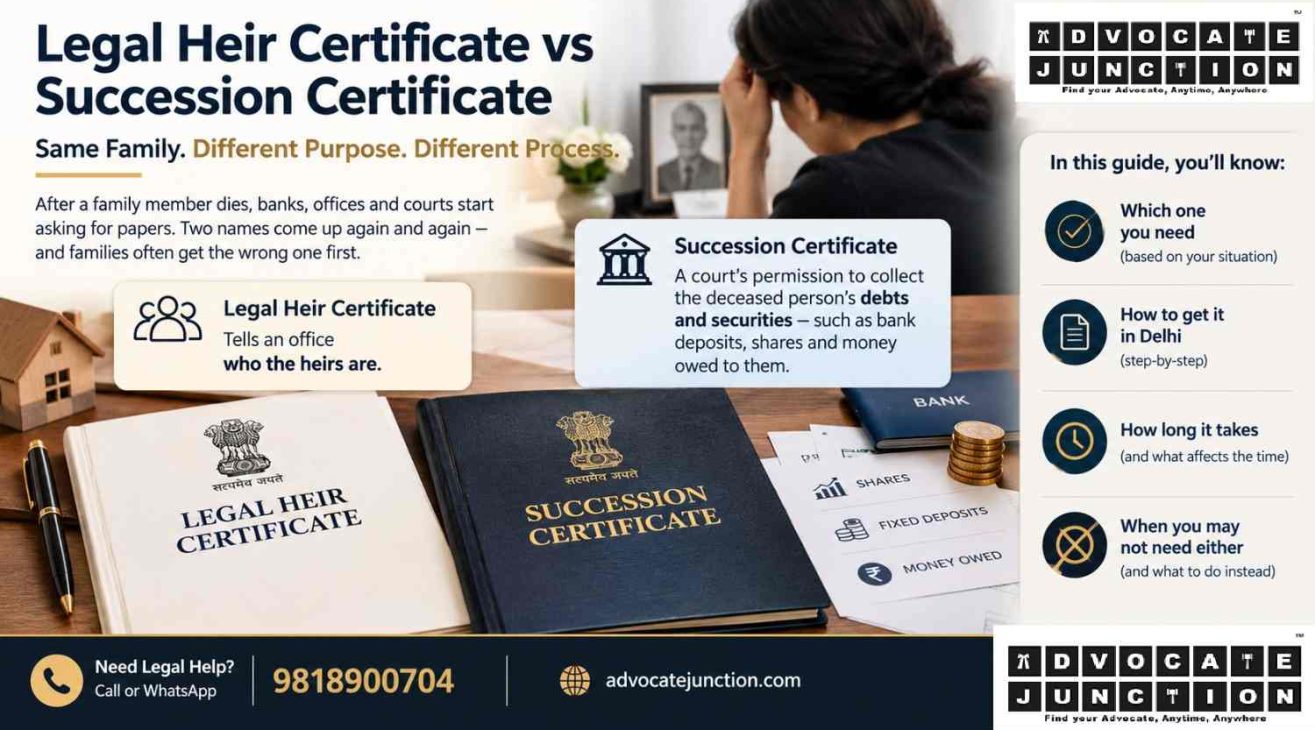
Legal Heir Certificate vs Succession Certificate: Which One Do You Need?
After a family member dies, banks, offices and courts start asking for papers. Two Certificates come up again and again — and families often get confused. Legal heir certificate vs succession certificate is not a matter of which is “better”: they do different jobs, come from different offices and take very different amounts of time.
In short, a legal heir certificate tells an office who the heirs are. A succession certificate is a court’s permission to collect the deceased person’s debts and securities — such as bank deposits, shares and money owed to them. This guide explains which one you need, how to get it in Delhi, and when you may not need either.
| Basic Understanding
• Legal heir certificate — issued by the revenue office (in Delhi, the SDM / Tehsildar, as a Surviving Member Certificate). It identifies the surviving family members. Used for pension, utility and record transfers, government dues and property mutation. Usually takes a few weeks. • Succession certificate — issued by the District Judge’s court under the Indian Succession Act, 1925. It authorises the holder to collect debts and securities (bank deposits, FDs, shares, money owed). It takes longer, involves a public notice and court fee. • Neither one decides who owns property. A house is transferred through the will or succession law, deeds among heirs, and mutation. |
Legal heir certificate vs succession certificate: side-by-side
| Legal heir certificate | Succession certificate | |
| What it proves | Who the surviving family members / heirs are | Authority to collect the deceased’s debts and securities |
| Issued by | Revenue office — Tehsildar / SDM (Delhi: Surviving Member Certificate) | District Judge’s court (Indian Succession Act, 1925, Part X) |
| Process | Application with affidavits; local verification | Petition in court; public notice; hearing; security bond if ordered |
| Typical time | A few weeks | Several months, longer if contested |
| Cost | Nominal fee | Court fee linked to the value of the assets, plus advocate’s fee |
| Used for | Pension, government dues, utilities, records, property mutation, some insurance and employer claims | Bank deposits and FDs (above simplified limits), shares, debentures, money owed to the deceased |
| Decides ownership? | No | No — it is not a final decision on title (Section 387) |
When you need a legal heir certificate
Ask for a legal heir (surviving member) certificate when an office simply needs to know who the family members are — for example:
- Family pension, gratuity or other dues of a government employee;
- Transferring electricity, water or gas connections and property tax records;
- Supporting a mutation application with the MCD, DDA or revenue office;
- Employer dues, PF and some insurance claims, alongside the death certificate.
How to get it in Delhi
- Apply on Delhi’s e-District portal under the Revenue Department for a Surviving Member Certificate, or at the SDM / Tehsildar office covering the deceased’s last address.
- Upload the death certificate, ID and address proof of the applicant and all surviving members, and a self-attested affidavit listing the family members.
- Local verification is carried out, usually through the patwari or revenue staff.
- Collect the certificate from the office once approved — typically in about three to four weeks if nobody objects.
Tip: list every surviving member, including married daughters and the mother. A certificate that leaves someone out can be challenged and will create problems at the bank or sub-registrar later.
When you need a succession certificate
You need a succession certificate when someone holding the deceased’s money — a bank, a company, a debtor — will not pay the heirs without a court’s authority. Common cases:
- Bank deposits or FDs above the RBI simplified limit with no nominee or survivor clause;
- Shares, debentures or other securities where the company or depository asks for it;
- Money lent by the deceased that a borrower now has to repay;
- Cases where heirs disagree and an institution wants a court order before paying anyone.
How to get it
- File a petition in the District Judge’s court where the deceased ordinarily lived (or, if they lived outside India, where the assets are), listing the heirs and each debt or security claimed.
- Pay court fee based on the value of the assets claimed.
- Public notice — the court issues notice to the heirs and publishes it so anyone with an objection can come forward.
- Hearing — if nobody objects and the papers are in order, the court grants the certificate, sometimes on a security bond.
- Present the certificate to the bank or company, which then pays out.
If the deceased left a will, a succession certificate may not be the right tool — depending on the case, probate or letters of administration may be needed instead. An advocate can tell you which applies.
| The law: Section 387, Indian Succession Act, 1925
A decision given while granting a succession certificate does not bar the same question of right from being tried in a regular suit. In other words, a succession certificate lets you collect the money — it does not finally settle who is entitled to keep it. |
The new RBI rule: bank claims up to ₹15 lakh without a succession certificate
In September 2025, the Reserve Bank of India issued directions on settling claims of deceased customers, which banks had to implement by 31 March 2026. Where an account has no nominee or survivorship clause:
| Point | What the RBI directions say |
| Simplified limit | Up to ₹15 lakh in commercial banks and ₹5 lakh in co-operative banks — no succession certificate needed |
| Documents | Claim form, death certificate, ID proof, indemnity bond, and a no-objection / disclaimer from the other legal heirs, plus proof of heirship acceptable to the bank |
| Timeline | Deposit claims to be settled within 15 calendar days of receiving all documents |
| Delay compensation | Interest at Bank Rate plus 4% per year on deposits; ₹5,000 per day for lockers and safe-custody articles |
Above these limits, or where heirs disagree, the bank can still insist on a succession certificate or other court document.
Nominee vs legal heir: who actually gets the money?
A nominee is not automatically the owner. In most cases, a nominee receives the money as a trustee and must share it with the legal heirs under the will or succession law. The bank or company is protected when it pays the nominee — but the heirs can claim their share from the nominee.
| Case law: Shakti Yezdani v. Jayanand Jayant Salgaonkar (2023)
The Supreme Court held that a nominee of shares under the Companies Act does not become the absolute owner. Nomination only gives the company a valid discharge; succession law decides who finally inherits. Reference: 2023 INSC 1076, decided 14 December 2023 (Justices Hrishikesh Roy and Pankaj Mithal) |
Exception to check: for life insurance, since the 2015 amendment to the Insurance Act, a nominee who is the policyholder’s parent, spouse or child can be beneficially entitled to the money. Get advice if a large policy is involved.
What about the house or flat?
Neither certificate transfers a house. Immovable property passes under the will or the Hindu Succession Act (or the relevant personal law). The heirs then use registered relinquishment, partition or family-settlement deeds where needed, and applies for mutation. A surviving member certificate often supports the mutation file. In landmark rulings (such as Sawarni v. Inder Kaur [1996] and Jitendra Singh v. State of Madhya Pradesh [2021]), the Supreme Court established that mutation entry in revenue records does not create or extinguish title, nor does it have any presumptive value on title. It is purely an administrative entry for the collection of land revenue and property tax
| Common mistakes
• Filing for a succession certificate when the bank amount is within the RBI limit — ask the bank for the simplified procedure first. • Leaving out a married daughter or the mother from the affidavit — it can lead to rejection or a later challenge. • Treating the nominee as the owner and spending the money without settling with other heirs. • Assuming either certificate gives title to a house. • Signing a disclaimer for another heir without understanding that you are giving up your share in that amount. |
| Heir living abroad?
• You can sign the affidavit, no-objection or disclaimer at the Indian embassy or consulate, or before a notary followed by an apostille. • A specific power of attorney lets a relative in India file the surviving member application or succession petition for you. • Money you inherit can be credited to your NRO account; repatriation of inherited funds is allowed within the FEMA limits, with a chartered accountant’s certificate. |
Frequently asked questions
1. What is the main difference between a legal heir certificate and a succession certificate?
-
Legal Heir Certificate (Surviving Member Certificate): Issued by local revenue authorities (e.g., Tehsildar, SDM) to list the surviving family members. It is an administrative document mainly used for claims, pensions, and local record updates.
-
Succession Certificate: Issued by a civil court under Section 371 of the Indian Succession Act, 1925. It grants legal authority to collect specific debts and movable securities (e.g., bank deposits, shares, bonds) of the deceased. Under Section 387, it does not decide ultimate ownership or bar a civil suit regarding substantive title.
2. Is a legal heir certificate called something else in Delhi?
-
Yes. In Delhi, the Revenue Department issues a Surviving Member Certificate (SMC) online via the e-District portal or through the concerned SDM/Tehsildar office.
3. Do I need a succession certificate to close my father’s bank account?
-
No, provided:
-
There is a valid registered nominee in the account, OR
-
The account balance falls within the simplified claim settlement limits set under RBI guidelines (₹15 lakh for commercial banks; ₹5 lakh for co-operative banks) where no nominee exists, and all legal heirs submit a standard claim form along with an indemnity bond, death certificate, and NOCs.
-
4. How long does a succession certificate take?
-
Timeline: Typically 3 to 9 months if uncontested.
-
Procedure: The civil court mandates a public newspaper notice inviting objections (usually giving a 30-to-45-day window) before conducting a summary inquiry and issuing the certificate. Contested disputes take significantly longer.
5. Can a nominee keep all the money?
-
General Rule (Banks, Shares, Mutual Funds, PPF): No. As established in Shakti Yezdani v. Jayanand Jayant Salgaonkar (2023) and Sarbati Devi (1984), a nominee is merely a trustee/fiduciary tasked with collecting funds to discharge the institution’s liability. The funds belong to the legal heirs or beneficiaries under a Will.
-
Special Exception (Life Insurance): Under Section 39(7) of the Insurance Act, 1938 (amended in 2015), if the life insurance nominee is an immediate family member—specifically a parent, spouse, or child—they are designated as a “Beneficial Nominee” and own the payout proceeds absolutely. For other nominees (e.g., siblings or friends), the general trustee rule still applies.
6. Is a legal heir certificate needed for property mutation in Delhi?
-
Yes, as supporting evidence. In Delhi, revenue authorities (MCD/DDA) ask for a Surviving Member Certificate (SMC) to confirm the identity of surviving family members, alongside death certificates, affidavits, NOCs, or a registered Relinquishment/Partition Deed under Section 17 of the Registration Act, 1908.
-
Important Note: A legal heir or surviving member certificate only supports the file—it does not transfer property title.
7. Can I get both certificates?
-
Yes. Families often obtain a Surviving Member Certificate first for immediate administrative needs (like processing pensions, gas connections, or bank claims within small limits) and simultaneously petition the civil court for a Succession Certificate to unlock high-value stock portfolios, mutual funds, or disputed movable debts.
8. Can a Succession Certificate be issued for an immovable property like a house or flat?
-
No. Under Section 370 of the Indian Succession Act, 1925, civil courts are explicitly barred from issuing a Succession Certificate for immovable property. A Succession Certificate only applies to movable “debts and securities.” For immovable property, ownership passes under personal inheritance laws (or a Will), and formal title transfers require registered deeds under Section 17 of the Registration Act, 1908.
9. Does updating the name on the municipal property tax record (Mutation) mean I am the legal owner of the house?
-
No. The Supreme Court in landmark decisions (such as Sawarni v. Inder Kaur [1996] and Jitendra Singh v. State of MP [2021]) established that municipal/revenue mutation (Dakhil Kharij) is purely an administrative entry for land revenue and tax collection purposes. Mutation does not create, transfer, or extinguish title—valid legal title comes only through personal succession laws, a valid Will, or registered conveyance/relinquishment instruments.
10. What happens if one legal heir refuses to sign the Relinquishment Deed for an inherited family house?
-
Co-ownership persists. If a legal heir refuses to sign a Relinquishment Deed or NOC, the house automatically devolves upon all legal heirs jointly as tenants-in-common (under laws like Section 8 of the Hindu Succession Act, 1956). The other heirs cannot unilaterally remove that heir’s name or sell the entire property without their consent. The remaining heirs would need to file a civil suit for Partition in a court of law to physically divide the property or order its sale and division of proceeds.
Need Further Legal Guidance?
Advocate Junction offers flexible consultation options to help you understand your legal rights and options.
- Online / Telephonic Consultation or Office Visit (Delhi): ₹499 for 30 minutes.
- Priority Doorstep Consultation – Delhi: ₹1,499 for 45 minutes.
- Priority Doorstep Consultation – Noida, Gurugram & Ghaziabad: ₹1,999 for 45 minutes.
Consultation Fee Adjustment: If you retain the advocate for further legal services, your consultation fee will be fully adjusted against the agreed advocate’s professional fees. Court fees and third-party expenses are excluded.
Call / WhatsApp: +91 98189 00704 · Website: www.advocatejunction.com
Appointments are subject to availability and location confirmation. Additional legal services are charged separately.
AdvocateJunction – Find Your Advocate Anytime Anywhere.