
Second Marriage: A New Beginning After Heartbreak, Loss, or Divorce
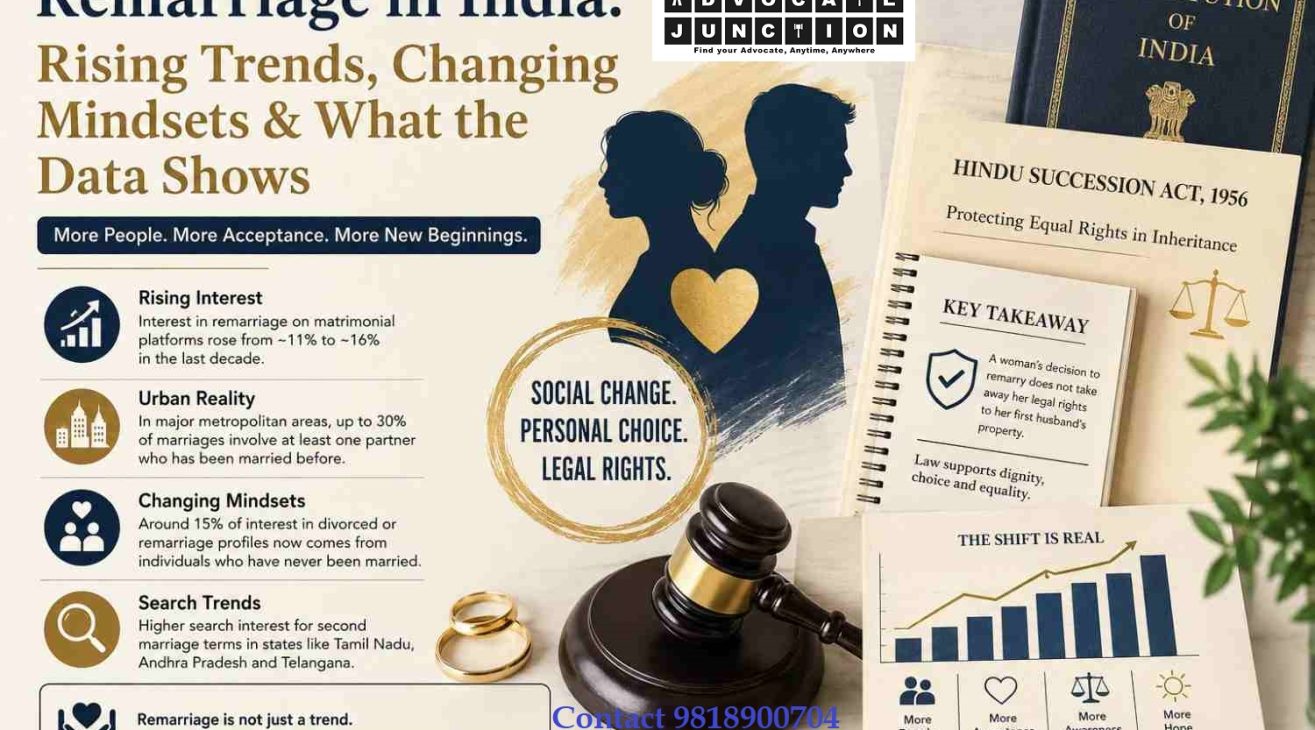
Profiles of people seeking a second marriage have grown from 11 per cent in 2016 to 16 per cent in 2025, and one in six success stories on Jeevansathi today involves individuals entering a remarriage.Finding love and marriage again after divorce, the loss of a spouse, or simply later in life is not only possible — it is your legal right, and the law protects that second innings far more fully than society sometimes lets you believe
What the Trends and Platform Data Show about Second Marriage
The way Indians approach remarriage is changing. While remarriage was once surrounded by significant social stigma, matrimonial platforms, search behaviour and changing urban demographics suggest that attitudes are gradually becoming more accepting.
- Growing interest in remarriage: Recent reporting based on data from matrimonial platforms indicates a significant rise in people exploring remarriage compared with a decade ago. One recent report noted that the share of users showing interest in remarriage had increased from approximately 11% to 16%, reflecting a broader shift in how people approach second marriages.
- Second marriage is increasingly visible in urban India: In metropolitan areas, remarriages and marriages involving a previously married partner are becoming more visible. However, reliable nationwide data on the exact percentage varies considerably depending on the source and methodology. Individual urban estimates should therefore be treated as indicative rather than as definitive national statistics.
- Changing social attitudes: Matrimonial-platform data also suggests that some people who have never married are increasingly open to profiles of divorced or previously married individuals. This may indicate a gradual reduction in the social stigma traditionally associated with divorce and remarriage.
- Search behaviour reflects changing curiosity: Google search trends can provide another indication of changing public interest. Searches relating to second marriage, remarriage and related matrimonial terms have shown notable interest in several southern states, including Tamil Nadu, Andhra Pradesh and Telangana. However, Google Trends measures relative search interest, not the actual number of remarriages, so it should be viewed as a behavioural indicator rather than demographic proof.
The Bigger Picture about Second Marriage
These trends do not mean that second marriage has become socially effortless or universally accepted. Family expectations, concerns about children from a previous marriage, financial issues and social perceptions can still make a second marriage complicated.
But the direction is clear: second marriage is increasingly being discussed as a normal life decision rather than something that should carry lifelong social stigma.
For widows, widowers and divorced individuals, the law generally does not treat the decision to rebuild their personal life as a reason to surrender their basic legal rights.
The growing visibility of remarriage therefore represents not only a social change, but also an important conversation about personal autonomy, dignity, equality and property rights.
There is a particular kind of loneliness that arrives after a marriage ends — whether it ended in a courtroom or a hospital. The house is quieter. Festivals feel longer. Well-meaning relatives change the subject when companionship comes up, as though wanting it again were something to be a little ashamed of, especially past a certain age, and especially for a woman.
And yet people do find each other again. A widow in her fifties, a divorced father in his forties, two people who had each quietly assumed that chapter of their life was closed. What stops many of them is not a lack of feeling but a fog of doubt — is it even allowed, will my children lose their rights, will I lose what my first marriage left me, what will people say. Most of that fog is made of social hesitation, not law. So let me clear the legal part of it, gently and completely, because you deserve to make this decision with facts rather than fear.
Second marriage Is Your Choice — And Your Right
Indian law places no bar on remarriage. Whether you are divorced or widowed, of any religion, in your thirties or your seventies, you are free to do a second marriage — the only real conditions being the ordinary ones of legal age and that any previous marriage has genuinely ended. The Hindu Widows’ Remarriage tradition in law dates back over a century and a half; today, every personal law and the secular Special Marriage Act recognize remarriage as an ordinary, protected choice. Nobody’s permission is required — not a family’s, not a community’s.
If you are a widow, the one practical requirement is usually producing your late spouse’s death certificate when you register. If you are divorced, it is a final divorce decree. Beyond that, the door is simply open.
The one rule that matters most about Second Marriage : make sure the first marriage has truly ended
If there is a single legal caution in this whole subject, it is this. You may do second marriage only after your previous marriage has fully and finally ended — a divorce decree that is final and beyond the appeal period, or the death of your former spouse. Marrying while a divorce is still pending, or while an appeal could still be filed, is not a valid marriage and can even amount to bigamy.
So the loving, unglamorous advice is: wait until the decree is genuinely final, keep a certified copy of it (or the death certificate), and only then plan the wedding. This single step protects your second marriage, your new spouse, and any children who may come, from every later complication.
| Register the marriage — it is your protection, not a formality
A quiet temple ceremony or an exchange of garlands may feel like enough, but registration is what secures your second innings in law. A registered marriage gives your new spouse clear inheritance rights, insurance and pension nomination, the status of legal next-of-kin for medical decisions, and protection against future disputes with children or relatives over property. For a couple marrying later in life, when questions of assets and family can be delicate, that certificate is one of the kindest things you can do for each other. Interfaith or civil couples can register under the Special Marriage Act, which involves a notice period; couples within the same personal law can register under it. |
Will my children from the first marriage lose their rights?
This fear stops more people than any other, and the reassurance is clear: your remarriage does not strip your existing children of their rights. Children from your first marriage remain your legal heirs, retain their inheritance in your property, and their right to maintenance and support continues. A widowed parent also remains the natural guardian of their minor children after remarrying. Your choosing companionship again does not disinherit the family you already have — and where you want to be certain about how everything is divided between an existing family and a new one, a clear will settles it with love rather than leaving it to conflict.
Will I lose what my first marriage left me?
Largely, no — and this is widely misunderstood. If you are a widow who has already inherited property from your late husband, remarrying does not, as a rule, take that property away from you; what you own, you continue to own. Recent judicial thinking has reinforced this. The Madras High Court, in a December 2024 decision, held that the Hindu Succession Act does not disqualify a widow from inheriting her deceased husband’s property even after she remarries — a clear, humane affirmation that a woman need not choose between companionship and security.
Two Important Points to Keep in Mind
Remarriage ( Second Marriage) does not automatically mean that a widow loses her legal rights. However, some pensions, government benefits, or specific legal arrangements may have their own rules about remarriage.
So, while remarriage (Second Marriage) generally does not take away a woman’s existing property or inheritance rights, the exact position can depend on her individual circumstances and the type of benefit or property involved. When in doubt, it is always better to have the specific situation legally checked.
| Madras High Court on widow’s inheritance after remarriage | 2024 | High Court of Madras Malliga v. S. Shanmugam as the principal 2024 authority
In a December 2024 decision, the Madras High Court held that the Hindu Succession Act, 1956 does not disqualify a widow from inheriting her deceased husband’s property merely because she later remarries. The ruling affirmed that a widow’s inheritance rights, once vested, are not automatically lost on remarriage, reinforcing a woman’s freedom to seek companionship again without forfeiting the security her first marriage left her. It reflects the modern, dignity-affirming direction of Indian law on widow remarriage.The Madras HC case was not a blanket declaration that every property right of every remarried widow can never be affected by remarriage. The judgment turned substantially on when succession opened and which statute governed that succession. In this case, the deceased husband died in 1968, after the Hindu Succession Act came into force. |
What to settle before your second marriage
Practical love means tidying a few things first, so the new chapter starts clean:
- Confirm the first marriage has fully ended — final divorce decree past the appeal period, or the death certificate.
- Sort out matters from the first marriage — pending maintenance, custody, or property questions, ideally resolved before you remarry.
- Think about your children — both existing and any to come — and how you want things divided; a will is the kind, clear way to do this.
- Register the new marriage — for inheritance, nomination, medical next-of-kin, and peace of mind.
- Update your records and nominations — identity documents, insurance, bank and pension nominees, to reflect your new reality.
None of this is romantic, exactly. But done quietly and early, it is what lets the romantic part unfold without a shadow over it.
The data-led report, “The Big Shift: How India Is Rewriting the Rules of Partner Search and Marriage”, conducted by matrimony platform Jeevansathi, and published in a major newspaper says
It is not too late, and it is not wrong
Strip away the whispers and the raised eyebrows, and what remains is simple. The law does not think you are too old, or that a second marriage is a lesser marriage, or that wanting companionship again is something to apologise for. It gives you the full right to marry, protects the family you already have, and — increasingly — lets you keep the security your first marriage left you while you build something new.
If a second innings is quietly calling you, the legal path is more open and more protective than you have been led to believe. Settle the few things that need settling, register what needs registering, and let yourself begin again. People do. And the law, quietly, is on their side.
Read More Articles on it
- Second Marriage -India’s Love game is changing – Times of India
- India Today article on Marriage and second marriage
- Re-Marriage seekers data up by 43% The Tribune
- Child Custody Rights in India
Find Your Advocate, Anytime, Anywhere
In legal matters, the cost of waiting is almost always higher than the cost of advice — deadlines pass, documents go missing, and a weak first step is hard to undo. The right advocate, early, changes the outcome.
Talk to one now — clear, honest guidance, no false promises:
- ₹499 — a focused 45-minute consultation on Google Meet, or visit our Legal Studio at our Rohini office.
- ₹999 — 45-minute doorstep legal advice across Delhi, to understand your case.
- ₹1499 — 45-minute doorstep legal advice in Noida, Gurgaon, Ghaziabad & Faridabad.
All consultations are by prior appointment. To book, contact WhatsApp: 9818900704 — or visit advocatejunction.com and drop your enquiry.
This article explains the general legal position and is not a substitute for advice on your specific facts. All content verified under current Indian law 2026.
© 2026 AdvocateJunction. All rights reserved. | advocatejunction.com | For informational purposes only. Not legal advice.