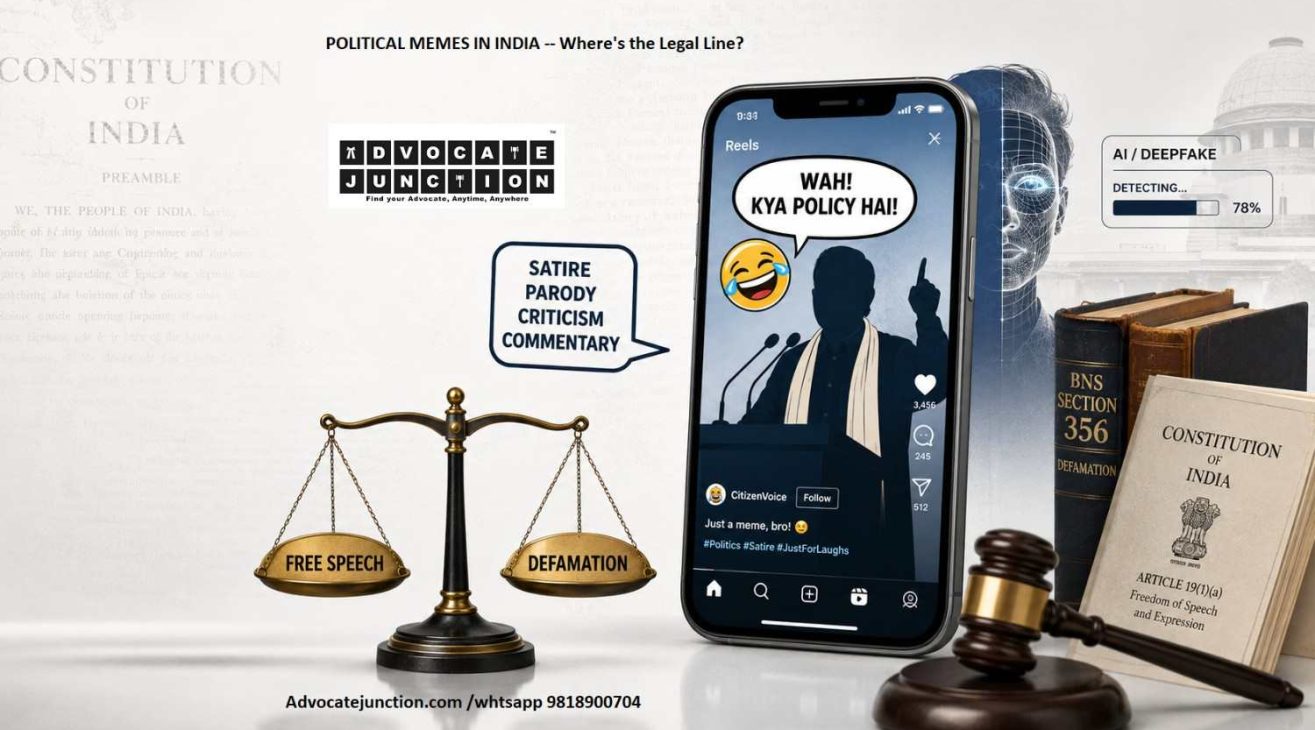
The Gen Z Creator Cheat Sheet: Can Your Meme Actually Get You Arrested?
is Political meme legal in India ? satire is a constitutional right ? These are very common questions now a days , specially after the famous GenZ protest and police actions after that.
If your social feed is full of political content, AI voiceovers, and political satires, you are walking in a risk zone. If you run a meme page or post political meme and reels, you need to know where harmless satire ends and a legal case begins.
- Honestly, just open Insta on any random night and it’s all over your feed — someone edited a politician into a scene from a movie, remixed a speech into a funny audio, or added a petty caption over a rally clip.
- Most of it is just harmless, dumb fun. Sometimes it’s actually a pretty solid point. But then once in a while, a post goes way too far and it becomes viral. family becomes upset, the police actually show up, and some normal kid who posted it without thinking twice suddenly gets hit with a police case, totally stressed out like, am I actually getting arrested for a meme?
- Jan 2026 , Uttar Pradesh Govt filed an FIR against 14 year kid for his Political Posts on social media. So please donot think that if you are below 18 years , Police may not take action against your social media posts.
So it is worth knowing, before you hit ‘post’, where the law actually draws its line — because that line is a lot clearer than the internet’s panic suggests, and it protects you far more than you might expect.
Is political satire legal in India?
Yes. The right to criticize, mock, and satirize those in power is not a loophole — it sits at the heart of Article 19(1)(a) of the Constitution, which guarantees freedom of speech and expression. Making fun of a politician, ridiculing a policy, parodying a speech: all of this is protected expression. Courts have long held that public figures, precisely because they hold power, must tolerate a far thicker skin’s worth of criticism than an ordinary private citizen.
The Supreme Court made this vivid in the landmark Shreya Singhal case, where it struck down Section 66A of the IT Act — a vague provision that had been used to arrest people for online posts — as an unconstitutional attack on free speech. That judgment remains the backbone of your right to speak, and joke, online.
| Shreya Singhal v. Union of India | 2015 | Supreme Court of India
The most important judgment on online free speech in India. The Supreme Court struck down Section 66A of the Information Technology Act — which had criminalized vaguely-defined ‘offensive’ online messages and been widely misused to arrest people for social-media posts — holding it unconstitutional for violating Article 19(1)(a). The Court drew a firm line between mere discussion or advocacy, which is protected, and incitement, which is not, and insisted that restrictions on online speech must be clear and narrow. It is the case every content creator’s freedom ultimately rests on. |
So where does a meme become a crime?
The protection is strong, but it is not unlimited — Article 19(2) allows reasonable restrictions, and a post crosses the line when it stops being an opinion or a joke and becomes something the law treats as a genuine harm. In practice, that happens in a handful of recognizable ways.
- A false factual claim that damages reputation — not an opinion, not exaggeration, but a fabricated ‘fact’ presented as true. This is defamation under Section 356 of the Bharatiya Nyaya Sanhita (which carried forward the old Section 499/500 IPC).
- Personal abuse or content aimed at provoking public disorder — profanity, threats, or inflammatory content meant to incite hostility rather than make a point, which can attract provisions on intentional insult and breach of peace.
- A morphed image, fake screenshot, or deepfake — digitally altering someone’s photo, or creating a fake account or fabricated post in their name, which attracts the IT Act’s provisions on identity theft and impersonation (Sections 66C and 66D).
- Obscene or sexually explicit content — sexualising a public figure or publishing obscene material, punishable under Section 67 of the IT Act.
- Content dragging in caste, religion, or community — mixing political criticism with communal or caste-based attacks can attract separate, serious charges around promoting enmity between groups.
Notice the pattern: nearly every red line involves either a lie dressed as fact, deliberate abuse, a fabricated image, or obscenity. Pure opinion — however harsh — almost never gets you there.
The rule the courts keep returning to: opinion is safe, false facts are not
If there is one principle to carry in your head before posting, it is this distinction between comment and false fact. The Supreme Court set it out clearly in the R. Rajagopal case: a public official cannot silence criticism of their official conduct through defamation law unless the statement is false and made with reckless disregard for the truth. In other words, the burden runs in favour of the speaker when the target is a public figure and the subject is their public role.
| This is why ‘this policy is a disaster’ or a mocking parody of a speech is safe, while ‘this minister stole ₹500 crore’ — stated as fact, with nothing to back it — is dangerous. The first is opinion. The second is a factual allegation that, if false, is defamatory. Satire lives comfortably on the first side of that line. |
What the punishments can look like
If a post does cross into criminal territory, the consequences vary by what exactly was done:
- Defamation (BNS Section 356): imprisonment up to two years, or fine, or both.
- Identity theft — morphed image or fake account (IT Act Section 66C): up to three years and fine.
- Online impersonation (IT Act Section 66D): up to three years and fine.
- Obscene electronic content (IT Act Section 67): up to three years and fine for a first offence, more on repetition.
These are maximums, not automatic outcomes. Many complaints never reach conviction — but an FIR alone can mean questioning, seized devices, and real stress, which is reason enough to stay on the right side of the line.
The biggest 2026 development: Delhi High Court on political satire
One of the most important recent cases for anyone creating political memes and reels is:
Raghav Chadha v. Ashok Kumar John Doe & Ors. — Delhi High Court, 1 July 2026
The case involved social-media content concerning Raghav Chadha, including allegedly defamatory, vulgar and AI-generated material.
The judgment is particularly significant because the Delhi High Court made an important distinction between political satire and content that crosses into unlawful territory.
The Court examined 52 pieces of allegedly objectionable content.
It found that the majority appeared to be satirical expressions concerning Chadha’s political decisions.
The Court observed that political decisions naturally attract both praise and criticism and that public figures should not be excessively sensitive to criticism of their political conduct.
The Court specifically recognized that humour concerning:
- political party alliances;
- changes in political affiliation;
- governance;
- policies;
- political decisions; and
- public conduct
can form part of political discourse.
However, the Court did not give political satire a blanket immunity.
Certain posts were found to contain explicit, profane and vulgar content and were considered outside harmless satirical humor. The Court therefore ordered takedown of specified material while leaving the majority of the satirical content untouched.
Why this judgment matters
This case provides perhaps the clearest recent judicial explanation of the meme problem:
Political humor does not automatically become defamation merely because the politician dislikes it.
At the same time:
Calling something a “meme” does not automatically protect defamatory, obscene or malicious content.
That distinction is crucial.
What exactly did the Delhi High Court say?
The Court’s reasoning can be simplified into three categories.
- Political criticism and satire
A meme saying:
“Minister changes party faster than changing WhatsApp status.”
This is obviously mocking political conduct.
It may be insulting.
It may be unfair.
It may be politically biased.
But that does not automatically make it criminal defamation.
- Satirical representation
A cartoon showing a politician carrying a suitcase labelled “Promises” may be understood as political commentary.
Again, the context matters.
The audience may understand that the creator is using exaggeration and humour rather than claiming that the politician literally committed a particular offence.
- Fabricated factual allegation
Now imagine a reel stating:
“Politician X secretly took ₹50 crore from Contractor Y.”
If there is no evidence and the creator presents this as a real fact rather than obvious satire, the legal analysis changes dramatically.
It may amount to a defamatory imputation.
The creator cannot simply defend the post by saying:
“It was only a meme.”
The legal question is what the content communicates to a reasonable viewer and whether the ingredients of the relevant offence or civil wrong are satisfied.
What does BNS Section 356 say about memes?
Since 1 July 2024, the Bharatiya Nyaya Sanhita, 2023 (BNS) has replaced the Indian Penal Code for offences committed after its commencement.
For political memes, one of the most important provisions is Section 356 — Defamation.
BNS Section 356 covers imputations made through:
- words;
- signs;
- visible representations; and
- Publication in any manner.
That is particularly relevant to memes because a meme is often a visible representation.
The provision applies where a person makes or publishes an imputation concerning another person with the intention of harming reputation, or knowing or having reason to believe that it will harm reputation, subject to the statutory exceptions.
In simple terms:
A meme can potentially be defamatory even though it contains no conventional paragraph of text.
A manipulated photograph, cartoon, caption, video or graphic can potentially communicate an imputation.
But Section 356 does NOT mean every insult is defamation
This is where many social-media users get confused.
Defamation is not simply:
“The politician felt insulted.”
There must be an imputation of the type recognized by law, accompanied by the required mental element and capable of causing the relevant reputational harm, subject to the statutory exceptions.
The BNS retains important exceptions.
For example, it is not defamation to publish something that is true and for the public good.
There is also an exception concerning a good-faith opinion about the conduct of a public servant in the discharge of public functions, and another concerning good-faith opinion on the conduct of a person touching a public question.
That makes political criticism particularly important.
Political opinion is different from a factual allegation
This is probably the easiest way to understand the legal boundary.
Opinion:
“I think this politician’s policy is disastrous.”
Generally, this is political opinion.
Satire:
“The minister’s new policy deserves a Nobel Prize — for making everything more complicated.”
This is clearly exaggerated political humour.
Factual allegation:
“The minister accepted ₹10 crore in cash from Company X.”
This is presented as a factual claim.
If false and reputation-damaging, it can create substantially greater legal risk.
False allegation disguised as a meme:
Photograph of politician + “Caught taking bribe at midnight.”
If the presentation gives an ordinary viewer the impression that an actual bribery incident occurred, simply calling the post a “meme” does not eliminate the legal risk.
The Supreme Court’s position on criticism of public officials
Long before Instagram and YouTube, the Supreme Court had already recognized the special importance of criticism concerning public officials.
In R. Rajagopal v. State of Tamil Nadu (1994), commonly known as the Auto Shankar case, the Supreme Court considered the relationship between freedom of expression, privacy and criticism of public officials.
The Court emphasized that public officials and public figures cannot ordinarily demand prior restraint merely because they fear criticism or defamatory publication. It held that remedies, where available, generally arise after publication and must be tested according to law.
The judgment is important because democracy requires space for criticism of people exercising public power.
The Court also recognized that government and governmental authorities cannot simply use defamation as a tool to suppress criticism of public administration.
That principle remains highly relevant to political memes.
Subramanian Swamy case: defamation itself is constitutionally permissible
There is another important Supreme Court judgment that meme creators should understand.
In Subramanian Swamy v. Union of India (2016), the Supreme Court upheld the constitutional validity of criminal defamation.
This means that Article 19(1)(a) does not create an unrestricted licence to damage another person’s reputation.
At the same time, the Court recognized the importance of the statutory exceptions, including protection for truth in appropriate circumstances and good-faith comment concerning public servants and public questions.
So the legal position is not:
“Free speech means you can say anything about a politician.”
Nor is it:
“A politician can stop any meme that they dislike.”
The constitutional balance lies between the two.
What about Section 66A of the IT Act?
This is one of the most important points for social-media users.
You may still see people online saying:
“You can be arrested under Section 66A of the IT Act for an offensive meme.”
That is wrong.
The Supreme Court struck down Section 66A in Shreya Singhal v. Union of India in 2015.
The provision was found unconstitutional because terms such as “grossly offensive” and similar expressions were too vague and had an impermissibly chilling effect on free speech.
The current India Code version of the Information Technology Act records Section 66A as omitted.
Therefore:
There is no valid offence of “posting an offensive meme” under Section 66A.
But that does not mean that the IT Act has no relevance to social-media content.
Other provisions continue to operate.
Can the IT Act apply to a meme or reel?
Yes, depending on what the content contains.
For example, Section 67 of the Information Technology Act deals with publishing or transmitting obscene material in electronic form.
The Act also contains provisions dealing with matters such as:
- identity theft;
- cheating by personation;
- violation of privacy;
- cyber terrorism; and
- sexually explicit material.
Therefore, a political meme may be harmless political commentary, but the technology used to create or publish it does not place the creator outside other applicable laws.
BNS Section 294 and obscene memes
The BNS also specifically recognises electronic content in its obscenity provision.
Section 294 BNS includes electronic-form content within the statutory definition of obscene material.
The provision covers content that is lascivious, appeals to prurient interest, or has the legally specified tendency to deprave and corrupt persons likely to see or hear it, subject to the statutory exceptions.
This is important because a political meme can cross the line if it is not merely insulting but contains legally actionable obscene material.
And this is precisely what the Delhi High Court’s 2026 Raghav Chadha decision demonstrates.
The Court protected a broad category of political satire but ordered removal of selected content that was explicit and profane.
What if the meme uses a morphed photograph?
This is a much higher-risk area.
There is an enormous difference between:
A cartoon caricature
and
A digitally manipulated photograph designed to make the politician appear to have committed an act that never happened.
A caricature is normally understood as artistic exaggeration.
A manipulated photograph can potentially be understood as a representation of reality.
That distinction becomes even more important with AI.
AI deepfakes are changing the legal problem
The growth of generative AI has created a new category of political content:
deepfake political reels.
A creator can now take a politician’s:
- face;
- voice;
- speech pattern;
- photograph;
- body movements; or
- public video
and create an entirely fabricated clip.
The legal risk becomes significantly higher when the AI-generated material is presented as genuine.
Raghav Chadha case: AI-generated political content
The 2026 Raghav Chadha litigation involved allegations of AI-generated deepfakes, morphed visuals and manipulated social-media content.
In its July 2026 decision, the Delhi High Court distinguished political satire from content that crossed into malicious, vulgar or defamatory territory.
The Court also directed takedown of specified material and required disclosure of account-related information concerning the offending content.
The case is particularly relevant because it shows that the courts are not treating AI manipulation as automatically unlawful.
Instead, the purpose, context, nature of the manipulation and its impact matter.
Another major 2026 case: Saleem Iqbal Shervani
In August 2026, the Delhi High Court dealt with another politically relevant AI-content dispute involving former Union Minister Saleem Iqbal Shervani.
The Court ordered Meta to take down two AI-generated videos that allegedly linked Shervani with deceased gangster Atiq Ahmed.
The Court also restrained the concerned parties from publishing or republishing the disputed material pending further proceedings.
This is an important warning for creators:
An AI-generated political video can create serious legal exposure when it falsely associates a politician with criminal activity.
A viewer may not understand that the video is synthetic.
That is fundamentally different from an obvious cartoon or parody.
Sudhir Chaudhary and AI-generated political statements
The problem is not limited to politicians themselves.
In Sudhir Chaudhary v. Meta Platforms Inc. & Ors., proceedings before the Delhi High Court concerned alleged AI-generated deepfake videos in which the journalist’s face and voice were used to make statements on politically sensitive subjects that he allegedly had never made.
The case illustrates the broader legal problem:
Synthetic media can falsely attribute statements to public figures.
The legal consequences can involve defamation, personality rights, privacy and other legal issues depending upon the circumstances.
Shazia Ilmi case: even real video can create privacy problems
Another important 2025 case involved BJP leader Shazia Ilmi and journalist Rajdeep Sardesai.
The Delhi High Court directed platforms including X and Meta to take down specified material involving a portion of a video of Ilmi during a television debate.
The Court found that publication of the particular portion violated her right to privacy.
This demonstrates another important principle:
Not every public recording is automatically free for unlimited republication in every context.
The circumstances surrounding the recording, publication, editing and purpose can matter.
What about reposting somebody else’s political meme?
This is an area many creators underestimate.
A person may think:
“I didn’t create the allegation. I only reposted it.”
That is not necessarily a complete defence.
A particularly relevant case is Arvind Kejriwal v. State & Anr., concerning the retweet of content originally posted by YouTuber Dhruv Rathee.
The underlying allegations concerned a person associated with the BJP IT Cell.
The Delhi High Court examined whether re-tweeting allegedly defamatory content can amount to publication for defamation purposes.
The Court observed that a re-tweet can potentially constitute publication and that the question of liability depends on the facts, including the content, context, reach and applicable defenses.
The case is therefore an important warning:
“I only shared it” is not necessarily a complete legal defence.
If the repost itself republishes the defamatory imputation to a new audience, legal consequences can follow.
Does adding “allegedly” protect you?
Not automatically.
Creators sometimes write:
“Politician X allegedly took money.”
Then they assume the word “allegedly” provides legal immunity.
It does not.
The entire context matters.
If the content communicates a serious allegation as though it is true, simply inserting “allegedly” does not necessarily eliminate the risk.
The safer approach is to distinguish clearly between:
verified facts
and
commentary/opinion.
Can you make a meme calling a politician a “liar”?
This requires context.
A statement such as:
“This politician is the biggest liar in India.”
may be understood as rhetorical political criticism rather than a precise factual allegation.
But:
“This politician lied about his educational qualification in affidavit X.”
is a specific factual assertion that can be tested for truth.
The more specific and factual the statement becomes, the more carefully it should be verified.
Can you call a politician corrupt?
Again, context matters.
There is a significant legal difference between:
“His government is corrupt.”
and:
“Politician X personally took ₹20 crore from Company Y.”
The second statement identifies a specific alleged act of criminal conduct.
If it is false and reputationally harmful, it presents much greater defamation risk.
What if the politician really did something controversial?
This is where evidence becomes extremely important.
If you are criticizing:
- a government policy;
- a parliamentary speech;
- a public statement;
- an election promise;
- a court-recorded event;
- an official document;
- a publicly announced decision; or
- conduct documented in reliable public records,
your position is generally much stronger than when you repeat an unverified allegation.
The BNS’s defamation exceptions specifically recognize truth coupled with public good and good-faith opinions concerning public servants and public questions.
But truth and public good are legal questions that may depend on evidence and circumstances.
Election-related memes require extra caution
Political memes become particularly sensitive during elections.
BNS Section 175 deals with false statements concerning the personal character or conduct of a candidate, where the statement is made or published with intent to affect the result of an election and is known or believed to be false or not believed to be true.
The provision provides for punishment with fine.
This means election-period content deserves additional caution.
A meme about a candidate’s political ideology is one thing.
A knowingly false factual claim about a candidate’s personal character or conduct designed to influence voters is another.
What about fake news that creates public panic?
Not every false meme becomes an offence under BNS Section 353.
But Section 353 is relevant where false statements, information, rumours or reports—including through electronic means—are published or circulated in circumstances specified by the provision, such as intending or being likely to cause public fear or alarm that may induce offences against the State or public tranquility, or inciting classes or communities to commit offences.
Section 353(2) separately deals with false information or alarming news intended or likely to promote enmity, hatred or ill-will between specified groups.
Therefore:
“This politician’s speech was terrible.”
is fundamentally different from:
“This politician has ordered people of Community X to attack Community Y tonight.”
The second type of content can raise substantially more serious legal issues.
Religious or communal memes can cross another legal line
Political memes frequently mix politics and religion.
That is legally sensitive.
BNS Section 196 deals with electronic or other communications that promote or attempt to promote disharmony, enmity, hatred or ill-will between specified religious, racial, linguistic, regional or caste/community groups in the circumstances specified by the provision.
Section 299 addresses deliberate and malicious acts intended to outrage the religious feelings of a class by insulting religion or religious beliefs, including through electronic means.
Therefore, a political meme can move from ordinary political criticism into a different category if its real target becomes a protected religious or community group.
What about memes using sexually edited images?
This is one of the clearest danger zones.
A creator may take a politician’s photograph and superimpose:
- nudity;
- sexual acts;
- sexually explicit imagery;
- obscene captions; or
- fabricated intimate material.
The legal exposure can extend beyond ordinary defamation.
Depending on the content and circumstances, provisions dealing with obscenity, sexually explicit electronic material, privacy, impersonation, defamation and personality rights may become relevant.
The IT Act specifically contains provisions concerning obscene and sexually explicit electronic material.
Is political satire protected even if it is offensive?
Sometimes, yes.
Offensive does not automatically mean illegal.
This distinction is essential.
Democratic speech often involves:
- ridicule;
- sarcasm;
- parody;
- exaggeration;
- irony;
- cartoons;
- memes;
- political jokes; and
- harsh criticism.
The constitutional question is not simply whether the politician was offended.
The question is whether the restriction falls within a constitutionally permitted ground under Article 19(2) and whether the relevant statutory ingredients are actually satisfied.
The Supreme Court’s decision in Shreya Singhal remains a foundational authority against vague restrictions on online expression.
The Kunal Kamra controversy shows the practical reality
The 2025 controversy surrounding comedian Kunal Kamra and a parody that was interpreted as referring to Maharashtra Deputy Chief Minister Eknath Shinde generated an intense national debate over political humour.
The incident involved police proceedings, political backlash and the cancellation/controversy surrounding Kamra’s performance.
The Bombay High Court proceedings also included discussion concerning people reposting clips or re-singing portions of the parody. The Maharashtra government told the Court that it had not taken vindictive action against citizens who reposted the material.
The broader lesson is important:
Even when content may ultimately be protected speech, a creator can still face a complaint, police inquiry, takedown demand or litigation.
Legal protection and practical immunity are not the same thing.
Can a politician file an FIR over a meme?
A complaint can certainly be made.
But the existence of a complaint or FIR does not mean the creator is legally guilty.
A social-media post may generate:
- a police complaint;
- an FIR, where the alleged offence permits and the legal requirements are met;
- a criminal defamation complaint before a Magistrate;
- a civil defamation suit;
- a takedown request;
- an injunction application;
- a privacy claim;
- a personality-rights claim; or
- proceedings against unknown social-media accounts.
The actual remedy depends on the content and the legal provision invoked.
Can a politician force Instagram or YouTube to delete a meme?
Potentially, yes — but not simply because the politician dislikes criticism.
Courts can order platforms to remove specific content where legal grounds are established.
The recent Raghav Chadha case demonstrates this.
The Delhi High Court refused to treat the majority of political satire as automatically unlawful, but ordered removal of specified vulgar/explicit content and directed disclosure of account information associated with the objectionable posts.
Similarly, in the Saleem Iqbal Shervani case, the Delhi High Court ordered Meta to take down specified AI-generated videos.
The 2026 legal test for a political meme
A useful practical test is to ask the following questions before posting.
Question 1: Is it obviously satire?
If an ordinary viewer can immediately understand that the content is parody, exaggeration or humour, the creator’s position is generally stronger.
Question 2: Does it make a factual allegation?
If yes, ask:
Can I prove it?
If the answer is no, reconsider the wording.
Question 3: Does it accuse the politician of a crime?
Claims involving:
- bribery;
- corruption;
- cheating;
- sexual misconduct;
- fraud;
- terrorism;
- criminal conspiracy; or
- other serious wrongdoing
carry much greater reputational risk.
Question 4: Did you alter the politician’s photograph or voice?
If yes, ask:
Could an ordinary viewer believe this is genuine?
If yes, the risk increases substantially.
Question 5: Is it AI-generated?
If yes, make the nature of the manipulation clear where appropriate.
A clearly labelled parody is materially different from an unlabeled deepfake presented as real footage.
Question 6: Is it sexually explicit?
If yes, stop and reassess.
The legal risk can be much greater than ordinary political criticism.
Question 7: Does it target a religion, caste or community?
If yes, additional BNS provisions may become relevant.
Question 8: Are you reposting someone else’s allegation?
If yes, do not assume that reposting eliminates liability.
The Kejriwal retweet litigation demonstrates why amplification and republication matter.
Frequently Asked Questions
- Is it legal to make memes about politicians in India?
Generally, yes. Political criticism, parody, satire and commentary are protected forms of expression under Article 19(1)(a), subject to the restrictions permitted by Article 19(2) and other applicable laws. A meme can, however, create legal risk if it contains defamatory allegations, obscene material, threats, unlawful disclosure of private information or other actionable content.
- Can a politician file a case against me for making a meme?
A politician can initiate appropriate legal proceedings if the content allegedly violates the law. Depending on the facts, this may involve a defamation complaint, civil proceedings, an injunction or a takedown request. However, the mere fact that a politician dislikes or is offended by a meme does not automatically establish an offence.
- Can a meme be considered defamation under BNS Section 356?
Yes. BNS Section 356 covers defamatory imputations made through words, signs or visible representations and published in any manner. Therefore, a meme, image or video can potentially amount to defamation if the statutory requirements are satisfied and no applicable exception applies.
- Is Section 66A of the IT Act still applicable to offensive memes?
No. Section 66A was struck down by the Supreme Court in Shreya Singhal v. Union of India and is recorded as omitted from the Information Technology Act. Other provisions of the IT Act can still apply to particular types of online content.
- Can I use a politician’s photograph in a meme?
Using a politician’s photograph in an obvious political cartoon, parody or commentary is not automatically illegal. However, the legal position can change if the image is manipulated to create a false factual impression, used in obscene material, violates privacy or creates other legally actionable harm.
- Are AI-generated political memes legal in India?
AI-generated political content is not automatically illegal. The legal risk depends on how the AI content is created and presented. A clearly recognisable parody is different from a realistic deepfake presented as genuine footage or used to make a defamatory allegation.
- Can I get into trouble for reposting someone else’s political meme?
Yes, potentially. Reposting or re-tweeting content can amount to republication in circumstances where the content is defamatory. In Arvind Kejriwal v. State & Anr., the Delhi High Court considered a re-tweet of allegedly defamatory material as publication for the purpose of the defamation proceedings.
- Can political satire be treated as defamation?
Political satire is not automatically defamation. Courts look at the substance and context of the content. In the 2026 Raghav Chadha case, the Delhi High Court observed that much of the material concerning political decisions was satirical, while specific explicit and vulgar content was restrained.
If an FIR has already been filed against you
An FIR over a social media post can be filed — including as a ‘Zero FIR’ at any police station, regardless of where you live — and receiving that news is genuinely frightening, especially for a young person facing it for the first time. But an FIR is not a conviction; it is the start of a process, and how you respond in the first days matters enormously. Do not delete everything in a panic, do not post further about it, and do not speak to the police without advice. Preserve the original content and context, and get proper legal guidance before responding to any notice. Many such cases, handled calmly and correctly, do not survive scrutiny — particularly where the post was opinion or satire rather than a false factual claim.
A quick self-check before you post
You do not need to be a lawyer to stay safe. Before you publish, run the content past a few honest questions:
- Am I stating an opinion, or asserting a ‘fact’? Opinion and parody are protected; a false factual allegation is not.
- Have I altered anyone’s image or faked a post? Morphing and fake accounts are among the riskiest things you can do.
- Is this criticism, or is it abuse? Attacking an argument is safe; profane personal attacks and threats are not.
- Have I dragged in religion, caste, or community? That can convert a political joke into a far more serious offence.
- Is there anything obscene or sexual in it? If yes, remove it.
| Content | General legal risk |
| Political cartoon | Lower |
| Policy criticism | Lower |
| Sarcastic political joke | Lower |
| Obvious parody | Lower |
| Unverified allegation | Medium/high |
| False corruption allegation | High |
| Fake criminal accusation | High |
| AI deepfake presented as real | High |
| Explicit sexual morphed image | Very high |
| Threatening content | Very high |
Received a Legal Notice or FIR Over a Social Media Post?
A meme, reel or political post can raise questions of defamation, cyber law, privacy, AI-generated content and free speech.
If you have received a legal notice, FIR, police communication or court summons relating to a social-media post, get the specific facts reviewed by a qualified advocate rather than relying on general information available online.
Consult a lawyer before responding to a serious legal notice or police action.
Advocate Junction — Find the Right Legal Professional for Your Matter.
Talk to one now — clear, honest guidance, no false promises:
- ₹499 — a focused 45-minute consultation on Google Meet, or visit our Legal Studio at Rohini ( Our Delhi Office)
- ₹999 — 45-minute doorstep legal advice across Delhi, to understand your case.
- ₹1499 — 45-minute doorstep legal advice in Noida, Gurgaon, Ghaziabad & Faridabad.
All consultations are by prior appointment. To book, contact WhatsApp: 9818900704 — or visit advocatejunction.com and drop your enquiry. The sooner you understand where you stand, the more you can do about it.
Related Articles on AdvocateJunction
Legal disclaimer
This article is intended for general legal information and educational purposes only. It does not constitute legal advice and does not create an advocate-client relationship. Social-media cases are highly fact-specific, and the applicable law may depend on the exact content, context, intention, publication method and provisions invoked. If you have received an FIR, police notice, legal notice or court summons concerning a social-media post, consult a qualified advocate for advice on the specific facts of your case.