
POCSO Punishment, Bail and Trial: Your Questions Answered
POCSO Punishment, Bail, Trial and Compensation: What Families Should Know
Understanding POCSO punishment, bail, and how the trial works helps families know what to expect — and shows how seriously the law treats sexual offences against children.
Once a POCSO case is set in motion, families naturally want to understand the legal road ahead: what punishment may apply, whether the accused can get bail, how long the trial may take, and what the child is entitled to. Here are the key questions, explained simply.
What is the punishment under the POCSO Act?
POCSO follows a graded punishment structure. The punishment depends on the nature and seriousness of the offence and, in certain offences, the age of the child.
Broadly:
- Penetrative sexual assault (Section 4): minimum 10 years’ imprisonment, which may extend to life imprisonment, along with fine. If the child is below 16 years, the minimum punishment is 20 years and may extend to imprisonment for the remainder of the person’s natural life, along with fine.
- Aggravated penetrative sexual assault (Section 6): minimum 20 years’ imprisonment, which may extend to imprisonment for the remainder of the person’s natural life, along with fine, or, in the circumstances specified by law, the death penalty.
- Sexual assault (Section 8): imprisonment of 3 to 5 years, along with fine.
- Aggravated sexual assault (Section 10): imprisonment of 5 to 7 years, along with fine.
- Sexual harassment (Section 12): imprisonment up to 3 years, along with fine.
The POCSO framework also provides for the child’s rehabilitation, and fines or compensation may be directed towards the child’s relief and rehabilitation.
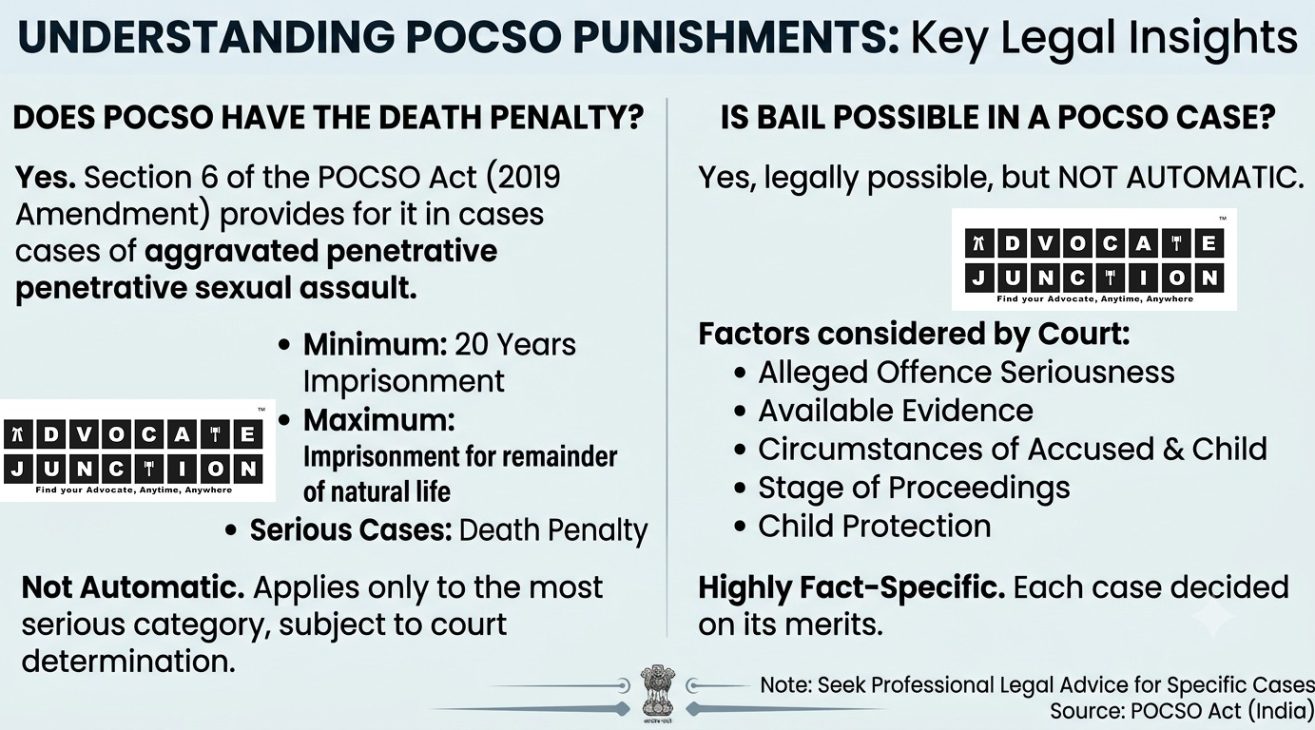
Does POCSO have the death penalty?
Yes. Section 6 of the POCSO Act provides for the death penalty in cases of aggravated penetrative sexual assault where the statutory conditions are satisfied. Section 6 of the POCSO Act provides punishment for aggravated penetrative sexual assault. After the 2019 amendment, the punishment is a minimum of 20 years’ imprisonment, which may extend to imprisonment for the remainder of the offender’s natural life, along with fine. In the most serious cases covered by the provision, the death penalty may also be imposed
However, the death penalty is not automatic merely because a case is registered under POCSO. It applies only to the most serious category of aggravated penetrative sexual assault and remains subject to the court’s determination of the facts, applicable law and sentencing principles.
Is bail possible in a POCSO case?
Yes, bail is legally possible in a POCSO case, but it is not automatic.
The possibility of bail depends on factors such as the offence alleged, the available evidence, the circumstances of the accused and child, the stage of the proceedings, and the applicable bail provisions. Courts also have to consider the seriousness of the allegations and the protection of the child.
The law therefore does not support a simple rule that every POCSO accused will either get bail or be denied bail. Bail decisions are highly fact-specific and should not be predicted from the registration of the case alone.
How long does a POCSO trial take?
POCSO aims to complete proceedings without unnecessarily prolonging the child’s involvement in the criminal justice process.
Under Section 35, the child’s evidence should be recorded within 30 days of the Special Court taking cognizance of the offence, and the Special Court should complete the trial, as far as possible, within one year from the date of taking cognizance.
These are statutory objectives rather than guaranteed deadlines. In practice, the actual duration can vary depending on the number of witnesses, evidence, adjournments, forensic reports, complexity of the case and other circumstances.
Dedicated Special Courts and Fast Track Special Courts have also been established to help deal with POCSO cases more efficiently.
What compensation is the child entitled to?
POCSO provides for compensation to support the child’s relief and rehabilitation.
Under Section 33(8) of the POCSO Act, the Special Court may direct payment of compensation to the child for physical or mental trauma or for immediate rehabilitation. The POCSO Rules also provide a framework for determining and paying compensation, including interim compensation where appropriate.
Compensation is therefore not simply an additional punishment for the accused. It is intended to provide practical support to the child and help with recovery and rehabilitation.
The amount and timing of compensation depend on the circumstances of the individual case and the applicable victim-compensation framework.
Can a POCSO case be withdrawn or settled between the parties?
Generally, a POCSO case cannot simply be withdrawn because the child or family no longer wants to pursue it. POCSO offences are treated as offences against the child and the criminal process is not controlled solely by the wishes of the complainant. Depending on the facts and stage of the case, the High Court may have limited powers to intervene in appropriate circumstances, but a private settlement does not automatically end a POCSO prosecution.
What happens if the child or family changes their statement in a POCSO case?
A change in the child’s statement does not automatically end the case. The court examines the evidence as a whole, including earlier statements, testimony given before the court, medical or forensic evidence and other surrounding circumstances. A child may also have experienced fear, pressure, confusion or other circumstances that affect their testimony. The court ultimately decides what evidence can be relied upon.
Can the accused contact or meet the child during a POCSO case?
The accused should not attempt to contact, threaten, influence or pressure the child or witnesses. Depending on the circumstances, the court may impose bail conditions restricting contact or requiring the accused to stay away from the child. POCSO also contains safeguards intended to protect the child from intimidation or repeated trauma during the proceedings.
What happens if the accused is found guilty under POCSO?
If the accused is convicted, the Special Court proceeds to determine the appropriate sentence according to the offence proved and the punishment prescribed under POCSO. Depending on the offence, the sentence may include imprisonment, fine and, in the case of the most serious aggravated penetrative sexual assault covered by Section 6, potentially imprisonment for the remainder of natural life or the death penalty where the statutory requirements are met. The court may also make orders relating to compensation for the child.
Does POCSO apply if the alleged offence happened several years ago?
A delay in reporting does not by itself mean that POCSO cannot apply. The applicability of the Act depends on factors including the age of the child at the time of the alleged offence and the law applicable to the conduct. However, limitation and other procedural issues can depend on the nature of the offence, the dates involved and the applicable law. A delayed complaint should therefore be assessed on its specific facts rather than assumed to be either valid or invalid.
What are the recent Supreme Court rulings on POCSO?
Several recent judgments shape POCSO today:
| Just Rights for Children Alliance v. S. Harish | 2024 | Supreme Court of India
Delivered on 23 September 2024 by a bench of then Chief Justice D.Y. Chandrachud and Justice J.B. Pardiwala, this landmark ruling held that even viewing, possessing, and storing child sexual abuse material is an offence under Section 15 of POCSO and Section 67B of the IT Act — not only its creation or distribution. It resolved a split among High Courts and strengthened protection against online child exploitation, placing India among jurisdictions that explicitly criminalise consuming such material. |
| In Re: Right to Privacy of Adolescents | 2025 | Supreme Court of India
In a case arising from West Bengal, the Supreme Court in 2023 reinstated a conviction and firmly rejected notions of ‘non-exploitative’ sexual acts involving minors — but on 23 May 2025 took the exceptional step of holding back the 20-year sentence, weighing the specific facts and the young woman’s own circumstances, and directing an expert committee to examine consensual adolescent relationships. It reflects the Court balancing strict child protection with the constitutional dignity of adolescents in genuinely consensual peer situations. |
Can a POCSO conviction be appealed?
Yes. Like other criminal convictions, a POCSO conviction and sentence can be challenged on appeal before the higher courts — the High Court and ultimately the Supreme Court. Equally, an acquittal can be challenged by the prosecution or the victim’s side. The higher courts examine whether the law and evidence were correctly applied, as the recent Supreme Court cases show, where High Court decisions were reconsidered. Appeals are technical and time-bound, so they need prompt, experienced legal handling.
| Important helplines — save these
Police / Emergency: 112 Childline (children in distress): 1098 National Commission for Protection of Child Rights (NCPCR) POCSO e-Box Delhi Commission for Women: 181 AdvocateJunction, confidential: +91-9818900704 |
Need Further Legal Guidance?
Advocate Junction offers flexible consultation options to help you understand your legal rights and options.
- Online / Telephonic Consultation or Office Visit (Delhi): ₹499 for 30 minutes.
- Priority Doorstep Consultation – Delhi: ₹1,499 for 45 minutes.
- Priority Doorstep Consultation – Noida, Gurugram & Ghaziabad: ₹1,999 for 45 minutes.
Consultation Fee Adjustment: If you retain the advocate for further legal services, your consultation fee will be fully adjusted against the agreed advocate’s professional fees. Court fees and third-party expenses are excluded.
Call / WhatsApp: +91 98189 00704
Website: www.advocatejunction.com
Appointments are subject to availability and location confirmation. Additional legal services are charged separately.
AdvocateJunction – Find Your Advocate Anytime Anywhere.
Related Articles on AdvocateJunction
- The POCSO Act Explained — How to Report Child Sexual Abuse
- POCSO vs Rape Case — What’s the Difference?
The legal concepts discussed here are overview , generic and not exhaustive. For a comprehensive legal analysis tailored to your case, please consult an Advocate.