Cheque Bounce Mistakes in India. The Legal Guide
The Definitive Guide to Cheque Bounce Law in India: 5 Fatal Mistakes and How to Master Section 138
In the Indian financial landscape, the cheque remains a vital instrument for securing credit, repaying loans, and conducting business-to-business (B2B) transactions. However, when a cheque is returned unpaid, it creates more than just a financial gap—it triggers a high-stakes legal battle. Under Section 138 of the Negotiable Instruments Act, 1881, a cheque bounce is a criminal offense, yet thousands of payees fail to recover their money due to procedural blunders.
This “Pillar Guide” explores the intricate legal framework of the NI Act, identifies the five most common pitfalls that sink legitimate claims, and provides a roadmap for successful recovery.
Part I: Understanding the Legal Framework
What Constitutes a Criminal Offense?
A “cheque bounce” occurs when a bank refuses to honor a cheque. While the bank may cite various reasons—ranging from “Signature Mismatch” to “Account Closed”—the criminal liability under Section 138 specifically targets cheques issued for the discharge of a legally enforceable debt or liability.
To prosecute someone successfully, three specific conditions under the Proviso to Section 138 must be met:
-
Presentation: The cheque must be presented to the bank within its validity period (usually 3 months).
-
Demand Notice: The payee must make a demand for the payment by giving a notice in writing to the drawer within 30 days of receiving the “Return Memo” from the bank.
-
Failure to Pay: The drawer must fail to make the payment within 15 days of receiving the said notice.
Only when the 15-day grace period expires without payment does the “Cause of Action” arise.
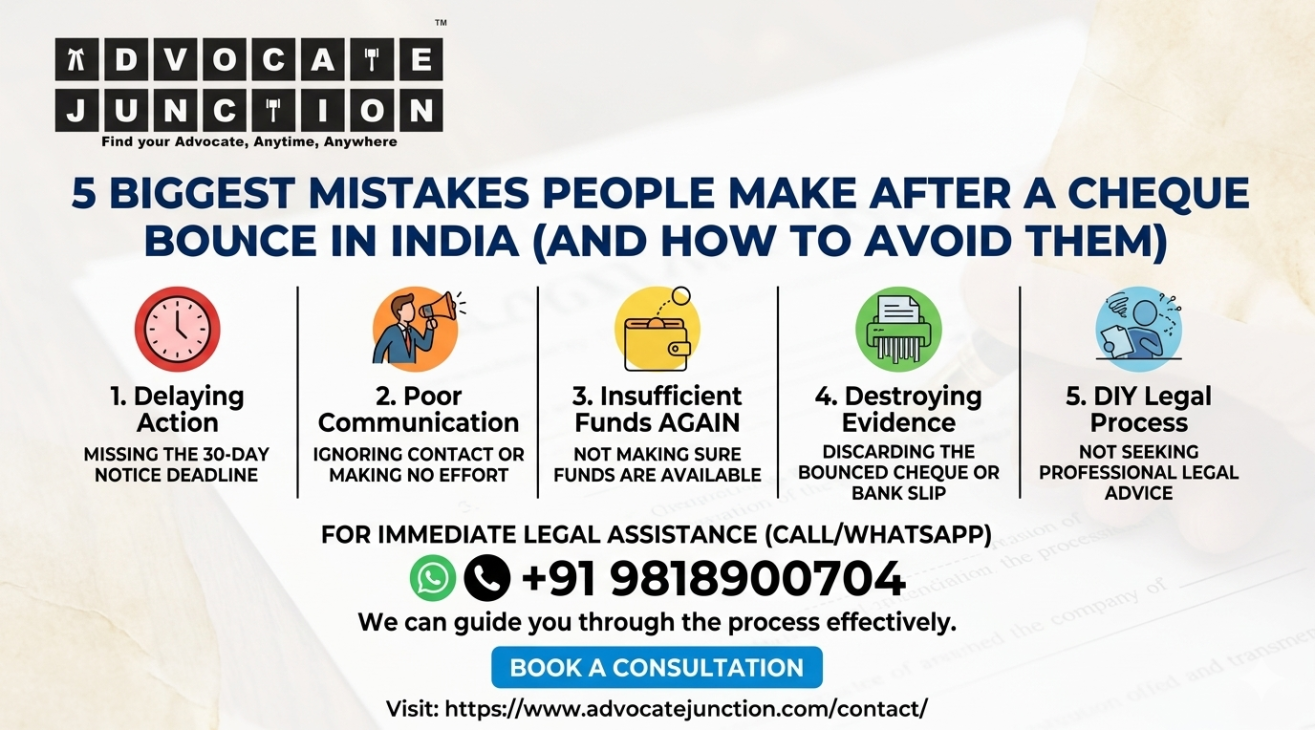
Part II: The 5 Biggest Mistakes (And the Legal Analysis)
Mistake 1: The “Limitation Trap” – Delaying Beyond the 30-Day Window
In Indian law, “Limitation” is the death of a right. The NI Act is a time-bound statute. Many people lose their case before it even starts by failing to track the calendar.
The Legal Reality:
The Supreme Court has clarified in numerous judgments, including MSR Leathers v. S. Palaniappan, that while a cheque can be presented multiple times within its validity, the “Notice” window is rigid. Once you receive that bank memo, the clock starts ticking.
-
The Trap: Attempting to “negotiate” via phone for 40 days before sending a notice.
-
The Consequence: Your Section 138 complaint will be barred by limitation. While Section 142(1)(b) allows a judge to condone delay if “sufficient cause” is shown, Indian courts are notoriously strict. A “friendly request” for payment is rarely accepted as a sufficient cause for missing a statutory deadline.
How to Avoid It: Establish a “Standard Operating Procedure” (SOP). The day the memo arrives, scan it and send it to your legal counsel. Aim to have the notice dispatched by Day 7.
Mistake 2: Sending a Defective or “Vague” Demand Notice
The Demand Notice is the most scrutinized document in a cheque bounce trial. If the notice is “infirm,” the complaint is “stillborn.”
Common Drafting Errors:
-
Averment of Debt: If you fail to clearly state that the cheque was issued for a “legally enforceable debt,” the defense will argue the cheque was given as “security” or a “gift.”
-
Mathematical Errors: Demanding ₹5,05,000 when the cheque was for ₹5,00,000 without explaining the extra ₹5,000 (interest/costs) can lead to the notice being declared invalid.
-
Identity Crisis: Addressing the notice to a “Director” in their personal capacity for a cheque issued by a “Company” (or vice versa) violates Section 141 of the NI Act (Vicarious Liability).
The Legal Standard: As established in Central Bank of India v. Saxons Farms, the notice must make a “clear demand” for the cheque amount. It should be sent via Registered Post AD. While WhatsApp notice is increasingly accepted as secondary evidence, it should never replace a physical, registered letter.
Mistake 3: Mishandling the “Original” Evidence
Many complainants treat the original cheque like a common receipt. In court, the Best Evidence Rule applies.
The Evidentiary Checklist:
-
The Original Cheque: Without this, you cannot prove the instrument exists.
-
The Bank Return Memo: This is the primary evidence of dishonor. Ensure the bank stamp is legible.
-
Postal Receipt & Tracking Report: This proves you sent the notice.
-
Acknowledgment Due (AD) Card: This proves the drawer received the notice.
The “Presumption” Advantage:
Under Section 139 of the NI Act, the court presumes that the holder of a cheque received it for the discharge of a debt. This is a massive advantage for the payee. However, if you lose the original documents, you lose the benefit of this presumption, and the burden of proof shifts back to you.
Mistake 4: Filing in the Wrong Jurisdiction
Jurisdiction has been a point of massive legal evolution. If you file in the wrong court, your case could be returned after years of litigation, forcing you to start over.
The Current Law (Section 142):
Following the 2015 Amendment and the landmark Dashrath Rupsingh Rathod case:
-
If you deposit the cheque for collection through your account: The jurisdiction is where your bank branch is located.
-
If you present the cheque over the counter: The jurisdiction is where the drawer’s bank branch is located.
Example for Delhi-based Businesses: If your office is in Noida but your bank account is in South Delhi, and the bounced cheque was deposited in your South Delhi branch, you have the right to file the case in the South Delhi (Saket) courts. Filing in Noida simply because your office is there would be a jurisdictional error.
Mistake 5: Ignoring the “Interim Compensation” Provision (Section 143A)
This is perhaps the most overlooked “pro-payee” tool added to the Act in 2018. Many people file a case and then wait years for a judgment without realizing they can get money during the trial.
What is Section 143A?
The court may order the drawer of the cheque to pay interim compensation to the complainant.
-
The Amount: Up to 20% of the cheque amount.
-
The Timing: This can be ordered at the stage of framing charges.
-
The Benefit: It provides immediate financial relief and puts immense pressure on the accused to settle the matter quickly.
The Mistake: Not filing a specific application for interim compensation at the start of the trial.
Part III: Step-by-Step Recovery Procedure
Stage 1: The Banking Phase
As soon as the cheque bounces:
-
Obtain the Return Memo.
-
Check the reason. “Funds Insufficient,” “Account Closed,” and “Stop Payment” all fall under Section 138. “Refer to Drawer” is also generally accepted.
Stage 2: The Notice Phase
-
Draft the notice within 30 days.
-
State the transaction history (why the money was owed).
-
Give a clear 15-day ultimatum for payment.
-
Send it via Registered Post AD. Keep the tracking ID safe.
Stage 3: The Complaint Phase
-
If no payment is received by Day 16 after the notice is delivered, you have 30 days to file the complaint.
-
The complaint is filed before a Metropolitan Magistrate (MM) or a Judicial Magistrate First Class.
-
Pre-Summoning Evidence: You will give a sworn statement (affidavit) to the court.
Stage 4: The Trial Phase
-
Summoning: The court issues a summons to the accused.
-
Bail: The accused must appear and take bail (as it is a bailable offense).
-
Notice/Framing of Charges: The accused is asked if they plead guilty.
-
Evidence & Cross-Examination: This is where the “Legally Enforceable Debt” is tested.
Stage 5: Judgment and Execution
-
If convicted, the accused can face up to 2 years in prison.
-
The court can order a fine up to double the cheque amount.
-
If the accused appeals, they are usually required to deposit a minimum of 20% of the fine amount (Section 148).
Part IV: Advanced Strategy – Civil vs. Criminal Remedies
One of the most common questions we receive at Advocate Junction is: “Should I file a criminal case or a civil suit?”
The answer is: Both.
1. The Criminal Path (Section 138 NI Act)
-
Goal: Punishment and pressure.
-
Pros: Faster than regular civil suits, potential jail time for the debtor, interim compensation.
-
Cons: Does not “guarantee” money recovery if the accused prefers jail over payment (though rare).
2. The Civil Path (Summary Suit – Order 37 CPC)
-
Goal: A formal decree for money recovery.
-
Pros: You can get a “Decree” which allows you to attach the debtor’s property, bank accounts, or assets.
-
Cons: Can be more expensive in terms of “Court Fees” (which are a percentage of the claim amount).
Strategic Tip: File the Section 138 notice immediately. If the amount is high, follow up with an Order 37 Summary Suit. The pressure of a criminal case often leads to a settlement in the civil case.
Part V: Special Scenarios
Case A: Cheque Issued by a Company
If a company issues a bounced cheque, you must implead both the Company and the Directors/Authorized Signatories who were in charge of the company’s affairs at the time. Failing to name the company as an accused is a fatal error (Aneeta Hada v. Godfather Travels).
Case B: “Stop Payment” Instructions
Drawers often think they can escape liability by instructing the bank to “Stop Payment.” The Supreme Court has ruled that this does not stop a Section 138 prosecution. In fact, it often strengthens the payee’s argument that the drawer had dishonest intentions.
Case C: Security Cheques
The most common defense is: “It was a blank security cheque.” Recent rulings clarify that as long as the debt exists on the date the cheque is presented, it doesn’t matter if the cheque was originally given for “security.” The burden is on the drawer to prove no debt existed.
Part VI: Checklist for a Winning Case
To ensure your pillar of recovery is strong, verify your file against this checklist:
-
[ ] Is the cheque presented within 3 months?
-
[ ] Is the Return Memo dated?
-
[ ] Was the Demand Notice sent within 30 days of the Memo date?
-
[ ] Did the Notice give exactly 15 days for payment?
-
[ ] Is the “Legally Enforceable Debt” supported by an invoice, contract, or ledger?
-
[ ] Is the complaint filed in the correct jurisdiction (based on your bank branch)?
-
[ ] Have you included a prayer for Interim Compensation?
Why Professional Legal Support is Non-Negotiable
The Negotiable Instruments Act is designed to be “Summary” (quick), but the procedural hurdles are high. A single mistake in the notice or a missed deadline can result in the loss of lakhs or crores of rupees.
At Advocate Junction, we bridge the gap between financial loss and legal recovery. Our specialized team handles:
-
Precision Drafting: Bulletproof legal notices and complaints.
-
Jurisdiction Mapping: Ensuring your case is filed in the correct court to avoid “Return of Complaint.”
-
Doorstep Service: We collect your documents from your office or home in Delhi NCR, so you can focus on your business while we focus on the law.
- Rajpal Yadav: The actor has been embroiled in a long-running case over unpaid loans of approximately ₹9 crore related to his 2010 directorial debut Ata Pata Laapata. Due to repeated failures to pay, he was ordered to surrender to Tihar Jail in February 2026.
- Ameesha Patel: In 2018, filmmaker Ajay Kumar Singh accused her of fraud and cheque bounce, claiming she failed to repay ₹2.5 crore invested in her film Desi Magic. The case was disposed of in 2024 after she repaid the entire amount.
- Rajkumar Santoshi: The filmmaker was convicted in a cheque bounce case in 2024 related to a ₹1 crore loan for film production. A court in Jamnagar sentenced him to two years of imprisonment and ordered a fine, though he was granted bail for an appeal.
- Ram Gopal Varma: In 2018, a Mumbai court convicted the director in a cheque bounce case filed by a supplier, sentencing him to three months’ imprisonment.
- Koena Mitra: The actress was convicted in a 2013 case where she was ordered to pay a fine and a significant compensation amount to a model.
- Padmaja Rao: In August 2024, a Kannada actress, Padmaja Rao, was convicted by a Mangaluru court in a cheque dishonour case and ordered to pay a fine of ₹40.2 lakh.
Lessons from the Headlines – Famous Cheque Bounce Cases
To understand the weight of Section 138, one must look at how it has affected even the most high-profile individuals and shifted legal paradigms in India.
1. The Rajpal Yadav Case (2010–2026): A Cautionary Tale
Perhaps the most famous example of celebrity financial mismanagement in India involves actor Rajpal Yadav.
-
The Conflict: Yadav took a loan of approximately ₹5 crore to finance his directorial debut, Ata Pata Laapata.
-
The Spiral: Due to non-payment and accrued interest, the debt swelled to over ₹9 crore. When the cheques he issued bounced, legal proceedings were initiated.
-
The Consequence: The legal battle spanned over a decade, eventually leading to the actor being sent to Tihar Jail.
-
The Lesson: In the eyes of the law, stardom is no shield. Section 138 applies equally to everyone, and the interest on unpaid debts can quickly double your liability.
2. Gimpex Private Limited vs. Manoj Goel (2021)
This landmark Supreme Court case addressed the “Settlement Loophole.”
-
The Rule: The Court clarified that if a first complaint is withdrawn unconditionally after a settlement, you cannot file a second complaint based on a new cheque given for that same settlement.
-
The Lesson: If you are settling a case, ensure the terms are recorded in court. You cannot restart a criminal proceeding for the same debt if you have already closed the first chapter without proper legal safeguards.
3. Kaveri Plastics vs. Mahdoom Bawa (2025)
A recent but vital ruling that emphasizes technical perfection.
-
The Rule: The Supreme Court held that the statutory legal notice must demand the exact cheque amount.
-
The Lesson: If you demand an amount that includes un-calculated interest or penalties not mentioned on the cheque, your notice—and consequently your entire case—can be invalidated due to “typographical errors” or discrepancies.
- Serious Penalties: Under Section 138, individuals can face up to two years in jail, a fine, or both.
- Non-Exemption of Celebs: Courts have observed that public profile or celebrity status does not exempt anyone from the law, as highlighted in the Rajpal Yadav case.
- Mediated Settlements: Cases are often resolved through court-ordered mediation, such as the one in the Ameesha Patel case.
Take Action Today
If you are holding a bounced cheque, every day you wait is a day closer to your limitation period expiring.
Connect with Advocate Junction for Expert Legal Support:
-
WhatsApp/Call: +91 9818900704
-
Office Locations: Serving all major courts in Delhi NCR (Saket, Rohini, Tis Hazari, Dwarka, Noida, and Gurugram).
Don’t just wait for your money. Compel it with the Law.
Disclaimer – This blog is just for educational purpose and you must consult an advocate before taking any legal steps.