
Cheque Bounce is a Criminal Offence in India — Complete Legal Guide for 2026
Cheque Bounce is a Criminal Offence in India — You Can Face Jail, Fine and Criminal Trial
Cheque Bounce Criminal Offence India is no longer just a banking issue. Under Section 138 of the Negotiable Instruments Act, cheque dishonour can lead to criminal prosecution, court summons, financial penalties, and even imprisonment.Many people in India still believe that cheque bounce is merely a “payment dispute” or a simple banking issue. That belief is legally dangerous.
Under Section 138 of the Negotiable Instruments Act, 1881, issuing a cheque that bounces due to insufficient funds or similar reasons can attract criminal liability when the cheque was issued towards a legally enforceable debt or liability.
For businesses, traders, freelancers, property dealers, suppliers, consultants, lenders, and even individuals giving friendly loans, this law acts as a strong legal weapon against dishonest payments.
Cheque Bounce is Not Merely a Civil Dispute
One of the biggest misconceptions in India is that cheque bounce cases are only civil matters.
That is incorrect.
A cheque bounce matter under Section 138 is criminal in nature. Once the legal procedure is completed properly, the accused may be summoned by a criminal court and forced to face criminal proceedings.
The purpose behind criminalising cheque dishonour was to maintain trust in banking transactions and commercial dealings. If people start issuing cheques without consequences, financial discipline collapses.
That is exactly why Indian law treats cheque dishonour seriously.
Criminal Liability Begins the Moment Legal Requirements are Completed
The moment a cheque bounces and the legal notice procedure is properly completed, the drawer of the cheque may face criminal prosecution.
Many accused persons make the mistake of ignoring legal notices thinking it is merely a “warning letter.” Later they receive court summons from a Magistrate Court and realise the seriousness of the matter.
Once the complaint is filed properly, the accused may have to:
- Appear before court
- Engage advocates
- Apply for bail in certain situations
- Attend repeated hearings
- Face criminal trial
- Negotiate settlement under pressure of prosecution
For many businesses and professionals, criminal prosecution itself becomes a strong recovery mechanism.
Punishment for Cheque Bounce in India
Indian courts have the power to impose serious punishment in cheque bounce matters.
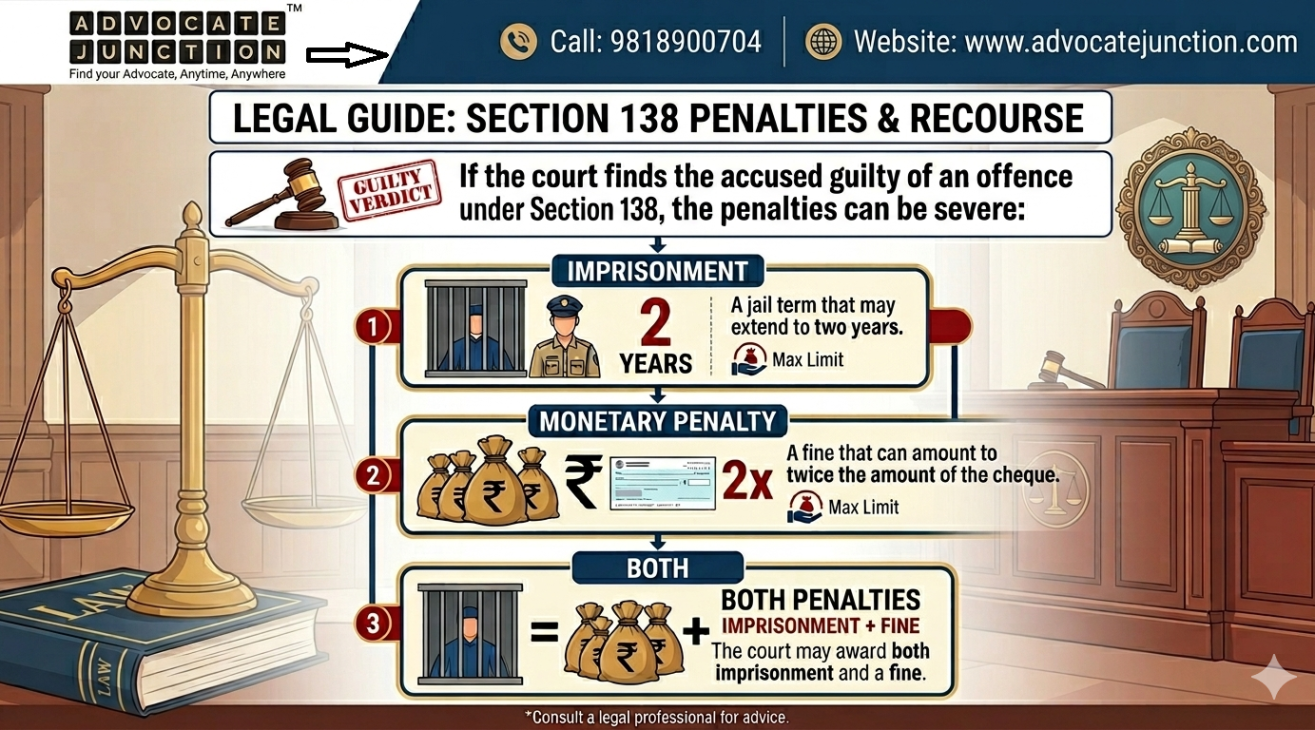
A person found guilty under Section 138 may face:
- Imprisonment up to 2 years
- Fine up to twice the cheque amount
- Both imprisonment and fine together
Apart from punishment, courts may also direct compensation to the complainant.
For example, if someone dishonestly issues a cheque of ₹10 lakhs without maintaining sufficient funds, the financial consequences may become far higher than the original amount itself because of penalty, litigation expenses, advocate fees, interest, and settlement pressure.
Ignoring Court Summons Can Make the Situation Worse
Many accused persons initially ignore notices and court summons assuming nothing serious will happen.
This often becomes a costly mistake.
If the accused repeatedly avoids appearance before court, the Magistrate may issue:
- Bailable warrants
- Non-bailable warrants
- Coercive legal proceedings
This damages the legal position of the accused significantly.
In many situations, business reputation also suffers once criminal litigation starts.
Why Section 138 Cases Create Strong Legal Pressure
Unlike ordinary money recovery cases that may continue for years without immediate consequences, cheque bounce complaints create direct criminal pressure on the drawer.
This is why cheque bounce law is considered one of the strongest recovery tools available for financial disputes in India.
The fear of criminal conviction, imprisonment, warrants, and repeated court appearances often forces defaulters toward settlement.
For this reason, many businesses intentionally prefer cheque transactions because dishonoured cheques provide stronger legal remedies.
Friendly Loans and Personal Transactions Also Qualify
Cheque bounce law is not limited to commercial business transactions.
Even if the cheque was issued against:
- Friendly loans
- Personal borrowings
- Family transactions
- Property dealings
- Informal financial arrangements
criminal proceedings may still arise if legal requirements are satisfied.
This surprises many people because they assume criminal action only applies to companies or large business disputes.
Directors and Companies May Also Face Criminal Proceedings
In many corporate cheque bounce matters, liability may extend beyond the company itself.
Directors and persons responsible for business operations may also be prosecuted in appropriate cases.
This is particularly serious for startups, private limited companies, LLPs, and partnership firms where dishonoured cheques are issued during business operations.
Settlement Usually Happens Under Criminal Pressure
A major reason cheque bounce law remains effective is because parties often settle disputes after criminal proceedings begin.
Once summons are issued and repeated court appearances start, many accused persons prefer settlement instead of continuing criminal litigation.
In practical terms, criminal prosecution often succeeds where ordinary recovery requests fail.
AdvocateJunction Helps Victims of Cheque Bounce Across India
AdvocateJunction helps individuals and businesses take proper legal action in cheque bounce matters through professional legal support and advocate coordination services.
Services may include:
- Drafting strong legal notices
- Connecting clients with experienced advocates
- Filing cheque bounce complaints
- Documentation assistance
- Court representation support
- Settlement negotiation assistance
- Strategic guidance for recovery
For people in Delhi NCR, AdvocateJunction also assists in coordinating doorstep legal support for documentation and legal process handling.
A properly drafted notice and correctly filed complaint can make a major difference in the outcome of a cheque bounce matter.
Final Thoughts
Cheque bounce is not a mistake or a minor banking issue in India. It is a criminal offence that can lead to imprisonment, financial penalties, criminal court proceedings, warrants, and long-term legal consequences.
Many people realise the seriousness only after criminal summons reach their doorstep. If you are an NRI and facing any problem with cheque bounce , we will give you all legal support and services . Whether the cheque amount is small or large, ignoring cheque dishonour laws can become legally expensive for the drawer and financially damaging for the victim.If you are dealing with a cheque bounce matter, taking timely legal action is extremely important.
For legal notice drafting, cheque bounce complaint filing, and advocate support, contact AdvocateJunction.
Website: https://www.advocatejunction.com/contact/
Contact Number: 9818900704
Disclaimer – The article is for educational and awareness purpose only .