Handling Objections in Court Marriage: Complete Legal Guide Delhi 2026
Court Marriage Objection: The Fear of “What If?”
Planning a court marriage in India is an act of courage and legal transition. However, for many couples—especially those in inter-caste, inter-faith, or simply “unapproved” love marriages—the 30-day notice period feels like a ticking clock. The primary fear is the Court Marriage Objection.
Will my parents find out? Can my neighbor stop us? What happens if the Registrar sends a notice to my home?
If you are asking these questions, you are in the right place. At Advocate Junction, we believe that legal knowledge is your best defense. This guide is designed to provide you with a 360-degree understanding of how to handle objections under the Special Marriage Act. We’ve helped dozens of couples successfully navigate these hurdles. The bottom line: Most objections fail if you are prepared.
1. Understanding the Concept: What is a Court Marriage Objection?
1.1 The Legal Definition
A court marriage objection is a formal challenge filed by a third party at the Office of the Marriage Officer (Registrar). This challenge asserts that the proposed marriage violates one or more legal requirements set forth by the Special Marriage Act, 1954.
1.2 The “Window of Vulnerability”: The 30-Day Notice Period
When you apply for a court marriage, the Registrar publishes a “Notice of Intended Marriage.” This notice is displayed on the office notice board for 30 consecutive days.
-
The Purpose: To allow the public to come forward if they know of a legal reason why the marriage cannot take place.
-
The Timing: Objections can only be filed during this 30-day window. If someone tries to object on Day 31, the Registrar is legally bound to ignore it.
1.3 Why Objections Occur in 2026
Even in 2026, social dynamics in India mean that many families view court marriage as a loss of control. Objections are rarely about the law; they are usually about delaying the process in hopes that the couple will succumb to emotional or social pressure.
2. Who is Legally Allowed to File an Objection?
2.1 The “Any Person” Clause
Section 7 of the Special Marriage Act states: “Any person may, before the expiration of thirty days from the date on which the notice has been published, object to the marriage.”
Technically, this includes:
-
Family Members: Parents, siblings, and cousins (The most common objectors).
-
Community Members: Neighbors or members of a local council (Khap).
-
Total Strangers: While rare, anyone who sees the notice board can theoretically file.
2.2 The Requirement of Identification
Anonymous objections are not valid. An objector must:
-
Provide their full name and address.
-
Sign the objection.
-
Appear before the Registrar for an inquiry.
If someone sends an anonymous letter or a fake email, the Registrar will generally disregard it as it cannot be verified during an inquiry.
3. Valid vs. Invalid Grounds: What Can Actually Stop Your Marriage?
This is the most critical part of your defense. The law only recognizes five specific grounds for an objection. Anything else is legally irrelevant.
3.1 The 5 Legal Pillars (Valid Grounds)
-
Age Deficiency: If the male is under 21 or the female is under 18.
-
Existing Subsisting Marriage: If either party has a living spouse and hasn’t obtained a legal divorce (Bigamy).
-
Prohibited Relationship: If the couple are “Sapindas” or fall within prohibited degrees of relationship (unless custom allows it).
-
Unsound Mind: If either party is mentally incapable of giving valid consent.
-
Lack of Free Consent: If one party is being forced, threatened, or coerced into the marriage.
3.2 The List of Invalid Grounds (Common Myths)
Couples often worry that their marriage will be stopped for social reasons. None of the following are valid grounds for an objection:
-
Caste Differences: “They are from different castes/gotras.” (Dismissed)
-
Religious Differences: “One is Hindu, one is Muslim.” (Dismissed—the Special Marriage Act was specifically made for this).
-
Parental Disapproval: “We do not give permission.” (Dismissed—adults do not need parental permission).
-
Financial Status: “The boy doesn’t earn enough.” (Dismissed).
-
Social Status: “This will ruin our family reputation.” (Dismissed).
4. The Anatomy of an Objection: The Step-by-Step Process
When an objection is filed, the “clock stops.” The marriage cannot be solemnized until the objection is resolved.
Step 1: The Filing (Days 1–29)
The objector submits a written statement to the Marriage Officer. They must state the specific ground (e.g., “The girl is only 17”).
Step 2: Notice to the Couple (The “Summons”)
The Registrar will immediately inform you. You will receive a copy of the objection and a date for a Summary Inquiry.
Step 3: The Inquiry Hearing
The Registrar acts like a judge. You, your partner, and the objector must appear.
-
The Objector’s Burden: They must prove their claim. If they say you are underage, they must show a birth certificate.
-
Your Opportunity: You present your documents to disprove the claim.
Step 4: The Private Interview
In cases where “force” or “kidnapping” is alleged, the Registrar will take the bride into a private room. This is a safe space where the bride can clearly state: “I am an adult, I am here by choice, and I want to marry this person.” Once this statement is recorded, the objection of “force” usually evaporates.
Step 5: The Final Order
The Registrar will pass a written order.
-
If Dismissed: You get a “clearance” and can proceed with the marriage.
-
If Upheld: The marriage is stayed. You then have the right to appeal to the District Court.
5. Strategic Defense: How to Respond to an Objection
5.1 Immediate Mental Readiness
Don’t panic. An objection is just a legal speed bump, not a brick wall. Most families use it as a bluff. When they realize they have to appear in a government office and face a legal inquiry, many back down.
5.2 Gathering Your “War Chest” of Evidence
Prepare a file containing:
-
Age Proofs: 10th Class mark sheets, Birth Certificates, Passports.
-
Marital Status Proofs: Divorce decrees (if applicable) or “Unmarried Affidavits.”
-
Consent Proofs: Photos of the relationship over time, chat logs, or a video statement recorded beforehand.
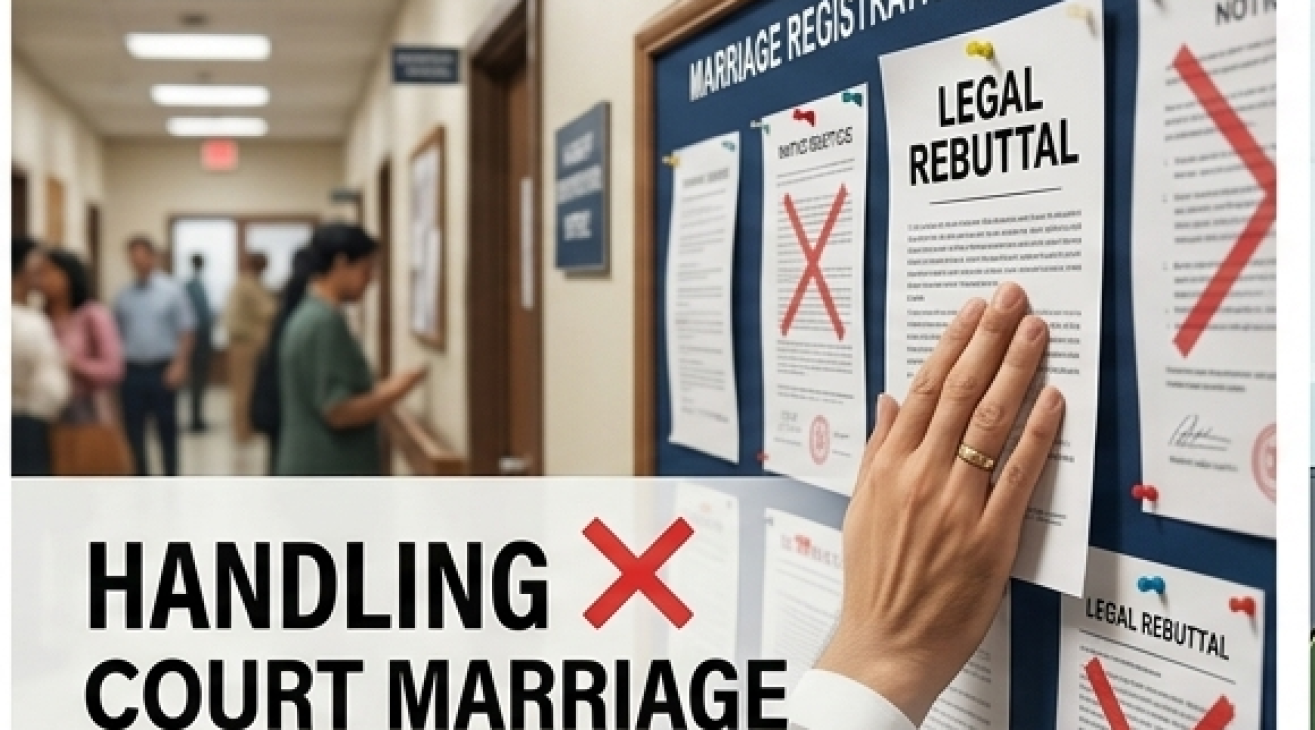
5.3 Drafting the Written Response (The “Rebuttal”)
Your response should be professional and cite the law. A typical response includes:
-
Point-by-point rebuttal: “The objector claims [X]. This is false because [Y].”
-
Constitutional Reference: Mentioning your right to life and liberty under Article 21.
-
Prayer: A request to the Registrar to dismiss the objection and impose a fine on the objector for wasting the court’s time (The Registrar can fine up to ₹1,000 for frivolous objections).
6. Landmark Supreme Court Cases: Your Legal Shield
In 2026, the law is more on the side of couples than ever before. You should cite these cases if your hearing gets complicated:
6.1 Shakti Vahini vs. Union of India (2018)
The Supreme Court held that the right of two consenting adults to choose their life partner is a fundamental right. It explicitly stated that no “Khap Panchayat” or family member has the right to interfere in the marriage of two adults.
6.2 Lata Singh vs. State of UP (2006)
The Court directed the police to provide protection to inter-caste couples and observed that “this is a free and democratic country,” and once a person becomes a major, they can marry whomever they like.
6.3 Shafin Jahan vs. Asokan K.M. (Hadiya Case – 2018)
The Supreme Court ruled that a person’s choice of religion and partner are part of their “inner core” of privacy that the state or family cannot enter.
7. After the Objection: Next Steps and Safety
7.1 What to do once it is Dismissed
-
Get the Written Order: Always ask for a signed copy of the dismissal.
-
Check the Expiry: Ensure your original notice is still valid (notices usually expire after 3 months).
-
Execute the Marriage: Bring your 3 witnesses and finish the ceremony immediately.
7.2 Safety Precautions for Love Marriages
If you suspect your family will become violent after the objection is dismissed:
-
Request Police Protection: You can file a petition in the High Court or approach the local DCP for protection during and after the marriage.
-
Change Residence: If you were living at home, move to a safe location before the 30-day notice is published.
-
Confidentiality: Do not share your chosen Marriage Registrar’s location with anyone outside your trusted circle.
8. Preventing Objections: Proactive Measures
Can you avoid an objection altogether? While you can’t stop someone from filing, you can make it very difficult for them.
8.1 Choice of Jurisdiction
Under the Special Marriage Act, you can file your notice in any district where either the bride or groom has resided for at least 30 days. If you reside in Delhi but your family is in a distant village, file in Delhi. They are less likely to see the notice board in a different city.
8.2 Accurate Documentation
The #1 reason “valid” objections succeed is because of typos. If your Aadhaar says one birth year and your 10th certificate says another, you are giving the objector a weapon. Clean up your documents first.
8.3 The “Police Intimation” Strategy
Before the family can file an objection, you can send an “Intimation Letter” to the local police station stating that you are two adults marrying by choice. This creates a record that you are not “missing” or “kidnapped,” which pre-emptively weakens any future objection.
9. Costs Involved in Handling Objections
| Service Type | Estimated Official Fee | Professional/Lawyer Fee |
| Response Drafting | ₹0 | ₹3,000 – ₹7,000 |
| Inquiry Representation | ₹0 | ₹5,000 – ₹12,000 |
| Appeal to District Court | ₹500 – ₹1,000 | ₹15,000 – ₹30,000 |
| Police Protection Petition | ₹1,000 | ₹10,000 – ₹25,000 |
Note: Advocate Junction offers packaged services to keep these costs predictable for couples.
“Worried about someone opposing your union? Learn [how to handle objections in court marriage] legally.”
10. Frequently Asked Questions (Detailed)
Q1: Does the Registrar send a notice to my parents’ house?
Legally, the Registrar is only required to post the notice on the Office Notice Board. However, in some jurisdictions, they may send a notice to the “Permanent Address” listed on your IDs. At Advocate Junction, we guide you on how to handle your addresses to minimize this risk. Court Marriage Without Parents Consent.is possible.
Q2: Can a family member claim I am mentally unstable?
They can claim it, but they must prove it. They would need a recent medical certificate from a government psychiatrist. A mere verbal allegation of “being brainwashed” is not a legal ground for an objection.
Q3: What happens if I fail to appear for the hearing?
If you don’t show up, the Registrar may uphold the objection or cancel your notice. Always attend your hearing.
Q4: Can we marry under the Arya Samaj ritual to avoid the 30-day notice?
Yes, Arya Samaj marriages do not require a 30-day public notice. However, for a Special Marriage Act (Court Marriage), the notice is mandatory. Many couples do both: an Arya Samaj ceremony for immediate validity and then a court registration.
How Advocate Junction Stands By You
We understand that this is more than just a legal case; it is your life and your future. Our team, led by Gunjan Priyadarshi, specializes in ensuring that the law works for you, not against you.
Our Objection Defense Package Includes:
-
Case Assessment: We analyze the objection to find legal loopholes.
-
Drafting: Professional drafting of your rebuttal with Supreme Court citations.
-
Representation: A seasoned advocate to stand with you during the inquiry.
-
Post-Marriage Security: Guidance on obtaining a protection order if needed.
Don’t let a piece of paper stop your union.
Contact Advocate Junction Today:
-
WhatsApp/Call: 9818900704
-
Website: www.advocatejunction.com
-
Quick Support: Delhi NCR – Doorstep Services Available