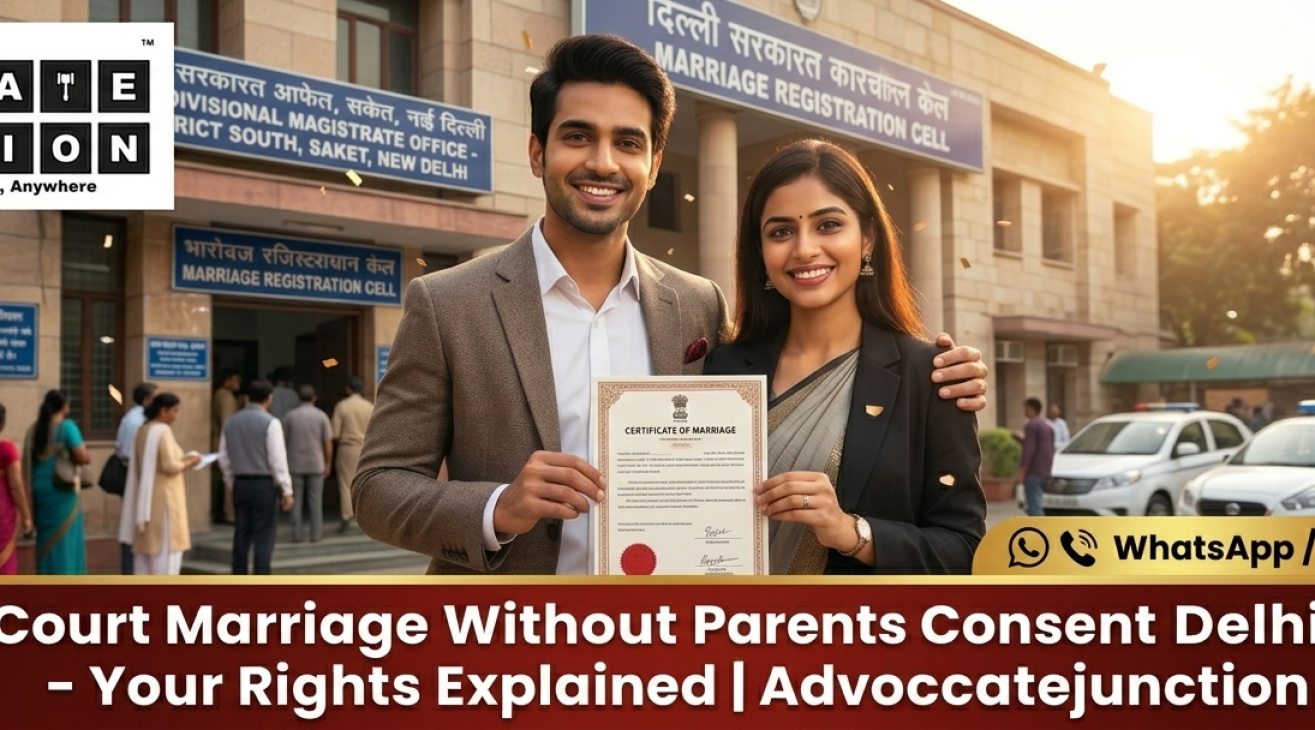
Court Marriage Without Parents Consent in Delhi – Complete Legal Guide 2026
Is Court Marriage Without Parents Consent Legal in Delhi?
Yes. Court marriage without parents consent is 100% legal in India.
This is one of the most important things every young couple in Delhi needs to know.
If you are:
- 18 years or above (bride) and
- 21 years or above (groom)
You have the complete legal right to marry without anyone’s permission – including your parents, family members, or anyone else.
The Special Marriage Act, 1954 and Hindu Marriage Act, 1955 both clearly state that two consenting adults can legally marry without parental approval.
Nobody – not your parents, not your relatives, not the khap panchayat, not anyone – can legally stop two consenting adults from marrying.
This comprehensive guide explains everything about court marriage without parents consent in Delhi:
- What does law say about marrying without parents’ permission?
- Complete process of court marriage without parents’ approval
- Documents required for court marriage
- How to stay safe from family interference
- Can parents legally stop your court marriage?
- What to do if family threatens you?
- How to get police protection for court marriage
- FAQs answered by practicing advocates
What Does Indian Law Say About Marriage Without Parents’ Consent?
The Fundamental Right to Marry
Indian law clearly protects your right to marry the person of your choice as an adult. This right flows from:
- The Special Marriage Act, 1954 (Section 4)
“Notwithstanding anything contained in any other law for the time being in force relating to the solemnization of marriages, a marriage between any two persons may be solemnized under this Act, if at the time of the marriage the following conditions are fulfilled…”
The conditions listed are:
- ✅ Neither party is already married
- ✅ Both parties are capable of consent (sound mind)
- ✅ Bride is 18+ years, groom is 21+ years
- ✅ Not within prohibited degrees of relationship
Parental consent is NOT listed as a condition. It simply does not exist in law.
- The Hindu Marriage Act, 1955 (Section 5)
Similarly lists conditions for valid marriage with no requirement for parental consent for adults.
- The Constitution of India
Article 21 – Right to Life includes right to choose your life partner (Supreme Court has repeatedly upheld this).
Article 19 – Freedom of movement, expression, and association.
Supreme Court ruling in Shakti Vahini vs Union of India (2018):
“The right to choose a life partner is a fundamental right under Article 21 of the Constitution.”
- Landmark Supreme Court Judgments:
| Case | Ruling |
| Lata Singh vs State of UP (2006) | Adults can marry anyone of their choice; family interference is illegal |
| Shakti Vahini vs Union of India (2018) | Right to choose partner is fundamental right; honor violence is crime |
| Nandakumar vs State of Kerala (2018) | Interfering in adult’s marriage choice is violation of fundamental rights |
| Shafin Jahan vs Asokan (2018) | Choice of partner is fundamental right regardless of religion, caste |
Bottom Line: Indian law, Constitution, and Supreme Court all clearly support your right to court marriage without parents’ consent.
Can Parents Legally Stop Court Marriage in Delhi?
No. Parents CANNOT legally stop court marriage between two consenting adults.
Here’s what parents CAN and CANNOT do:
What Parents CANNOT Do (Legally):
- File any case to stop the marriage (no grounds exist in law)
- Apply to court to cancel marriage (not possible for valid adult marriage)
- Pressure marriage registrar to refuse registration (unlawful interference)
- File “missing person” complaint to harass the couple (courts have held this as misuse)
- Use panchayat or community to pressure the couple (illegal)
- Physically assault the couple (criminal offense – IPC Sections 323, 325, 506)
- Commit “honor violence” of any kind (serious criminal offense)
What Parents Can Do (Legally):
- Express their disapproval verbally or in writing (freedom of expression)
- Choose not to attend the wedding
- Choose not to maintain relations with the couple (personal choice)
- Disinherit from property (in some circumstances, subject to law)
Important: Filing a “missing person” complaint or “abduction” complaint against an adult woman who has willingly married is misuse of police process. Courts have repeatedly dismissed such complaints when the woman confirms she married voluntarily.
Objections During 30-Day Notice Period – Can They Stop Marriage?
Under Special Marriage Act, 1954, after filing marriage notice, a 30-day public notice period begins. Anyone (including parents) can file an “objection.”
But can parental objection stop court marriage?
Almost always NO.
Valid grounds for objection are STRICTLY limited:
| Valid Legal Objection | Invalid Objection (Will Be Rejected) |
| Either party is underage | “Different castes” |
| Either party already married | “We don’t approve” |
| Either party is mentally unsound | “Our religion doesn’t allow” |
| Marriage within prohibited relationship | “Society will not accept” |
| Consent obtained by fraud/force | “Family honor” |
If parents file objection saying “different caste” or “we don’t approve” – the marriage officer MUST reject the objection. It has no legal standing.
💡 Pro Tip: In Delhi, if parents file an invalid objection, the marriage officer can proceed after finding the objection has no merit. Consult an advocate if parents file objection – they can be legally addressed.
Complete Process: Court Marriage Without Parents Consent in Delhi
The process for court marriage without parents’ consent is identical to regular court marriage. There is no separate process or additional requirements.
Step 1: Check Eligibility
Before proceeding:
| Requirement | Details |
| Bride’s age | 18 years minimum (verify with birth certificate) |
| Groom’s age | 21 years minimum |
| Neither party married | Both must be single/divorced/widowed |
| Mental capacity | Both must be of sound mind |
| Not prohibited relationship | Not closely related by blood |
Parental approval: NOT required ✅
Step 2: Decide on Type of Marriage Registration
Option A: Special Marriage Act, 1954
- For inter-religion marriages (most common choice for couples without parental support)
- Covers ALL religions (Hindu, Muslim, Christian, Sikh, Buddhist, Jain, others)
- Government-issued marriage certificate
- 30-day notice period mandatory
Option B: Hindu Marriage Act, 1955
- For both parties being Hindu/Sikh/Jain/Buddhist
- Also doesn’t require parental consent
- Can register at Sub-Registrar office
- Different procedure from Special Marriage Act
Recommendation for couples without parental support: Special Marriage Act is stronger as it explicitly overrides personal laws and parental objections.
Step 3: Gather Documents
Documents required for court marriage without parents’ consent:
| Document | Bride | Groom |
| Age Proof | Birth certificate / 10th Marksheet / Passport | Birth certificate / 10th Marksheet / Passport |
| Address Proof | Aadhaar / Voter ID / Passport | Aadhaar / Voter ID / Passport |
| ID Proof | PAN / Aadhaar / Passport | PAN / Aadhaar / Passport |
| Passport Photos | 4 recent photos | 4 recent photos |
| Affidavit | Stating age, marital status, consent | Stating age, marital status, consent |
| 30-day Residence Proof | Showing Delhi residence for 30 days | Not mandatory if bride has it |
Note: NO parental permission letter, NO parental affidavit, NO parental approval required in any document.
Step 4: Arrange 3 Witnesses
You need 3 witnesses for court marriage. They must be:
- 18 years or above
- Carry their own ID proof and address proof
- Willing to appear on ceremony day
- Sign the marriage register
Can witnesses be friends instead of family?
YES. Witnesses do not need to be family members. Friends, colleagues, or anyone you trust can be witnesses. This is especially relevant when marrying without parental support.
Witness checklist:
- [ ] 3 reliable friends/colleagues confirmed
- [ ] Their Aadhaar/ID copies collected
- [ ] Address proofs collected
- [ ] 2 passport photos from each
- [ ] Date confirmed with all 3
Step 5: File Marriage Notice at SDM Office
Both bride and groom visit the Sub-Divisional Magistrate (SDM) office:
- Choose SDM office where one of you has lived for 30 days
- Fill marriage notice form (Form I under Special Marriage Act)
- Submit all documents
- Pay nominal fee (₹100-150)
- Notice displayed on notice board for 30 days
- Objection period begins
What if parents come to SDM office to stop filing?
Marriage officers cannot refuse to accept notice from eligible adults. If parents create a scene, you can:
- Request police assistance from nearby police post
- Have your advocate present during filing
- File advance complaint at local police station about anticipated interference
Step 6: 30-Day Notice Period
After filing, wait for 30 days.
During this period, if you fear family interference:
- Stay at safe location if home is not safe
- Keep mobile charged and accessible
- Document any threats (screenshot messages, note dates)
- Consult advocate for protection petition if needed
- Police protection can be sought (explained below)
Step 7: Marriage Ceremony
After 30 days, ceremony is scheduled at SDM office:
- Both parties appear with witnesses
- Simple declaration of consent
- Sign marriage register
- Marriage officer declares marriage solemnized
- Duration: 15-30 minutes
Step 8: Marriage Certificate
Marriage certificate issued (same day or within 15 days):
- This is a government document
- Valid across India and internationally
- Cannot be “cancelled” by parents
- Legal proof of your marriage forever
How to Stay Safe When Doing Court Marriage Without Parents’ Consent
This is the most important section for couples facing family opposition.
Legal Protection Available:
- Seek Police Protection in Delhi
Couples facing threats can approach Delhi Police or Delhi High Court for protection.
Option A: DCP/SP Complaint
Write complaint to:
- Senior Superintendent of Police (SSP) of your area
- Mention specific threats received
- Request police protection during marriage notice filing and ceremony
Option B: Delhi High Court Protection Petition
File a Writ Petition under Article 226 in Delhi High Court seeking:
- Police protection for the couple
- Direction to police not to interfere with lawful marriage
- Direction to family not to threaten or harass
Delhi High Court has routinely granted protection in such matters.
How quickly can protection be obtained?
Emergency hearing: Delhi High Court can hear urgent protection petitions within 24-48 hours in genuine cases.
- Safe Location During Notice Period
If home is not safe, consider:
- Trusted friend’s home in a different area
- PG accommodation (paying guest – independent)
- Women’s shelter (Delhi Commission for Women helpline: 181)
- Working women’s hostel
Important: An adult woman leaving her parental home to get married is LEGAL. This is NOT “running away.” This is exercising her fundamental right.
- In Case of Forceful Confinement
If a parent or family member is preventing you from leaving home or meeting your partner:
Immediate steps:
- Call 100 (Delhi Police emergency)
- Call 112 (Emergency helpline)
- Call Delhi Commission for Women: 011-23379181
- Call National Commission for Women: 7827170170
Habeas Corpus Petition:
If you’re physically confined, your partner or advocate can file a Habeas Corpus Petition in Delhi High Court seeking your immediate release. Courts have acted within hours in urgent cases.
- After Marriage – Protection from Harassment
After successful court marriage, if family harassment continues:
Civil protection:
- Restraining order against specific family members
- Injunction preventing interference in marital life
Criminal protection:
- FIR for criminal intimidation (Section 506 IPC)
- FIR for assault (Section 323 IPC)
- FIR for wrongful confinement (Section 340-342 IPC)
- FIR for “honor violence” offenses
Delhi Police has a special unit for couples facing family pressure. They can be approached directly.
Addressing Common Fears About Court Marriage Without Parents’ Consent
Fear 1: “Neighbors/Society Will Gossip”
Legal reality: What your neighbors think has zero legal relevance. Your marriage will be 100% valid regardless of social opinion.
Practical advice: Once married with a government certificate in hand, you are legally protected. Over time, families often come around.
Fear 2: “Parents Will Disown Me”
Legal reality: Property rights of a child are protected under Hindu Succession Act. In most cases, parents cannot legally disinherit an adult child who marries without consent.
Practical advice: Many families reconcile after the initial shock. Give it time. Focus on your legal protection first.
Fear 3: “Police Will Take Me Back to My Parents”
Legal reality: Delhi Police CANNOT legally “return” an adult woman to her parents against her will. The Supreme Court has clearly held that adult women are not property to be “returned.”
If police tries to do this:
- Clearly state “I am an adult, I married willingly, I do not want to go with them”
- Ask to call an advocate
- Contact Delhi Commission for Women
Fear 4: “They’ll File Missing Person Report”
Legal reality: When parents file a missing person complaint against an adult daughter who has willingly married, courts have consistently dismissed such complaints once the woman confirms she left voluntarily.
What typically happens:
- Police contacted the woman
- Woman confirms she left voluntarily and has married
- Police closed the “missing” matter
- Marriage remains valid
With your marriage certificate and a statement to police – the matter is resolved.
Fear 5: “Our Marriage Won’t Be Valid”
Legal reality: A court marriage under Special Marriage Act with proper documentation is 100% valid. The law does not recognize “invalid marriage due to no parental consent.” This concept does not exist in Indian law.
Special Considerations for Different Situations
Inter-Caste Court Marriage Without Parents’ Consent
Is inter-caste marriage legal in India?
Yes, 100% legal. Caste has no legal relevance to marriage eligibility.
Additional protections available:
The Dr. Ambedkar Scheme for Inter-Caste Marriage provides:
- Financial incentive of ₹2.5 lakhs for inter-caste married couples
- Assistance from district magistrate
- Protection from family harassment
Apply through: Department of Social Justice and Empowerment, Delhi
Inter-Religion Court Marriage Without Parents’ Consent
Is inter-religion court marriage legal?
Yes. The Special Marriage Act, 1954 was specifically designed for inter-religion marriages. It allows Hindu-Muslim, Hindu-Christian, Hindu-Sikh, and any other combination.
Key fact: Under Special Marriage Act, neither party needs to convert religion.
Important: Some personal laws (like Muslim personal law) may have different provisions, but the Special Marriage Act overrides personal law for those who choose to marry under it.
Court Marriage With One NRI Partner Without Parents’ Consent
Can NRI and Indian resident have court marriage without parents’ consent?
Yes. Additional documents needed:
- NRI partner’s valid passport
- Visa (if applicable)
- No Objection Certificate from NRI’s home country embassy
- Proof of single status (bachelor’s certificate from home country, apostilled)
The parental consent requirement doesn’t change for NRI marriages.
Checklist: Court Marriage Without Parents’ Consent
Use this complete checklist:
Legal Preparation:
- [ ] Both parties confirm they meet age requirements
- [ ] Both parties confirm they are not currently married
- [ ] Decide: Special Marriage Act or Hindu Marriage Act
- [ ] Consult advocate about legal protection options
- [ ] Assess threat level from family (low/medium/high)
- [ ] If high threat: Prepare protection petition in advance
Document Preparation:
- [ ] Bride’s age proof (original + 3 copies)
- [ ] Groom’s age proof (original + 3 copies)
- [ ] Both parties’ address proofs
- [ ] Both parties’ ID proofs
- [ ] Passport photos (4 each)
- [ ] Affidavits prepared and notarized
- [ ] 3 witnesses confirmed with their documents
Safety Preparation:
- [ ] Safe location decided during notice period (if needed)
- [ ] Emergency contacts listed (advocate, police helpline, DCW)
- [ ] Any threats documented (screenshots, written records)
- [ ] Police protection sought (if needed)
- [ ] Post-marriage address decided
Court Marriage Day:
- [ ] Both parties arrive at SDM office on time
- [ ] 3 witnesses present with all documents
- [ ] Original documents carried
- [ ] Advocate present (recommended)
- [ ] Emergency contacts accessible
After Marriage:
- [ ] Marriage certificate collected
- [ ] 5-10 certified copies obtained
- [ ] Documents updated (Aadhaar, PAN, Passport)
- [ ] New residence established
- [ ] Legal action ready if family harassment continues
Frequently Asked Questions
Q1: What is the minimum age for court marriage without parents’ consent in Delhi?
Bride: 18 years (must have turned 18 before applying)
Groom: 21 years (must have turned 21 before applying)
If either party is below these ages, no court marriage is possible – with or without parental consent.
Q2: Can parents file a police complaint to stop our court marriage?
They can file a complaint, but police cannot legally stop a valid adult marriage. If parents file “missing person” complaint, police will contact you. Simply confirm you are safe and married voluntarily. With marriage certificate in hand, the complaint becomes irrelevant.
Q3: Do we need any letter or NOC from parents for court marriage?
No NOC, no permission letter, no parental signature required for court marriage between consenting adults. Any demand for parental NOC by marriage office is incorrect and can be challenged.
Q4: What if our families file case under POCSO or abduction?
POCSO applies to minors (under 18). If both parties are above legal age, POCSO has no application. Abduction charges cannot stand when an adult woman clearly states she left voluntarily.
Consult an advocate immediately if such charges are filed.
Q5: Can we get police protection before our court marriage in Delhi?
Yes. Couples facing genuine threats can approach:
- Local SHO (Station House Officer) of Delhi Police
- Senior Superintendent of Police (SSP)
- Delhi High Court (urgent writ petition)
Courts have routinely granted police protection for inter-caste and inter-religion couples.
Q6: Is Arya Samaj marriage a better option than court marriage if parents don’t approve?
Comparison:
| Factor | Arya Samaj Marriage | Court Marriage (Special Marriage Act) |
| Time | Same day | 30+ days (notice period) |
| Parental consent | Not required | Not required |
| Religion | Both must be Hindu/Sikh/Jain/Buddhist | Any religion |
| Legal standing | Strong (with separate registration) | Very strong |
| Certificate | Arya Samaj certificate (then register separately) | Government marriage certificate (direct) |
| Protection | Good | Stronger (government record from day 1) |
For inter-religion couples: Court marriage under Special Marriage Act is the only valid option.
For same-religion couples: Both are valid. Arya Samaj is faster.
Q7: How long after court marriage can we get the certificate?
Same day to 15 days. Some SDM offices issue certificate same day, others take up to 15 days. Get 5-10 certified copies immediately.
Q8: If we marry without parents’ consent, will we lose property rights?
Generally NO. Under the Hindu Succession Act, children’s legal rights in ancestral property cannot easily be waived. Self-acquired property can be willed by parents to anyone, but this is rare in practice.
Most families reconcile over time. Property disputes should be addressed legally if they arise.
Q9: Can we do court marriage secretly without anyone knowing?
The 30-day notice period is public (displayed at SDM office notice board). However, practically:
- Very few people visit SDM offices to check notice boards
- Your names appear on notice board in the local SDM area only
- If you choose an SDM office in a different area from where you live, chance of anyone seeing it is minimal
Nothing in the process requires informing parents or neighbors.
Q10: What if parents claim the marriage is fraudulent after the fact?
A properly executed court marriage under Special Marriage Act cannot be “cancelled” due to lack of parental approval. Parental approval is not a legal requirement, so its absence cannot invalidate the marriage.
Grounds for challenging a marriage are strictly limited (fraud, force, underage, already married) – parental disapproval is not among them.
How Advocatejunction Helps Couples with Court Marriage Without Parents’ Consent
We understand that marrying without parental support is one of the most challenging experiences a young couple can face. You’re navigating not just legal procedures, but emotional pressure, family conflict, and safety concerns – all simultaneously.
Advocatejunction was built for exactly this situation.
Here’s how we provide complete support for court marriage without parents’ consent in Delhi NCR:
- Private Doorstep Consultation – Our advocate visits YOUR location (home, rented flat, trusted friend’s place) for complete document preparation. No need to be seen entering a lawyer’s office in your neighborhood.
- Safety Assessment First – Before anything else, we assess your specific safety situation. Low threat? We guide you through the process. High threat? We prepare legal protection measures first.
- Police Protection Coordination – If needed, we prepare and file police protection applications on your behalf. Our advocates have experience specifically in protection petition filings for couples facing family opposition.
- Optimal SDM Office Selection – We select the SDM office that provides maximum privacy for your specific situation, minimizing risk of family members encountering the notice.
- Witness Arrangement – If you don’t have 3 trusted witnesses available, we can help you find reliable witnesses (subject to availability).
- Complete Documentation – All affidavits, forms, and documents prepared at your location. Everything is ready before you step into the SDM office.
- Ceremony Day Support – Our advocate accompanies you on the ceremony day. If any last-minute issues arise (family shows up, objections filed), our advocate handles them.
- Post-Marriage Protection – If family harassment continues after marriage, we immediately prepare restraining order applications and FIR filings.
- Complete Privacy Protocol – All consultations are strictly confidential. We’ve helped hundreds of couples in similar situations and understand the sensitivity completely.
- NRI Partner Support – If one partner is an NRI, we coordinate the additional document requirements and can organize everything before their India visit.
You’ve made your choice. You have the law on your side. Let us make sure you’re protected every step of the way.
Whether you’re dealing with:
- Inter-caste love marriage against family wishes
- Inter-religion court marriage without approval
- Love marriage in a conservative family
- Court marriage with NRI partner without parental support
- Any situation where two consenting adults want to marry legally
Advocatejunction’s advocates provide complete support, complete privacy, and complete legal protection.
👉 [Book Free Confidential Consultation 9818900704 – Court Marriage Without Parental Consent]
100% confidential | Doorstep service in Delhi NCR | Available 24/7
Your right to marry the person you love is protected by law. We make sure it stays protected.
⚖️ Legal Disclaimer
This article is for general informational purposes only and should not be considered legal advice. Laws, procedures, and legal protections mentioned may vary based on specific circumstances, recent legal updates, and individual court discretion.
Couples facing safety concerns should seek immediate legal advice from a qualified advocate rather than relying solely on this article.
Emergency situations requiring immediate protection should contact Delhi Police (100), Delhi Commission for Women (181), or National Emergency Number (112) immediately.
Advocatejunction.com connects you with verified legal professionals but does not provide legal services directly. We are a legal service marketplace, not a law firm.