Court Marriage Witness Rules in India: Who Can Sign the Register — And What Happens If You Get It Wrong
Picture this scene.
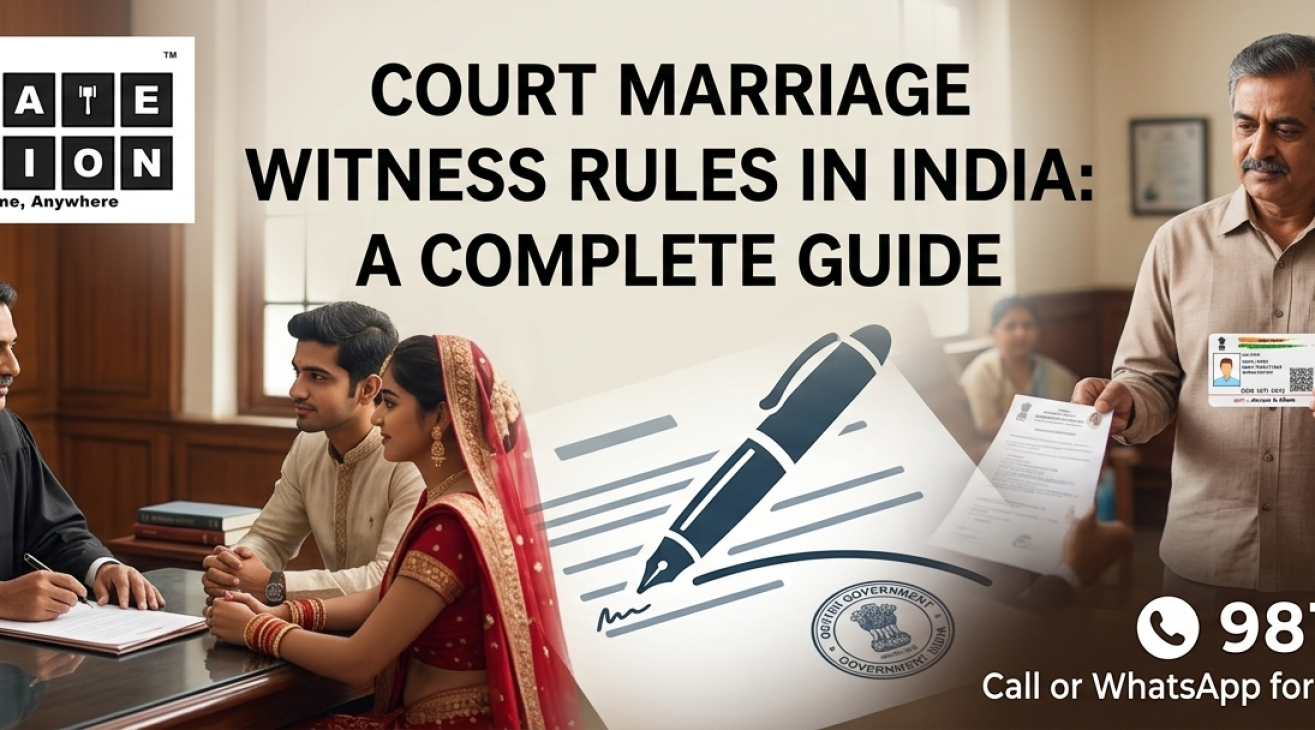
A heavy wooden desk. A thick, cloth-bound ledger — the kind that has witnessed decades of legal milestones. A government stamp pad, slightly ink-stained from years of official use. Neatly arranged papers: the marriage application form, identity proofs, photographs, and a file of documents tied with a red string. Behind the desk sits the Marriage Registrar, pen in hand, reading glasses balanced on the nose.
Two people — the couple — sit across the desk, palms slightly sweaty, hearts beating a little faster than usual.
And then the Registrar looks past them, at three other individuals sitting quietly to the side, and says the words that make this entire moment legally real:
“Witnesses, please come forward to sign the Register of Marriages.”
This is the moment that turns an intention into a legal fact. This is the moment most couples — and their witnesses — are completely unprepared for.
In India, a court marriage under the Special Marriage Act, 1954, is one of the most legally clean and socially progressive ways to get married. It works across religions, castes, and communities. It produces a marriage certificate that is valid before every court, bank, embassy, and government authority in the country.
But here is what most people do not know: the witnesses are not just guests who show up and sign. They are an integral part of the legal process. If the wrong person signs that register, the marriage registration can be questioned. If a witness is missing a document, the entire proceeding can be adjourned to another date.
This blog covers everything — the rules, the documents, the do’s and don’ts, and yes, even a look at how some of India’s most famous faces handled their own registered marriages.
WHAT IS A COURT MARRIAGE UNDER THE SPECIAL MARRIAGE ACT?
Before we get to witnesses, a quick foundation.
A court marriage in India is legally registered under the Special Marriage Act, 1954. This law allows any two adults — regardless of religion, caste, or community — to marry through a civil, secular process administered by the Marriage Registrar (also called the Marriage Officer) of the district.
The process involves:
Giving a Notice of Intended Marriage at least 30 days before the ceremony. This notice is publicly displayed so that anyone with a valid legal objection can raise it within that window.
After the 30-day notice period, the actual solemnization and registration of the marriage takes place at the Registrar’s office, in the presence of three witnesses.
That presence of three witnesses is not optional. It is a legal requirement under Section 12 of the Special Marriage Act.
WHY WITNESSES MATTER SO MUCH IN COURT MARRIAGE
In religious marriages — a Hindu shaadi, a Nikah, a Christian church wedding — witnesses exist as a social and community formality. Their role is largely ceremonial.
In a court marriage, witnesses have a formal legal standing. Here is what they are actually doing when they sign the Register of Marriages:
They are testifying, under the law, that they personally witnessed the marriage solemnization between the two parties. They are confirming that both individuals appeared willingly and without coercion. They are providing their identity as verifiable, traceable individuals who can be called upon if the marriage is ever legally challenged.
This is why the rules around witness eligibility are strict — and why understanding those rules before you walk into that Registrar’s office can save you from a wasted trip, or worse, a legally incomplete marriage registration.
THE CORE WITNESS RULES UNDER THE SPECIAL MARRIAGE ACT
Rule 1: Three Witnesses Are Mandatory
Under Section 12 of the Special Marriage Act, 1954, no fewer than three witnesses must be present during the solemnization of the marriage. All three must sign the Register of Marriages. There is no legal provision for a court marriage to proceed with two witnesses, even if the Registrar is personally satisfied. The law says three. It means three.
Rule 2: Witnesses Must Be Major — 18 Years or Above
A witness must be a major as per Indian law, which means they must be at least 18 years of age. A minor cannot legally attest to a marriage registration. If you bring a 17-year-old sibling or a young cousin as a witness, they will be turned away at the counter.
Rule 3: Witnesses Must Be of Sound Mind
The law requires witnesses to be of sound mind — meaning they must be mentally competent to understand what they are attesting to. While this is rarely an issue in practice, it is a legal criterion nonetheless.
Rule 4: No Restriction on Religion, Caste, or Nationality
One of the most liberating aspects of the Special Marriage Act is that witnesses can belong to any religion, caste, or community. A Hindu couple can have a Muslim friend as a witness. A Christian marrying a Sikh can have an atheist colleague sign the register. There is no religious requirement imposed on witnesses whatsoever.
However, foreign nationals serving as witnesses can create practical complications. Some Registrars insist on Indian citizens only, though the Act itself does not say so. As a practical precaution, choose Indian nationals as your witnesses wherever possible.
Rule 5: Witnesses Must Have Valid, Government-Issued Photo ID
Every witness must carry a valid government-issued photo identity proof to the Registrar’s office. Acceptable documents include:
Aadhaar Card, Voter ID Card, Passport, Driving Licence, or PAN Card.
The Registrar will record the witness’s name, father’s name, address, and ID number in the Register of Marriages. The witness will then sign against these details. Without valid ID, the witness cannot complete the process.
Rule 6: Witnesses Must Sign in Person — No Proxies, No Exceptions
This seems obvious, but it is worth stating clearly. A witness cannot sign in advance, cannot send a signed document separately, and cannot give power of attorney to someone else to sign on their behalf. Physical presence at the Registrar’s office on the day of solemnization is mandatory. If a witness cannot make it on the day, you need a replacement witness — period.
Rule 7: No Restriction on Gender
Witnesses can be male, female, or from any gender. There is no rule requiring a specific gender combination among the three witnesses.
DOCUMENTS EVERY WITNESS MUST CARRY
When your witnesses walk into the Registrar’s office, they need to carry:
Original government-issued photo ID (any one of the documents listed above). A self-attested photocopy of that ID, which will be attached to the marriage file. In some districts, a passport-size photograph may also be requested. Their personal mobile number, which is recorded in the file.
Advise your witnesses to carry both original and photocopy. A surprising number of court marriage adjournments happen simply because a witness brought the original but forgot the photocopy — and the Registrar’s office does not have a photocopier available on the premises.
THE SCENE AT THE REGISTRAR’S DESK: WHAT ACTUALLY HAPPENS
Here is a walkthrough of what occurs at that important moment — the actual signing of the Register of Marriages.
The couple and their three witnesses are called into the Registrar’s chamber. The Registrar first verifies the couple’s documents — their application, identity proofs, address proofs, and photographs. He then reads out the declaration of marriage to the couple, and both parties affirm their consent aloud.
The Registrar then turns to the witnesses. Each witness is asked to confirm their identity. The Registrar reads the details being entered into the Register of Marriages — the full names of the couple, the date, the place — and asks the witness to confirm they are signing as a voluntary witness to this marriage.
The Register of Marriages — that heavy, official ledger — is then placed before each witness in turn. They sign their name, and in many districts, also affix their thumb impression. Their ID details are recorded alongside their signature.
The Registrar then signs and applies the official government seal.
From this point, the marriage is legally solemnized and registered. The couple receives the Marriage Certificate, which carries the serial number of the register entry, the date, the Registrar’s signature, and the official seal of the Marriage Registration office.
This entire process, once initiated, takes between 30 minutes to two hours depending on the district office and the Registrar’s workload. In some busy districts like Central Delhi or Saket, it can take longer.
PRACTICAL TIPS FOR CHOOSING YOUR WITNESSES
Choose people who are punctual and reliable. A court marriage appointment is a scheduled proceeding. Late witnesses can cause delays or, in worst cases, force a postponement.
Choose people who carry their documents consistently. Frequent travelers who keep a valid passport handy, or people who are organized about their ID documents, make ideal witnesses.
Avoid choosing elderly relatives who may have difficulty with physical attendance or who do not have current valid ID.
If possible, brief your witnesses the day before — confirm the time, the address of the Registrar’s office, and the documents they need to carry. This simple step eliminates a large percentage of last-minute problems.
Have a backup witness. Life happens. If one of your three witnesses is suddenly unwell on the morning of the registration, you need to be able to call someone who can step in. Confirm availability with a fourth person informally.
BOLLYWOOD CELEBRITIES WHO CHOSE REGISTERED MARRIAGES
Court or registered marriages have become increasingly common among public figures, often precisely because they offer privacy, legal clarity, and simplicity over elaborate ceremonies.
Farhan Akhtar and Shibani Dandekar formalized their marriage through a registered ceremony in February 2022. The intimate event was attended by close family and friends, with producer Ritesh Sidhwani — Farhan’s longtime collaborator — reportedly among those present as a witness. The ceremony was deliberately kept small and private, with the paperwork done before the larger celebration. This is actually a model that many modern urban couples follow: court registration first, party later.
Rajkummar Rao and Patralekhaa had their wedding solemnized in Chandigarh in November 2021 with a registered ceremony. The couple, who had been together for over a decade, chose a small, legally complete registration over a large destination wedding. Close friends and industry colleagues from their respective circles served as witnesses.
Konkona Sen Sharma and Ranvir Shorey had a simple registered marriage in 2010 with minimal fanfare. The couple — both known for their preference for understated, real-world approaches to life and work — kept the witness group to close, trusted individuals from their personal circle.
It is worth noting that specific witness names from celebrity court marriages are rarely part of the public record, and rightly so. The Register of Marriages is an official government document, not a social media post. Witnesses sign in their legal capacity, and their privacy is as protected as the couple’s.
What these celebrity examples do illustrate is a broader cultural shift: educated, independent Indians increasingly see a court marriage as the primary legal act, with any social celebration being entirely separate and optional.
COMMON MISTAKES THAT DELAY COURT MARRIAGES
In our work helping couples across Delhi NCR complete their court marriages, we have seen the same avoidable mistakes repeatedly:
Witnesses arriving without photocopies of their ID. The Registrar’s office attaches ID copies to the file. Originals alone are not sufficient.
Bringing fewer than three witnesses. Some couples arrive with two witnesses assuming one of them will “count double” in some way. There is no such provision.
Witnesses who are minors. Young cousins or siblings who look older than their age have been turned away after ID verification revealed they were under 18.
Witnesses who are not physically present for the full proceeding. Some witnesses step out to take phone calls or wait in the car, and are then not available when the Registrar calls them. The Registrar will not wait.
Not carrying the original ID. Some witnesses carry only a photocopy assuming it is sufficient. The Registrar requires original verification.
HOW ADVOCATEJUNCTION MAKES THIS EASIER FOR YOU
At AdvocateJunction, we handle court marriages end to end — from document preparation and notice filing to accompanying you to the Registrar’s office on the day of solemnization.
Our advocates are familiar with the specific documentation requirements of Registrar offices across Delhi NCR, including Delhi, Gurgaon, Noida, Faridabad, and Ghaziabad. Requirements vary slightly by district, and local knowledge makes a significant difference.
We also brief your witnesses in advance — a simple checklist we share with them directly so that everyone shows up prepared.
And if you would prefer minimal travel, our doorstep service brings the advocate to your location for document verification, consultation, and preparation — before you step into the Registrar’s office.
CONCLUSION
The moment a witness signs the Register of Marriages, they are not just doing a friend a favour. They are performing a legally significant act that will be recorded in an official government ledger, filed with the district administration, and referenced for the rest of the couple’s life — in every visa application, property transaction, insurance claim, and inheritance matter that follows.
Getting the witnesses right is not a detail. It is a cornerstone of a legally valid court marriage.
Three witnesses. Adults. Valid ID. Present in person. That is the rule — and now you know exactly what it means.
Here’s the FAQ section — paste this at the bottom, just before the final CTA block:
FREQUENTLY ASKED QUESTIONS ABOUT COURT MARRIAGE WITNESSES IN INDIA
Q1. Can a family member be a witness in court marriage?
Yes, absolutely. There is no rule under the Special Marriage Act that disqualifies family members from being witnesses. Your brother, sister, cousin, parent, or any adult relative with valid ID can sign the Register of Marriages. Many couples bring at least one family member and one friend as part of their three witnesses. The only requirement is that the witness is 18 or above, of sound mind, and carries valid government-issued photo ID.
Q2. Can a Muslim person be a witness in a Hindu court marriage — or vice versa?
Yes. This is one of the most common questions we receive, and the answer is straightforward: under the Special Marriage Act, there is absolutely no restriction on the religion of witnesses. A Muslim, Christian, Sikh, or atheist can be a witness for a Hindu couple’s court marriage — and vice versa. The Special Marriage Act is a secular law. Religion of the witness is completely irrelevant.
Q3. What happens if one of our witnesses does not show up on the day?
The marriage registration cannot proceed with fewer than three witnesses present. If one witness fails to show up, you have two options: either the Registrar adjourns the proceeding to a new date, or you contact a fourth backup witness who can reach the office in time. This is exactly why we always advise couples to informally confirm a fourth person as a backup. A no-show witness is one of the most common reasons court marriage appointments get delayed.
Q4. Can a witness sign on behalf of another witness if they cannot come in person?
No. There is no provision for proxy signing under the Special Marriage Act. Each witness must be physically present, must personally verify their identity before the Registrar, and must sign the Register of Marriages themselves. A signed letter, a notarised document, or a power of attorney cannot substitute for physical presence. No exceptions.
Q5. Does the witness need to know both the bride and groom personally?
No, there is no such legal requirement. A witness does not need to have a prior personal relationship with the couple. They are signing as a legal attestant to the marriage solemnization — not as a character reference. In practice, most couples bring friends or colleagues who know at least one of them, but legally, even a stranger who meets the age and ID requirements can serve as a witness.
Q6. Can an NRI or foreign national be a witness in an Indian court marriage?
The Special Marriage Act does not explicitly restrict foreign nationals from being witnesses. However, in practice, many Registrar offices in Delhi NCR are reluctant to accept foreign nationals as witnesses because their ID documents — foreign passports, overseas driving licences — are harder to record in the standard register format. If your witness is an NRI holding a valid Indian passport, there is generally no issue. If they hold only a foreign passport, check with the specific Registrar’s office in advance to avoid a surprise on the day.
Q7. Is there an age limit on the upper side — can a very elderly person be a witness?
There is no upper age limit for witnesses under the Special Marriage Act. An 80-year-old grandparent with a valid Aadhaar card and sound mind is perfectly eligible to be a witness. The only practical consideration is physical presence at the Registrar’s office, which may be difficult for elderly individuals with mobility issues. As long as they can be present and sign the register, age on the upper end is not a legal barrier.
Q8. How long does the witness’s signature remain on record?
The Register of Marriages is a permanent government record. The witness’s signature, ID details, and address remain on file indefinitely with the district Marriage Registration office. This is an official legal document — it does not expire, and the record is not destroyed. This is also why witnesses should ensure their details are entered correctly at the time of signing, as corrections to the register require a separate legal process.
BOOK YOUR FREE 30-MINUTE CONSULTATION WhatsApp: 9818900744 Or call / fill the enquiry form on our website.
AdvocateJunction — Legal Services, Delivered to Your Door. Serving Delhi, Noida, Gurgaon, Faridabad, Ghaziabad and all of Delhi NCR.
This blog is for informational purposes only and does not constitute legal advice. For advice specific to your situation, please consult a qualified advocate. Legal review for this article has been conducted by a practicing advocate registered with the Bar Council.