Police Protection for Love Marriage Couples in Delhi 2026
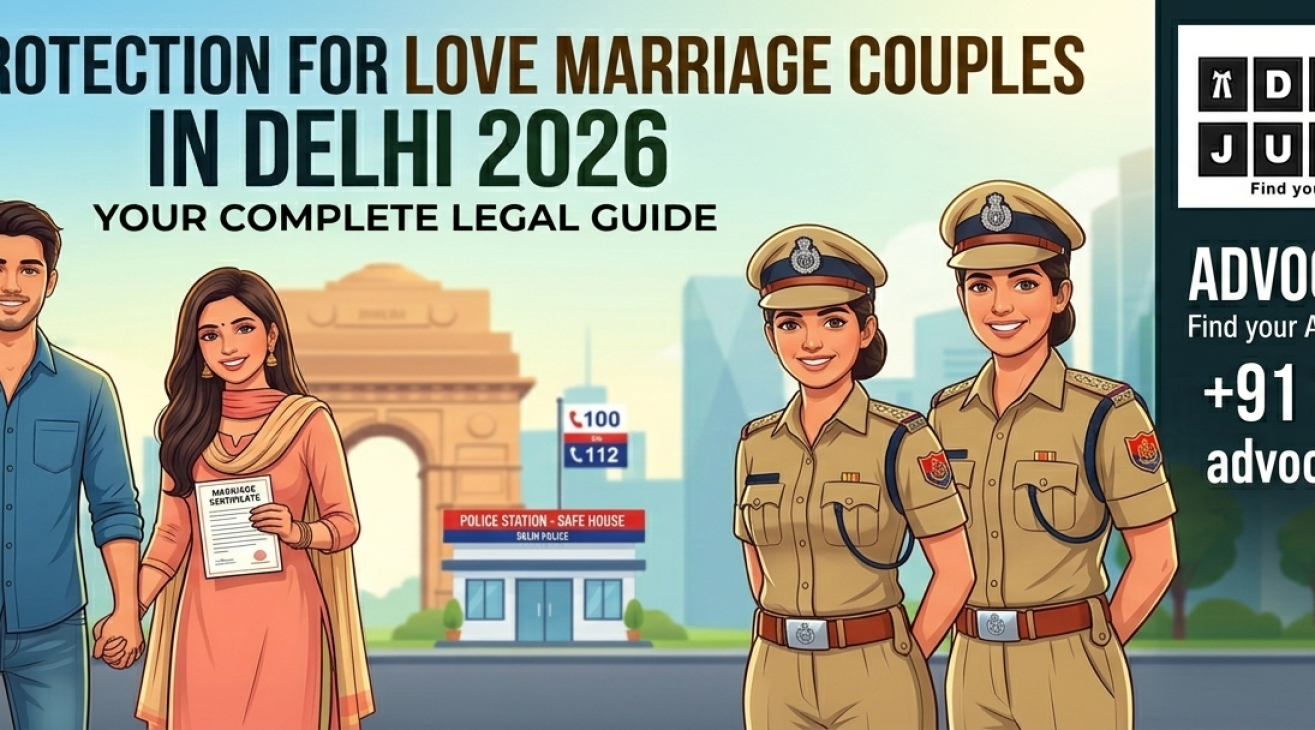
Police Protection for Love Marriage Couples in Delhi 2026 — Your Complete Legal Guide
| Key Fact: Every adult couple in India has a fundamental constitutional right to marry freely. The Supreme Court and Delhi High Court have repeatedly held that police MUST provide protection to love marriage couples facing family threats. You do not need to beg — you need to know the law. |
You have decided to get married. You love each other. You are both adults. And yet — your families are threatening you. Someone has mentioned violence. You are scared to leave your home. You do not know who to call or what to do.
This guide will tell you exactly what police protection is, how to get it, what it covers, and what to do if the police do not cooperate. AdvocateJunction has helped dozens of couples across Delhi NCR secure police protection for their court marriage. Everything in this guide is based on actual law and real ground experience.
What Is Police Protection for Love Marriage Couples?
Police protection for love marriage couples is an official arrangement where the Delhi Police — either at the local police station level or through a Senior Officer’s order — provides security to a couple who are facing threats, coercion, or physical danger from their families due to their decision to marry.
This protection can take several forms depending on the severity of the threat and the resources available.
| Type of Protection | What It Means |
| Police presence on marriage day | Officers present at the SDM office when you sign the marriage register |
| Escort to SDM office | Police accompany you from a safe location to the court and back |
| Written protection order | Formal order directing local police to protect the couple |
| High Court protection | Court issues writ directing police and family to not interfere |
| Safe house arrangement | In extreme cases, couple is housed safely until marriage is complete |
What Is the Legal Basis for This Protection?
The right to police protection for love marriage couples is not a favour — it is grounded in constitutional law and multiple Supreme Court and High Court judgments.
Constitutional Foundation
- Article 21 — Right to Life and Personal Liberty: The Supreme Court has held that the right to choose one’s life partner is a fundamental right under Article 21. Any interference with this right by family, community, or private individuals is unlawful.
- Article 14 — Right to Equality: Adults cannot be treated differently because of their religion or caste when exercising their right to marry.
- Special Marriage Act, 1954: Parliament enacted this law specifically to enable marriages across community lines. Police have a duty to uphold this law.
Key Supreme Court Judgments
- Lata Singh v. State of UP (2006): The Supreme Court held that if any relative or other person harasses an inter-caste or inter-religion couple, police must take strict action including FIR registration. Police who fail to act can be held in contempt.
- Shakti Vahini v. Union of India (2018): The Supreme Court issued comprehensive directions to all states to prevent honour crimes and protect couples who exercise their right to marry freely.
- Shafin Jahan v. Asokan K.M. (2018): Reaffirmed that the right to choose a partner is integral to Article 21 and cannot be overridden by family or community.
When Should You Apply for Police Protection?
You should apply for police protection when any of the following situations apply to your case.
- Your family has threatened you, your partner, or anyone close to you with physical violence.
- You have received threats — in person, on phone, or in writing — warning you not to marry.
- Your family has filed a missing person complaint or abduction complaint against your partner to harass you.
- You fear that your family will create a scene or physically disrupt your court marriage appointment.
- You belong to different castes or religions and face active community-level opposition.
- You or your partner have been physically confined at home and prevented from meeting freely.
| Important: You do not need to wait for violence to happen. You can apply for protection based on a credible threat alone. Courts and police are required to act on threat even before any physical harm occurs. |
How to Get Police Protection — Step by Step
Option 1: Approach Your Local Police Station
This is the first and easiest option. Both of you should visit the nearest police station together and submit a written application for protection. Here is what to do.
- Write a clear application addressed to the Station House Officer (SHO) stating your names, the nature of the threat, and that you are adults planning a court marriage.
- Carry your identity proofs — Aadhaar, passport, or voter ID.
- State clearly that you fear violence or interference in your marriage.
- Request that officers be present at the SDM office on your marriage date.
The SHO is legally obligated to take your application and respond. If the SHO refuses or dismisses you, escalate immediately to the Deputy Commissioner of Police (DCP) of your district.
Option 2: Approach the Superintendent of Police or DCP
If the local police station is uncooperative — which unfortunately happens in some cases — you have the right to approach higher authorities directly. File a written complaint with the DCP or Additional DCP of your area. This bypasses the SHO and puts the matter on record at a senior level.
Option 3: File a Writ Petition in Delhi High Court
This is the strongest form of protection available. Delhi High Court has a long history of issuing protection orders to love marriage couples, sometimes within the same day through an urgent hearing. The court can issue a writ directing the police to protect you AND directing your family members not to interfere with your marriage or your freedom of movement.
You do not need to have experienced violence for the High Court to act. A credible threat is sufficient. AdvocateJunction can connect you with an advocate who handles these petitions regularly.
Option 4: Contact the State Legal Services Authority
DSLSA (Delhi State Legal Services Authority) provides free legal aid to couples who cannot afford an advocate. They can help you draft your protection application or file a High Court petition at no cost.
Documents You Need
| Document | Why It Is Needed |
| Aadhaar card of both parties | Proof of identity and age |
| Any written threats received | Evidence of threat — screenshots, messages, letters |
| Phone call recordings if available | Evidence of verbal threats |
| Witness statement if any | Someone who witnessed threats |
| Your court marriage application / notice | Proof you are actively pursuing a legal marriage |
| Written application for protection | Formal request — must be submitted in writing |
What Happens on the Day of Court Marriage?
Once police protection has been arranged — whether through the local station or a court order — here is what typically happens on your court marriage day.
- Officers are present at the SDM office when you arrive.
- The marriage is solemnised with police visible in the premises — this alone deters family interference.
- If family members try to create a disturbance at the SDM office, officers are authorised to remove them from the premises.
- After the marriage is complete, officers may escort you to a safe location if needed.
What If Police Refuse to Help?
This is the most important part of this guide. If police at any level refuse to provide protection after you have made a written request, you have the following remedies.
- File a complaint against the SHO with the DCP or Police Commissioner.
- File a complaint with the Delhi Police Commissioner’s office directly.
- File a writ petition in Delhi High Court. Courts take police inaction in love marriage protection cases very seriously and have held officers in contempt for non-compliance.
- File a complaint with the National Human Rights Commission (NHRC) for violation of your fundamental rights.
| Real Ground Fact: In our experience, the mere mention of a High Court petition — and the name of the relevant Supreme Court judgment (Lata Singh v. State of UP) — is often enough to prompt a local SHO to cooperate. Knowledge of the law is your most powerful protection. |
Common Mistakes Couples Make
- Waiting too long: Do not wait until the day before your marriage to apply for protection. Apply at least 7 to 10 days before your SDM appointment.
- Not putting it in writing: A verbal request to police has no legal standing. Always submit a written application and keep a copy with the police stamp.
- Relying only on the local police: If the local station is from your community or known to your family, go directly to the DCP or High Court.
- Not having an advocate: Even for a police station visit, having an advocate with you changes how seriously you are taken.
How AdvocateJunction Can Help
AdvocateJunction has helped couples across Delhi NCR secure police protection for their court marriages. Our advocates know exactly which authority to approach, how to draft a protection application that gets results, and when to escalate to the Delhi High Court.
- Free 30-minute consultation to assess your specific threat situation
- Draft written protection application for police station
- Represent you before DCP if local police are uncooperative
- File High Court writ petition when required — urgent same-day hearings available
- Coordinate police presence on your court marriage day
- Doorstep service across Delhi NCR — we come to you
| Get Legal Help Now — It’s Free for 30 Minutes
WhatsApp / Call: 9818900704 Visit: www.advocatejunction.com/contact Doorstep legal services across Delhi NCR | Online consultations for all of India & NRIs |
Disclaimer: This article is for informational purposes only and does not constitute legal advice. For advice specific to your situation, please consult a qualified advocate. AdvocateJunction connects you with verified legal professionals across Delhi NCR.