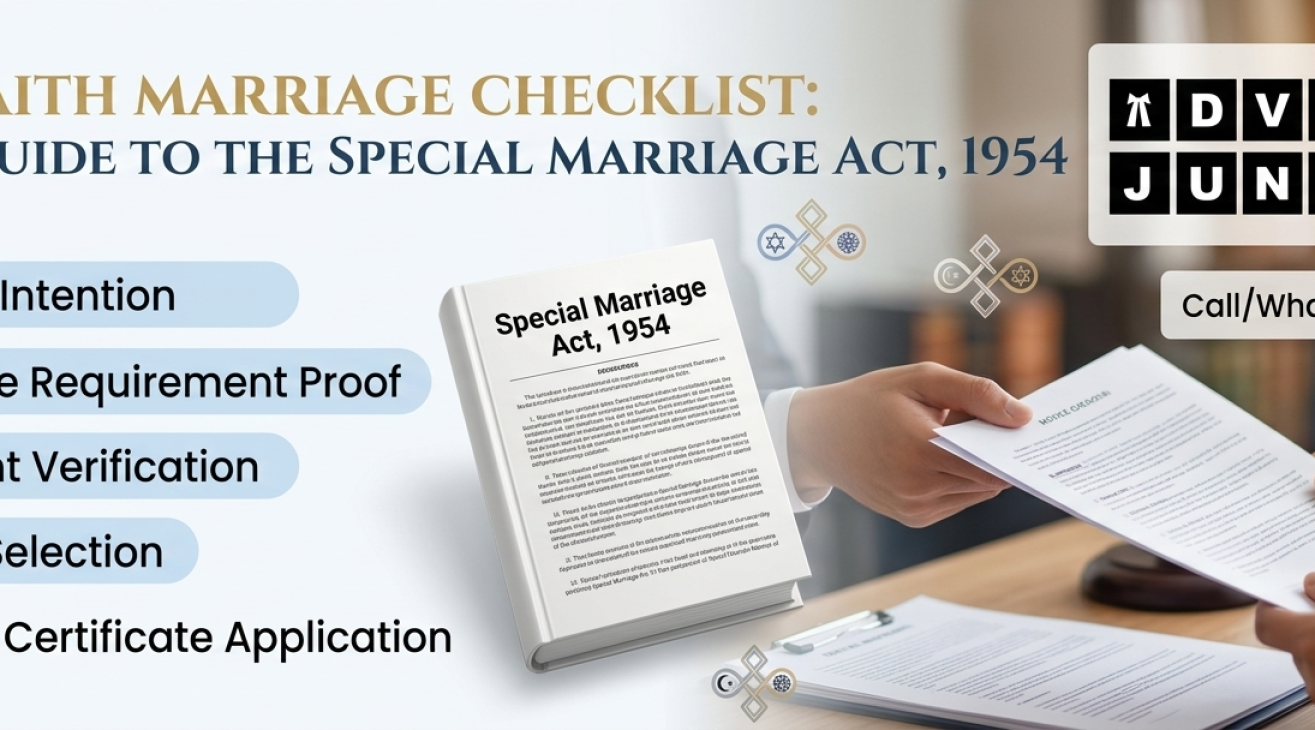
Inter-faith Marriage Checklist Under Special Marriage Act 1954
Inter-faith Marriage Checklist Under Special Marriage Act 1954 — Complete Guide for Delhi Couples 2026
| Quick Answer: Under the Special Marriage Act 1954, any two adults — regardless of religion, caste, or community — can legally marry in India. No conversion required. No religious ceremony needed. This guide gives you the complete checklist for an interfaith court marriage in Delhi. |
Hindu-Muslim. Hindu-Christian. Sikh-Muslim. Hindu-atheist. Inter-faith marriages in India are perfectly legal — and more common than most people realise. Yet millions of couples enter the process without knowing exactly what documents they need, what mistakes to avoid, and what their legal rights are.
This checklist-based guide is built specifically for couples planning an inter-faith court marriage in Delhi in 2026. Every item here is accurate as of current Indian law under the Special Marriage Act, 1954.
Why the Special Marriage Act 1954 Is the Right Law for You
India has multiple marriage laws — Hindu Marriage Act, Muslim Personal Law, Christian Marriage Act, and others. But ALL of them require both parties to belong to a specific religion. The Special Marriage Act 1954 is different. It is India’s only truly secular marriage law — applicable to any two persons, regardless of religion, caste, or nationality.
| Feature | Special Marriage Act 1954 |
| Applies to | Any two adults — any religion or no religion |
| Conversion required? | No — neither party needs to convert |
| Religious ceremony needed? | No — purely civil process before SDM |
| Parental consent needed? | No — for adults (bride 18+, groom 21+) |
| Certificate strength | Highest — accepted by all courts, banks, embassies globally |
| Waiting period | 30 days mandatory notice period |
The Complete Document Checklist for Inter-faith Court Marriage
Documents Required from Both Parties
The following documents are required from EACH party — bride and groom — individually.
- Original birth certificate OR 10th class marksheet showing date of birth — to prove minimum age
- Aadhaar Card — original and 2 self-attested photocopies
- Passport (if available) — original and 2 self-attested photocopies
- Voter ID Card (if available) — original and 2 self-attested photocopies
- Current address proof — electricity bill, rent agreement, or bank statement showing current address in Delhi NCR
- 6 passport-size photographs (white background) — recent, within 3 months
- Affidavit of date of birth (if no birth certificate or marksheet available) — on ₹10 stamp paper, notarised
- Affidavit of marital status — declaring you are unmarried / divorced / widowed — on ₹10 stamp paper, notarised
- Affidavit of nationality — on ₹10 stamp paper, notarised
Additional Documents for Divorced Persons
- Certified copy of the final divorce decree — must be the absolute decree, not interim
- If divorce is from a foreign court — apostilled copy with certified English translation
Additional Documents for Widowed Persons
- Original death certificate of deceased spouse — or certified copy from municipal authorities
Witness Documents — 3 Witnesses Required Under SMA
- Original government ID of each witness — Aadhaar / Voter ID / Passport
- 2 self-attested photocopies of each witness’s ID
- 2 passport-size photographs of each witness
- Witnesses must be adults (18+) — no restriction on religion, gender, or relationship to couple
| Tip: Witnesses do not need to be from the same city or state. Friends, colleagues, or relatives all qualify. Your advocate from AdvocateJunction can also serve as one witness in most SDM offices. |
Religion-Specific Additional Requirements
If One or Both Parties Is Muslim
- No conversion required for the non-Muslim party under SMA — this is a common misconception
- If previously married under Muslim personal law (nikah), provide nikah-nama AND divorce document (talaq-nama or court decree) proving the previous marriage has legally ended
- For Muslim party: Affidavit confirming this is a first marriage OR that previous marriage has legally ended
If One or Both Parties Is Christian
- Baptism certificate is NOT required under SMA — but may be asked by some SDMs as additional proof of identity, so carry it if available
- If previously married in a church, a formal church divorce letter alone is NOT sufficient — a civil court divorce decree is mandatory
If One or Both Parties Is NRI or Foreign National
- Valid passport and Indian visa
- No Objection Certificate from your country’s embassy in India — confirming you are free to marry
- Proof of 30-day residence in the SDM’s jurisdiction — or apply for waiver of residence requirement
- All foreign documents must be apostilled and accompanied by certified English translation
If One Party Is Sikh, Jain, or Buddhist
- No additional requirements — these religions are treated on par with Hindu for most purposes
- Standard SMA document checklist applies fully
The Process — Step by Step
| Step | What Happens |
| Step 1: Notice Filing | Both parties appear before the SDM with all documents. Notice of Intended Marriage is filed. SDM displays notice on board for 30 days. |
| Step 2: 30-Day Wait | Mandatory waiting period. Couple does not need to visit SDM. If any valid legal objection is filed, it is investigated. |
| Step 3: No Objection or Objection Rejected | After 30 days with no valid objection, the couple is called for solemnisation. |
| Step 4: Solemnisation | Both parties and 3 witnesses appear before SDM. Marriage is solemnised and registered. |
| Step 5: Certificate Issued | Marriage certificate under SMA is issued on the same day or within 1-2 days. |
The 30-Day Notice Period — What It Means for Interfaith Couples
The 30-day notice period under Section 5 of the SMA is the most frequently discussed aspect of interfaith court marriages — because it is the period during which families who oppose the marriage may try to file an objection.
Can a Family File an Objection to Stop the Marriage?
Technically yes — but only on very specific legal grounds. An objection can only be filed if one of the following is true:
- One party is already married
- One party is below the legal age (18 for bride, 21 for groom)
- The parties are related within prohibited degrees of relationship
- One party is of unsound mind
A family CANNOT file an objection based on caste, religion, or personal disapproval. Any such objection must be rejected by the SDM. If the SDM wrongly entertains a frivolous objection, the couple can challenge this in District Court under Section 14 of the SMA.
| Ground Reality: In our experience, most family objections that reach the SDM are rejected within days because they have no legal basis. The 30-day period feels long and vulnerable — but legally, an interfaith adult couple is protected throughout. |
Common Mistakes in Interfaith Court Marriages
- Using the Hindu Marriage Act instead of SMA: If one party is not Hindu, Sikh, Jain, or Buddhist, HMA does not apply. Using HMA for an interfaith marriage will result in rejection.
- Not notarising affidavits: All affidavits — marital status, age, nationality — must be notarised. Unnotarised affidavits will be rejected.
- Bringing insufficient witness documents: All 3 witnesses must have original ID on the day of solemnisation. A missing witness document causes delay.
- Not verifying 30-day residential requirement: At least one party must show 30 days of residence in the SDM’s jurisdiction. Address proof must clearly show the local address.
- Thinking the 30 days can be avoided: It generally cannot, unless there is an extreme circumstance. Plan your marriage timeline accordingly.
Frequently Asked Questions — Interfaith Court Marriage
Q: Does an interfaith court marriage affect inheritance rights?
Yes — importantly. When you marry under the Special Marriage Act, your inheritance is governed by the Indian Succession Act, 1925 — not your personal religious law. This means a Hindu woman who marries under SMA will NOT inherit under the Hindu Succession Act but under the Indian Succession Act. Understand this implication before proceeding.
Q: Will our children be considered Hindu / Muslim / Christian?
Under SMA, there is no specific religious designation for children. Parents can choose to raise children in any faith. For legal purposes — passport, school admission — parents jointly decide the child’s religion. There is no automatic assignment.
Q: Is an interfaith court marriage valid across all Indian states?
Yes. An SMA marriage certificate issued in Delhi is valid across all states and territories of India without any re-registration.
Q: Can a ‘Love Jihad’ law affect our marriage in Delhi?
No. Love Jihad laws (Freedom of Religion Acts) have been enacted in states like UP, MP, and Haryana. Delhi is a Union Territory under central government jurisdiction. These state laws do not apply in Delhi. Your interfaith court marriage under SMA in Delhi is legally clean.
How AdvocateJunction Helps Interfaith Couples
An interfaith court marriage involves more legal steps than a standard same-religion court marriage. AdvocateJunction has a dedicated process for interfaith couples.
- Complete document checklist review before you visit the SDM — so nothing is missing on the day
- Affidavit drafting and notarisation arranged — at your doorstep
- SDM office coordination and representation
- Police protection arrangement if your situation involves family threats
- High Court petition if your notice period is threatened by frivolous objections
- Post-marriage name change and document update guidance
Famous Interfaith Celebrity Couples
- Shah Rukh Khan and Gauri Chhibber:A Muslim-Hindu marriage that has been a long-standing example in India.
- Saif Ali Khan and Kareena Kapoor:A prominent couple where the Bollywood actress married into the Muslim Pataudi family.
- Aamir Khan and Kiran Rao:Although divorced, their marriage was a notable interfaith union.
- Priyanka Chopra and Nick Jonas:An international interfaith marriage combining Hindu and Christian traditions.
- Soha Ali Khan and Kunal Kemmu:Married in 2015, bridging Muslim and Hindu backgrounds.
- Farhan Akhtar and Shibani Dandekar:Married in 2022, representing a modern approach to relationships.
- Genelia D’Souza and Riteish Deshmukh:An inter-religion union of a Christian/Catholic bride and a Hindu groom.
- Sanjay Dutt and Dilnawaz Sheikh (Maanyata):Married in 2008.
- Sonakshi Sinha and Zaheer Iqbal:A high-profile, recent interfaith marriage.
| Get Legal Help Now — It’s Free for 30 Minutes
WhatsApp / Call: 9818900704 Visit: advocatejunction.com/contact Doorstep legal services across Delhi NCR | Online consultations for all of India & NRIs |
Disclaimer: This article is for informational purposes only and does not constitute legal advice. For advice specific to your situation, please consult a qualified advocate. AdvocateJunction connects you with verified legal professionals across Delhi NCR.