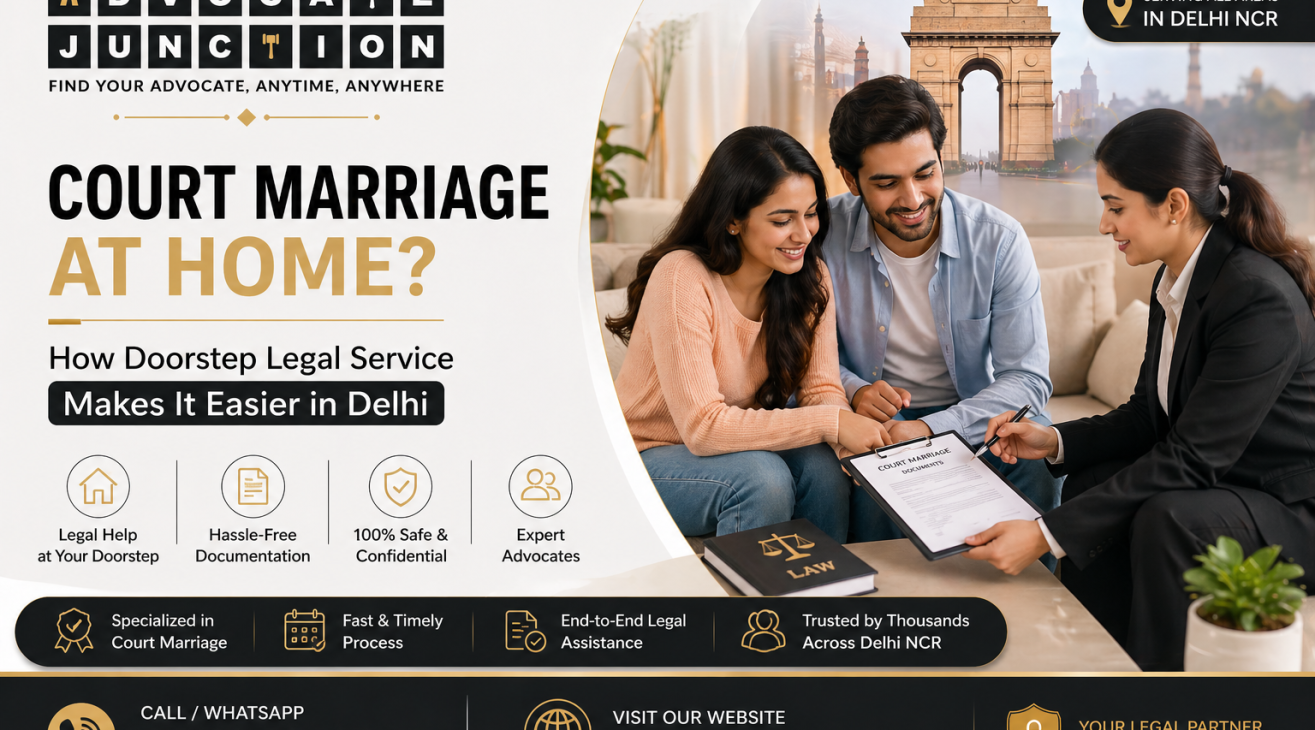
Court Marriage at Home? How Doorstep Legal Service Makes It Easier in Delhi
Introduction: Court Marriage in Delhi Does Not Have to Mean Courthouse Chaos
Court marriage in Delhi is one of the most searched legal topics in the city — and one of the most misunderstood. Couples planning to register their marriage often face a maze of misinformation about which documents are needed, which office to visit, how long it takes, and whether interfaith or inter-caste marriages face special complications.
AdvocateJunction has made court marriage one of its most active service areas because the need is enormous, the confusion is real, and the solution is simple with the right guidance.
And with doorstep legal service, the initial consultation, document preparation, and process planning all happen at your home — not in a crowded court corridor.
What is Court Marriage and Why Do Couples Choose It?
Court marriage refers to the legal registration of a marriage before a government-appointed Marriage Officer. It is a civil process — it does not require a religious ceremony, though couples may also have a religious ceremony separately.
In Delhi, court marriages are registered under:
- The Special Marriage Act, 1954 — for all couples, including interfaith and inter-caste marriages
- The Hindu Marriage Act, 1955 — for Hindu couples (the registration process is different)
Why do couples choose court marriage?
- They want a legally recognised marriage certificate, regardless of religious ceremony
- They belong to different religions or castes and cannot use religion-specific marriage acts
- They want to avoid a large traditional wedding for personal or financial reasons
- They need a marriage certificate urgently for visa, property, or insurance purposes
- They want to protect themselves legally — particularly in situations where family approval may not be forthcoming
The Court Marriage Process in Delhi: The Basics
Under the Special Marriage Act, 1954
Step 1: Notice of Intended Marriage Both parties file a notice of intended marriage with the Sub-Divisional Magistrate (SDM) in the area where either party has resided for at least 30 days before the notice.
Step 2: Publication and 30-Day Waiting Period The notice is published at the SDM’s office for 30 days. During this period, any person may object to the marriage on specified grounds.
Step 3: Solemnization and Registration If no valid objection is received, the Marriage Officer solemnises and registers the marriage. Both parties and three witnesses must be present.
Documents required (typically):
- Proof of age (birth certificate, school leaving certificate, passport)
- Proof of address for both parties
- Passport-size photographs
- Affidavit of marital status (that neither party is currently married)
- For widowed/divorced individuals: death certificate of former spouse or divorce decree
Note: Document requirements may vary slightly by SDM office and individual circumstances. AdvocateJunction’s advocate confirms the exact checklist for your specific situation during the home visit.
How Doorstep Legal Service Transforms the Court Marriage Process
Here is the traditional experience: A couple searches online, gets confused by contradictory information, drives to the SDM office, waits for hours, gets turned away because of a missing document, comes back another day, gets confused about the notice period, and spends weeks on what should be a straightforward process.
Here is the AdvocateJunction doorstep experience:
Step 1: WhatsApp or call AdvocateJunction (9818900704).
Step 2: Free 30-minute consultation. We understand your specific situation — religion, age, previous marital status, any concerns about family objections — and explain the exact process that applies to you.
Step 3: Home visit by a court marriage specialist advocate. The advocate comes to your home at a time that works for both partners. During the visit:
- Your documents are reviewed for completeness and accuracy
- Any gaps are identified and corrected
- The notice application and all supporting documents are prepared
- You are briefed exactly on what to expect on the court date
- If you have concerns about the objection period (family interference), the advocate explains your legal options
Step 4: SDM office visits. AdvocateJunction’s advocate accompanies you on both visits — for notice filing and for the solemnization — guiding you through the process so you are never uncertain about what to do or where to go.
Step 5: Marriage certificate in hand. You receive your registered marriage certificate, and AdvocateJunction ensures you have certified copies for future use.
Handling the 30-Day Objection Period
The 30-day notice period under the Special Marriage Act is the stage that causes most anxiety for couples — particularly those whose families may oppose the marriage.
It is important to understand:
Who can object? Any person may file an objection, but only on grounds specified in the Act: that either party is already married, that the parties are related within prohibited degrees, that either party is a minor, or that either party is of unsound mind.
What happens if an objection is filed? The Marriage Officer investigates the objection and decides within 30 days. If the objection is not valid or is not substantiated, the marriage proceeds. A frivolous or malicious objection can be challenged.
Important: Family disapproval alone is not a valid legal objection. A parent’s objection based purely on caste, religion, or personal preference has no legal standing under the Special Marriage Act.
AdvocateJunction’s advocates are experienced in handling the objection period — advising on what is a valid objection, how to respond, and how to protect the process from frivolous interference.
Special Situations AdvocateJunction Handles
Interfaith marriages: The Special Marriage Act is specifically designed for couples of different religions. AdvocateJunction has experience facilitating Hindu-Muslim, Hindu-Christian, and other interfaith marriages through the SDM registration process.
Urgency situations: If a couple needs a marriage certificate quickly — for a visa, for medical next-of-kin requirements, or for other urgent reasons — AdvocateJunction can advise on the fastest legal route given the mandatory 30-day notice period under the Special Marriage Act, or alternative registration options under the Hindu Marriage Act for eligible Hindu couples.
Previously married individuals: Divorced or widowed individuals have additional documentation requirements. AdvocateJunction ensures these are prepared correctly.
NRI court marriages: If one partner is based abroad and returning to India specifically for court marriage, AdvocateJunction can prepare all documentation in advance so the process is as efficient as possible during the India visit.
Court Marriage vs. Other Marriage Registration — What is Right for You?
| Situation | Recommended Route |
|---|---|
| Both parties are Hindu | Hindu Marriage Act registration (usually faster) or Special Marriage Act |
| Interfaith or inter-caste | Special Marriage Act, 1954 |
| Muslim + Non-Muslim | Special Marriage Act, 1954 |
| Already had religious ceremony, need registration | Hindu Marriage Act (for Hindus) or retrospective registration under applicable law |
| Need marriage certificate quickly | Hindu Marriage Act (for eligible couples) — registration often same day |
| Concerned about family objections | Special Marriage Act — AdvocateJunction advises on managing the 30-day period |
Frequently Asked Questions About Court Marriage in Delhi
Q. Can a court marriage be done without parents’ consent? If both parties are adults (18+ for women, 21+ for men), parents’ consent is not legally required for court marriage in India.
Q. How long does court marriage take in Delhi? Under the Special Marriage Act: minimum 30 days from notice filing to solemnization (the mandatory waiting period). Under the Hindu Marriage Act: registration can often happen sooner. AdvocateJunction advises on the fastest route for your specific situation.
Q. How much does court marriage in Delhi cost? Government fees are minimal (a few hundred rupees). AdvocateJunction’s service fee for court marriage assistance is transparent and discussed during the free consultation.
Q. Can the doorstep advocate help if we are from different states? Yes. Residence in the Delhi area for 30 days prior to filing is sufficient for a notice to be filed in Delhi.
Q. What if family members try to prevent the court marriage? If you believe there is a threat of physical interference, you can request police protection through a separate legal process. AdvocateJunction can advise on this.
Conclusion: Your Marriage, Your Choice — With the Right Legal Support
Court marriage in Delhi is a legal right for every eligible adult couple. The process, while procedural, is not complicated with the right guidance.
AdvocateJunction’s doorstep service brings that guidance to your home — protecting your privacy, ensuring your documents are right, and making sure the day you have planned goes exactly as it should.
📞 Book a Free Court Marriage Consultation Today
WhatsApp: 9818900704 Call: 9818900704 Enquiry Form: Fix your Doorstep appointment
Edited by: Practising Advocate Piyush Tomar | [AdvocateJunction Profile Link]
Related Reading:
What is Doorstep Legal Service?
Court Marriage in Delhi — Complete Guide