Court Marriage Documents Required in Delhi
Court Marriage Documents Required in Delhi — Complete 2026 Checklist
Planning a court marriage in Delhi? The first thing you need to get right is your document list. Nothing derails a court marriage registration faster than missing paperwork. Whether you’re an Indian couple, an interfaith couple, or an NRI marrying in Delhi, this guide will walk you through every single document you’ll need — clearly, accurately, and without any legal jargon.
At AdvocateJunction, we’ve helped hundreds of couples navigate Delhi’s court marriage process. The most common reason for delays? Incomplete or incorrect documents. This blog is your insurance against that.
Read this once. Save it. Follow it. Your court marriage will go smoothly.
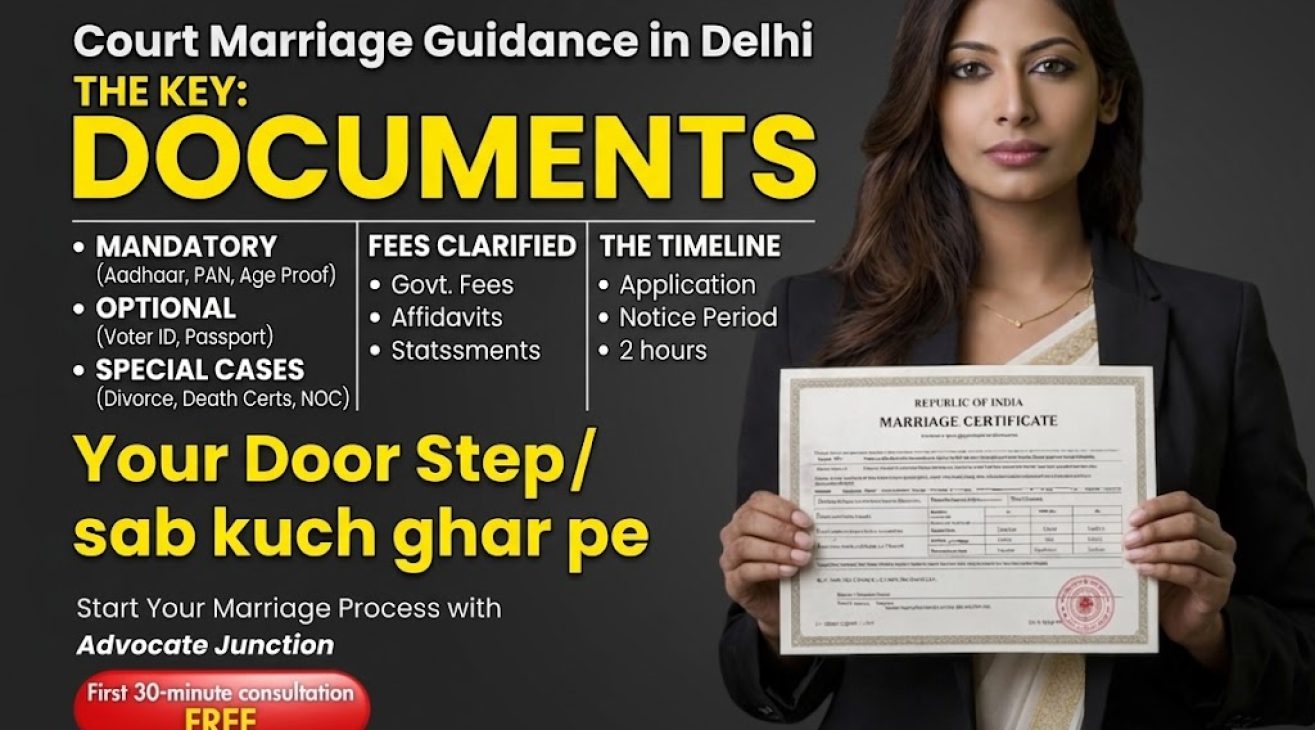
| 📋 Quick Answer — Court Marriage Documents Required in Delhi |
| ✅ Age Proof (Birth Certificate / Marksheet / Passport) |
| ✅ Address Proof (Aadhaar / Voter ID / Passport / Utility Bill) |
| ✅ Passport-Size Photographs (Both parties — 4 to 6 copies) |
| ✅ Application Form (SDM Office — Special Marriage Act, 1954) |
| ✅ Affidavit of Marital Status (Notarised) |
| ✅ Divorce Decree / Death Certificate (if previously married) |
| ✅ Two Witnesses with ID Proofs |
| ✅ Religion Conversion Affidavit (if applicable) |
| Need help gathering documents? WhatsApp us: 9818900704 |
📚 Table of Contents
- What Is Court Marriage & Why Do Documents Matter?
- Legal Framework — Which Act Governs Your Marriage?
- Complete Document List for Court Marriage in Delhi
- Documents for Bride (Detailed)
- Documents for Groom (Detailed)
- Documents for Witnesses
- Additional Documents for Special Cases
- Document Requirements for Divorced Persons
- Document Requirements for Widows / Widowers
- Court Marriage Documents for NRIs in Delhi
- Court Marriage Documents for Interfaith Couples
- Document Requirements for Minors? (What if age is disputed?)
- How to Prepare Your Document File — Step-by-Step
- Common Document Mistakes That Cause Delays
- Frequently Asked Questions (FAQs)
- How AdvocateJunction Can Help You
1. What Is Court Marriage & Why Do Documents Matter?
Court marriage is the legal registration of marriage under one of India’s civil marriage laws — primarily the Special Marriage Act, 1954 or the Hindu Marriage Act, 1955. Unlike a religious ceremony, court marriage is a government-recognised legal process conducted before a Sub-Divisional Magistrate (SDM).
Documents are the foundation of this process. The SDM Office in Delhi does not ‘verify your relationship’ — they verify your identity, age, address, and marital status entirely through documents. If your papers are in order, the process moves quickly. If they’re not, you could face adjournments, delays, or outright rejection.
This is why we always say at AdvocateJunction: the quality of your document file determines the speed of your court marriage.
Why Court Marriage Is Increasingly Popular in Delhi
Court marriage has seen a massive surge in Delhi NCR over the past five years. Young couples prefer it because it is:
- Legally binding from Day 1
- Independent of caste, religion, or community approval
- Affordable — typically ₹10,000 to ₹25,000 all-in
- Faster than arranging traditional ceremonies
- Accepted globally for visa and immigration purposes
2. Legal Framework — Which Act Governs Your Marriage?
Before we get into documents, you need to know which law applies to you. This matters because the documents required can slightly differ.
| Law | Applies To | Waiting Period | Key Feature |
|---|---|---|---|
| Special Marriage Act, 1954 | Any couple — same or different religion, caste, or nationality | 30 days (notice period) | No religious ceremony needed; secular marriage |
| Hindu Marriage Act, 1955 | Both parties must be Hindu, Sikh, Jain or Buddhist | Varies by District Court | Religious ceremony may be required prior to registration |
| Foreign Marriage Act, 1969 | One party is Indian, other is foreign national | 30 days (notice period) | Registered at specified offices |
For most couples coming to AdvocateJunction — especially love marriage couples, interfaith couples, and NRI couples — the Special Marriage Act, 1954 is the applicable law. The document checklist in this blog is primarily based on SMA 1954 requirements in Delhi, with specific additions for HMA registrations.
3. Complete Document Checklist for Court Marriage in Delhi
Below is the master checklist. Read this carefully, then refer to the sections that follow for detailed explanations of each document type.
| # | Document | Who Provides | Copies Needed | Must Be |
|---|---|---|---|---|
| 1 | Court Marriage Application Form | Both Parties | 1 Set | Signed by both |
| 2 | Age Proof — Bride | Bride | 2 Copies | Self-attested |
| 3 | Age Proof — Groom | Groom | 2 Copies | Self-attested |
| 4 | Address Proof — Bride | Bride | 2 Copies | Self-attested |
| 5 | Address Proof — Groom | Groom | 2 Copies | Self-attested |
| 6 | Passport-Size Photographs — Bride | Bride | 4–6 Copies | Recent (within 3 months) |
| 7 | Passport-Size Photographs — Groom | Groom | 4–6 Copies | Recent (within 3 months) |
| 8 | Joint Photograph (Bride + Groom) | Both Parties | 2 Copies | Recent, clear |
| 9 | Affidavit — Marital Status (Bride) | Bride | 1 Original | Notarised |
| 10 | Affidavit — Marital Status (Groom) | Groom | 1 Original | Notarised |
| 11 | Witness 1 — ID Proof | Witness | 2 Copies | Self-attested |
| 12 | Witness 2 — ID Proof | Witness | 2 Copies | Self-attested |
| 13 | Divorce Decree (if divorced) | Divorcee | 1 Certified Copy | Court-certified |
| 14 | Death Certificate (if widowed) | Widower/Widow | 1 Original or Certified Copy | Government issued |
| 15 | Religion Conversion Affidavit (if converted) | Converter | 1 Original | Notarised |
| 16 | Court Fee Challan/Receipt | Both Parties | 1 Copy | Paid at SDM office |
Important: The SDM Office in Delhi typically requires all copies to be self-attested by the concerned party — meaning you write ‘Certified True Copy’ and sign each photocopy yourself. Your advocate can guide you on exact attestation format.
4. Documents for Bride — Detailed Guide
4.1 Age Proof for Bride
The bride must be at least 18 years of age at the time of marriage. The following documents are accepted as age proof:
- Birth Certificate (Issued by Municipal Corporation / Hospital) — Strongest proof
- 10th Standard Marksheet (SSC / CBSE / ICSE) — Most commonly accepted
- Passport — Accepted if date of birth is clearly mentioned
- Aadhaar Card — Accepted in many Delhi SDM offices, but some may ask for additional supporting proof
- PAN Card — Sometimes accepted as supporting document
Pro Tip: If the bride’s 10th marksheet and Aadhaar card show slightly different dates of birth (a common issue), always carry the birth certificate as the primary proof and the marksheet as secondary.
4.2 Address Proof for Bride
The bride must prove her residential address in Delhi or any Indian state. Accepted documents include:
- Aadhaar Card (with current address)
- Voter ID Card
- Passport (with current address page)
- Driving Licence
- Utility Bill (Electricity / Water / Gas) — Not older than 3 months
- Bank Passbook with address — First page photo copy
- Ration Card
Note: If the bride’s Aadhaar shows an old address and she has recently moved, she should carry a utility bill or a rent agreement along with Aadhaar as secondary proof.
4.3 Photographs for Bride
The bride must provide 4 to 6 recent passport-size photographs. These must be:
- Taken within the last 3 months
- Clear, colour photographs on white/light background
- Standard passport size (3.5 cm × 4.5 cm)
- Name and date written lightly on the back of each photo
4.4 Affidavit of Marital Status — Bride
This is a critical document. The bride must submit a notarised affidavit declaring:
- She is not currently married to any other person
- She is of sound mind and consenting to the marriage freely
- She is of legal marriageable age
- She is not related to the groom within the degrees of prohibited relationship
This affidavit must be executed on non-judicial stamp paper (typically ₹10 or ₹100 value) and notarised by a Notary Public. AdvocateJunction can prepare this affidavit for you.
5. Documents for Groom — Detailed Guide
5.1 Age Proof for Groom
The groom must be at least 21 years of age at the time of marriage. The same documents accepted for the bride apply here:
- Birth Certificate — Preferred
- 10th Standard Marksheet
- Passport
- Aadhaar Card
Important: The minimum age for the groom (21 years) is higher than for the bride (18 years). This is mandated under the Special Marriage Act, 1954 and the Prohibition of Child Marriage Act, 2006. The SDM will verify this strictly.
5.2 Address Proof for Groom
Same accepted documents as the bride — Aadhaar, Voter ID, Passport, Driving Licence, Utility Bill (within 3 months), Bank Passbook, or Ration Card.
5.3 Photographs for Groom
4 to 6 recent passport-size photographs — same specifications as the bride.
5.4 Affidavit of Marital Status — Groom
The groom must submit an identical notarised affidavit declaring:
- He is not currently married to any other person
- He is of sound mind and consenting freely
- He is of legal marriageable age (21+)
- He is not related to the bride within prohibited degrees
6. Documents for Witnesses
Under the Special Marriage Act, 1954, three witnesses must be present on the date of marriage registration. Under the Hindu Marriage Act, typically two witnesses are required.
Who Can Be a Witness?
Any adult Indian citizen (18 years or above) can be a witness. There is no restriction on gender, religion, or relationship to the couple. Common witness choices:
- Friends
- Siblings or relatives
- Colleagues
- The advocate handling your case (in some SDM offices)
Documents Each Witness Must Carry
- Original ID Proof (Aadhaar / Voter ID / Passport / Driving Licence)
- 2 Self-attested photocopies of the same ID proof
- 2 Passport-size photographs
Important: Witnesses must be physically present on the date of marriage registration. They cannot provide documents and leave. Their presence and signature is mandatory.
Witness for Court Marriage Under SMA — 30-Day Notice Period
Under the Special Marriage Act, 1954, there is a 30-day mandatory notice period after the Notice of Intended Marriage is filed. During this 30-day period, any person can object to the marriage. After the 30-day period (if no objections), the marriage can be solemnised. On the day of solemnisation, three witnesses must be present.
7. Additional Documents for Special Cases
7.1 If the Bride or Groom Has Changed Their Name
If either party has legally changed their name (e.g., after conversion, or by deed poll), they must provide:
- Original Name Change Gazette Notification, OR
- Court Order for Name Change, AND
- Affidavit explaining the name change
All documents in the file should reflect the current legal name. If there are discrepancies, provide an affidavit explaining the difference.
7.2 If One Party Is Below 21 (Groom) or Below 18 (Bride)
Court marriage of minors is illegal in India. If the SDM suspects either party is below the legal age, they can demand an age verification by a government doctor. No court marriage will be conducted if either party is underage. There are no exceptions.
7.3 If Parents Are Objecting
In a Special Marriage Act court marriage, parental consent is NOT required. There is no document you need from parents. However, if you fear harassment or violence from family, you should:
- Carry a police protection request letter (your advocate can help draft this)
- Contact the nearest protection cell for inter-caste/inter-religion couples
- Inform the SDM office in advance about potential threats
8. Document Requirements for Divorced Persons
If either the bride or groom has been previously married and divorced, additional documents are mandatory:
8.1 Court Divorce Decree
- Certified copy of the divorce decree from the court that granted the divorce
- The decree must clearly state that the divorce is ‘absolute’ and final (not merely a ‘decree nisi’)
- If divorced outside India, the foreign court’s divorce decree must be apostilled and translated into English by an authorised translator
8.2 Affidavit Confirming Divorce Status
In addition to the court decree, the divorcee must also submit a notarised affidavit confirming they are currently not married to anyone.
8.3 If Divorced Under Mutual Consent
If the divorce was under Section 13B of the Hindu Marriage Act (mutual consent), the divorce is confirmed after two hearings (first and second motion). Make sure the divorce decree you carry is from the SECOND MOTION hearing — that is the final order. A decree from the first motion alone is not sufficient.
| Situation | Documents Required |
|---|---|
| Divorce — Indian Court | Certified Court Divorce Decree (Final Order) + Notarised Affidavit |
| Divorce — Foreign Court (NRI) | Apostilled Foreign Divorce Decree + Certified Translation + Notarised Affidavit |
| Divorce — Mutual Consent (HMA 13B) | Decree from Second Motion Hearing + Notarised Affidavit |
| Divorce — Contested (HMA 13) | Certified Decree from Final Judgment + Notarised Affidavit |
9. Document Requirements for Widows / Widowers
If either the bride or groom is a widow or widower, they must provide:
- Original or Certified Death Certificate of the deceased spouse — Issued by Municipal Corporation of Delhi or relevant state government
- Notarised Affidavit — Confirming the previous spouse’s death and that the party is now legally free to remarry
Note: If the death occurred outside India, you will need a foreign death certificate that has been apostilled and translated if required.
10. Court Marriage Documents for NRIs in Delhi
NRI court marriages are increasingly common in Delhi. Both NRI-to-NRI and NRI-to-Indian marriages can be registered under Indian law. Here’s what NRIs need additionally:
10.1 If the NRI Holds Foreign Citizenship
Foreign nationals marrying in India need:
- Valid Passport (Foreign) with current address page
- Valid Indian Visa (Tourist, Business, or OCI/PIO Card)
- No Objection Certificate (NOC) from their country’s Embassy or Consulate in India — Confirming they are free to marry in India
- Address Proof in India (Hotel booking / Host’s address proof + consent letter)
- All documents must be apostilled and translated into English if originally in a foreign language
10.2 If the NRI Is an Indian Passport Holder
Indian citizens living abroad (NRI) follow the same document requirements as resident Indians, plus:
- Indian Passport (current and valid)
- Proof of NRI Status — Visa stamped pages OR overseas address documents
- If they have a foreign bank account or foreign address — a utility bill or bank statement from abroad as additional address proof
10.3 Embassy NOC — What Is It and How to Get It?
The NOC from the Embassy is an official letter stating that the foreign national is legally free to marry. Each country’s embassy in India has its own process for issuing this. The process can take 2 to 6 weeks, so NRI couples should plan accordingly.
AdvocateJunction can guide you on which documents your specific country’s embassy requires and help you prepare the application.
11. Court Marriage Documents for Interfaith Couples
Interfaith court marriage (e.g., Hindu-Muslim, Hindu-Christian, Hindu-Sikh) is perfectly legal in India under the Special Marriage Act, 1954. There is no document specifically required for being from different faiths.
However, if one party has formally converted to another religion and wishes to declare that conversion, they may need to provide:
- Religion Conversion Certificate — Issued by the religious institution where conversion took place
- Notarised Affidavit of Conversion — If a formal ceremony was not performed but the person has adopted a different faith
Important: You do NOT need to convert to marry under the Special Marriage Act. The SMA is a secular law that applies to couples of any religion or no religion.
12. How to Prepare Your Document File — Step-by-Step
Having the right documents is only half the job. Presenting them correctly is equally important. Here is how our team at AdvocateJunction prepares document files for clients:
- Step 1: Gather All Originals First — Collect all original documents listed in the checklist.
- Step 2: Make Photocopies — Make 3 sets of photocopies of each document. Keep one set as your personal backup.
- Step 3: Self-Attest Every Photocopy — Sign each photocopy with ‘Self-Attested’ and your name.
- Step 4: Prepare Affidavits — Get your marital status affidavits prepared and notarised from a local Notary Public (typically costs ₹100 to ₹300 per affidavit).
- Step 5: Get Photographs Ready — Have 6 passport-size photos each for bride and groom, and 2 joint photos, ready.
- Step 6: Fill Application Form — Obtain the Notice of Intended Marriage form from the SDM Office and fill it accurately.
- Step 7: Arrange Witnesses — Confirm your three witnesses and collect their ID proof copies and photos in advance.
- Step 8: Compile in a Folder — Arrange all documents in the order they will be submitted. Use a clear file or document folder.
- Step 9: Double-Check — Review the checklist one final time the night before your SDM visit.
13. Common Document Mistakes That Cause Delays
After helping hundreds of couples, here are the most common document errors we see — and how to avoid them:
| Mistake | Why It Causes Delay | How to Avoid |
|---|---|---|
| Expired ID Proof | SDM rejects expired documents | Always check expiry dates before filing |
| Address mismatch between documents | Raises doubts about residence | Carry additional proof or an affidavit explaining the difference |
| Non-notarised affidavit | Affidavit without notary seal is invalid | Always get affidavits notarised — not just signed |
| Old photographs (more than 6 months) | May not match current appearance | Get fresh photographs taken specifically for court marriage |
| Missing witness documents | Witnesses without proper ID hold up the process | Brief witnesses in advance and collect their documents beforehand |
| Unattested photocopies | SDM may refuse to accept unattested copies | Self-attest every single photocopy |
| First motion divorce decree (not final) | Marriage cannot proceed on interim decree | Only carry the final divorce decree order |
| No NOC for foreign nationals | Foreign citizen cannot marry without Embassy NOC | Apply for NOC well in advance — allow 4-6 weeks |
| Name discrepancy across documents | Creates doubt about identity | Prepare an affidavit explaining any name variations |
| Forgetting court fee payment | Cannot file without paying fees | Pay the court fee challan on the day of filing |
14. Frequently Asked Questions (FAQs)
Q1. Can I use Aadhaar as both age proof and address proof?
Yes, in most Delhi SDM offices, Aadhaar is accepted as both age proof and address proof. However, some SDMs prefer a 10th marksheet or birth certificate as age proof. Carry both to be safe.
Q2. What if my 10th marksheet shows a different date of birth than my Aadhaar?
This is a very common issue. In this case, carry both documents and submit a notarised affidavit explaining the discrepancy. Your advocate will draft the appropriate affidavit.
Q3. Is parental consent required for court marriage in Delhi?
No. Under the Special Marriage Act, 1954, parental consent is not required. Only both parties must be of legal age (bride 18+, groom 21+) and of sound mind.
Q4. Can witnesses be from outside Delhi?
Yes. There is no restriction that witnesses must be Delhi residents. However, they must be physically present on the day of marriage registration with their original ID proof.
Q5. How long does it take to collect all documents?
If you have all originals readily available, preparing the complete document file takes 2 to 5 days (mainly for affidavit preparation and notarisation). NRI couples may need more time for Embassy NOC.
Q6. Do we need to appear together for document submission?
For the Notice of Intended Marriage (filing stage) under SMA, both parties typically need to appear. For document submission only, in some SDM offices, one party with a letter of authority from the other may be acceptable. Confirm with your advocate.
Q7. Is a lawyer/advocate mandatory for court marriage?
No, a lawyer is not legally mandatory. However, having an experienced advocate handle your file significantly reduces errors, delays, and stress. AdvocateJunction offers affordable court marriage packages with advocate support.
Q8. What is the court fee for marriage registration in Delhi?
The court fee under the Special Marriage Act in Delhi is approximately ₹150 to ₹500 (subject to change). This is paid at the SDM office via challan. Additional charges may apply for certificate and certified copy of marriage certificate.
Q9. Can a person on a tourist visa marry in India?
Technically, a tourist visa does not prohibit marriage. However, the foreign national should carry their Embassy NOC. Additionally, for the marriage to have legal standing for immigration purposes, certain visa categories may be required. Consult an advocate for your specific country.
Q10. How many days before the marriage date should documents be submitted?
Under the Special Marriage Act, the Notice of Intended Marriage must be filed at least 30 days before the marriage date. Under the Hindu Marriage Act, the timeline varies. Submit your documents well in advance to avoid last-minute delays.
15. How AdvocateJunction Can Help You
Court marriage documentation can feel overwhelming — especially when you’re doing it for the first time, dealing with family pressure, or handling an interfaith or NRI situation. That’s exactly why AdvocateJunction exists.
We are Delhi’s doorstep legal service — like Swiggy or Zomato, but for legal help. Our team of experienced advocates comes to you, helps you prepare your document file, guides you through every SDM visit, and ensures your court marriage goes through without a hitch.
What We Offer for Court Marriage Clients
- Free 30-minute initial consultation — No charges, no commitments
- Complete document checklist tailored to your specific situation
- Affidavit preparation and notarisation assistance
- Advocate representation at SDM Office
- Doorstep service — We come to you (Delhi NCR)
- Online consultation available for NRI clients
- End-to-end support until marriage certificate is in your hands
We’ve helped couples from all backgrounds — Hindu, Muslim, Christian, Sikh, NRI, interfaith, divorced, widowed — register their court marriages in Delhi smoothly and legally.
Conclusion — Documents Are Your Foundation
Court marriage in Delhi is a beautiful, legally empowering choice. It puts your relationship on firm legal ground regardless of family, religion, caste, or social pressure. But the process is only as strong as your documents.
Use this checklist. Verify every document. Get your affidavits notarised. Brief your witnesses. And if you feel unsure at any step — reach out to us at AdvocateJunction. We’re just a WhatsApp away.
Your love story deserves a strong legal foundation. Let us help you build it.
| 📞 Get Your First 30-Minute Consultation — FREE! | |
| Confused about court marriage documents? Talk to an expert advocate from AdvocateJunction — at your doorstep or online.
Your first 30 minutes are completely FREE. No hidden charges. ✅ WhatsApp Now → 9818900704 ✅ Fill Enquiry Form → AdvocateJunction.com/contact Available Monday to Saturday | 10AM–6PM | Delhi NCR
|